
A dent can happen in seconds. A shopping cart rolls into your door, another car bumps your bumper in a parking lot, or a minor accident leaves a crease across a body panel.
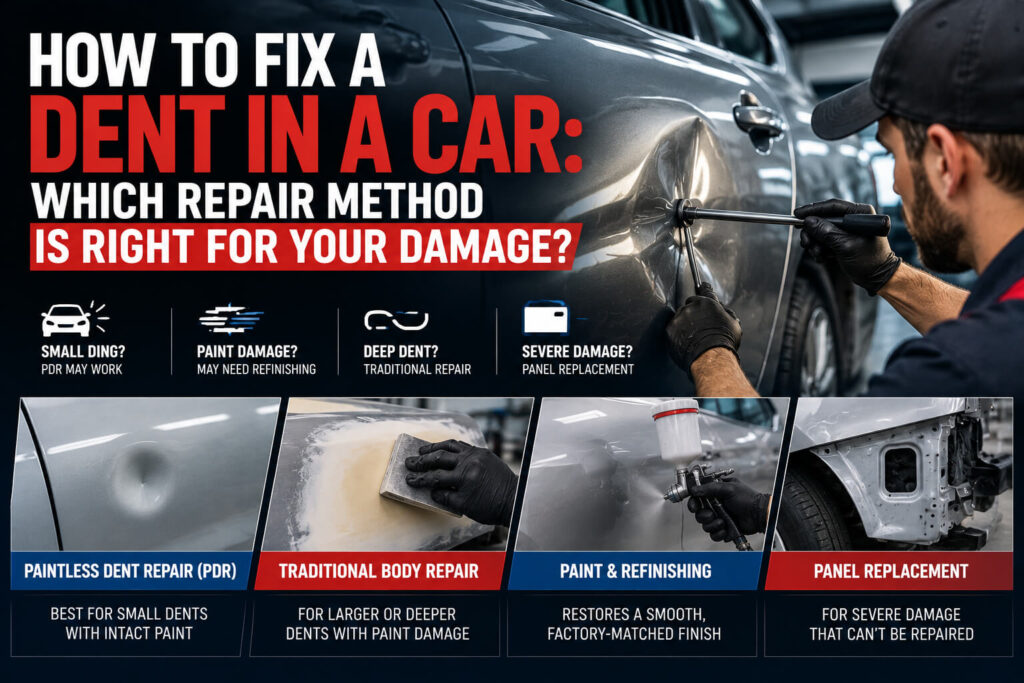
The good news is that not every car dent requires a new panel or a complete repaint. The right repair method depends on the dent’s size, depth, location, metal condition, and whether the paint has been damaged.
For minor dents, paintless dent repair (PDR) may be an option. Larger or deeper dents may require conventional auto body repair, while severely damaged panels may need replacement.
The first step is figuring out what type of damage you have.
For drivers in Cathedral City, professional dent repair services can help determine whether the damage can be repaired or requires more extensive bodywork.
What Is the Best Way to Fix a Dent in a Car?
The best repair method depends on the condition of the dent.
In general:
- Small dents with intact paint may be candidates for paintless dent repair.
- Dents with stretched or sharply creased metal may require traditional body repair.
- Dents with cracked or damaged paint usually need refinishing in addition to body repair.
- Severely damaged panels may be better candidates for replacement.
- Dents near panel edges or structural areas can be more difficult to repair.
There is no single repair method that works for every dent.
A technician needs to inspect the damage before recommending the appropriate approach.
Can a Dent Be Repaired Without Repainting?
Yes, some dents can be repaired without repainting the vehicle.
This is one of the main advantages of paintless dent repair.
PDR uses specialized tools and controlled pressure to reshape the damaged metal from behind the panel. Because the original factory paint remains intact, there may be no need for traditional sanding, filler, primer, and repainting.
However, PDR isn’t suitable for every dent.
The condition of the paint and metal matters just as much as the size of the dent.
If the paint is cracked, peeling, chipped, or heavily damaged, traditional repair and refinishing may be necessary.
CatCity’s dent repair service can help determine which approach makes sense for the condition of your vehicle.
What Is Paintless Dent Repair?
Paintless dent repair is a specialized technique used to remove certain dents while preserving the vehicle’s original paint.
Instead of filling and repainting the damaged area, a technician carefully manipulates the metal back toward its original shape.
PDR is commonly considered for:
- Small door dings
- Parking lot dents
- Minor hail dents
- Shallow body-panel dents
- Small creases
- Minor impact damage
The technique works best when the paint is still intact and the metal has not been excessively stretched.
For a deeper explanation of the process, see CatCity’s complete guide to paintless dent repair in Cathedral City.
When Is Paintless Dent Repair a Good Option?
PDR may be appropriate when several conditions are present.
The Paint Is Still Intact
If the original paint has not cracked or broken, the dent may be a good candidate.
The Dent Is Relatively Shallow
A shallow depression is generally easier to work with than a severe impact that has sharply folded the panel.
The Metal Has Not Been Severely Stretched
A strong impact can stretch sheet metal. Once the metal has changed shape significantly, restoring the original contour can become more difficult.
The Technician Can Access the Back of the Panel
PDR requires access to the damaged area or an appropriate repair path.
Some panels are difficult to access because of reinforcement, internal structures, trim, or other components.
When Does a Dent Need Traditional Body Repair?
Traditional auto body repair may be necessary when PDR isn’t practical.
This can happen when:
- Paint is cracked
- Paint has been removed
- Metal is severely creased
- The panel has been stretched
- The dent is extremely deep
- The damaged area is difficult to access
- The panel has torn
- There is significant collision damage
Traditional repair may involve reshaping the panel, preparing the surface, applying body filler where appropriate, sanding, priming, and refinishing.
The exact process depends on the damage.
The objective is to restore the panel’s shape and finish rather than simply making the dent less noticeable.
What If the Paint Is Cracked?
A cracked paint surface changes the repair decision.
Paint provides more than appearance. It also protects the underlying material from environmental exposure.
If a dent has cracked the paint, simply pushing the metal back into shape may not fully restore the damaged area.
Depending on the severity, the repair may require:
- Reshaping the damaged panel
- Preparing the surface
- Repairing the damaged finish
- Priming where necessary
- Matching the paint
- Refinishing the affected area
CatCity already has a dedicated guide covering whether a dent can be repaired without repainting when the paint is cracked.
Can a Deep Dent Be Repaired?
A deep dent can sometimes be repaired, but the repair method depends on how severely the panel has been damaged.
A deep impact may stretch the metal or create sharp creases.
Technicians may need to determine:
- How far the metal has moved
- Whether the panel has stretched
- Whether the paint is damaged
- Whether the panel can return to its original shape
- Whether access to the back of the panel is possible
- Whether replacement would be more practical
A dent that looks small from the outside can sometimes have more complicated damage underneath.
This is especially true when the dent was caused by a collision rather than a light contact.
Can a Dented Door Be Repaired?
Yes, many dented doors can be repaired.
The appropriate repair depends on the location and severity of the damage.
A shallow door ding may be suitable for PDR.
A deeper impact involving a sharp crease or damaged paint may require conventional body repair.
If the door has significant structural or functional damage, additional inspection may be needed.
Check whether the door:
- Opens and closes normally
- Lines up correctly
- Has consistent gaps
- Locks properly
- Has functioning handles and windows
- Shows signs of damage around the hinges or surrounding panels
A dent isn’t always just a cosmetic issue.
Can a Fender Dent Be Repaired?
Many fender dents can be repaired, but the method depends on the damage.
A small parking lot dent may be repairable without repainting.
A severe collision may create:
- Deep creases
- Torn metal
- Paint damage
- Misalignment
- Damage near mounting points
In those cases, traditional body repair or fender replacement may be more appropriate.
Because the fender connects visually and physically with surrounding body panels, proper alignment is important.
If the vehicle has damage extending beyond the fender, a broader collision inspection may also be necessary.
Can a Bumper Dent Be Repaired?
Bumper damage is different from a metal body-panel dent because many modern bumpers are made from plastic or composite materials.
Depending on the damage, a bumper may be:
- Repaired
- Reshaped
- Refinished
- Replaced
The decision depends on the material, location, severity, mounting points, and condition of the bumper.
If the bumper is cracked, loose, severely deformed, or has damaged mounting points, replacement may be necessary.
CatCity has a dedicated article explaining when a bumper can be repaired, as well as a local bumper repair service in Cathedral City.
How Do You Know If a Dent Needs Panel Replacement?
Panel replacement isn’t automatically necessary just because a dent is large.
However, replacement may make more sense when the panel has extensive damage.
Potential signs include:
- Torn metal
- Severe deformation
- Extensive corrosion
- Multiple deep creases
- Damage that cannot be properly restored
- Structural mounting damage
- Repair costs that make replacement more practical
The technician may compare the time and materials required for repair with the condition and availability of a suitable replacement panel.
The goal should be a safe, properly fitted repair rather than choosing replacement simply because it appears easier.
Does the Location of a Dent Matter?
Yes.
Two dents of the same size can require completely different repair approaches because of where they are located.
For example, a dent in the middle of a relatively accessible door panel may be easier to repair than a similar dent located near:
- A sharp body line
- Panel edges
- Reinforcement
- Structural components
- A door frame
- A wheel arch
The technician also needs to consider how easily the damaged area can be accessed.
What Happens During Professional Dent Repair?
The repair process depends on the method used.
Step 1: Damage Inspection
The technician examines the dent and surrounding area.
They may look at:
- Size
- Depth
- Location
- Paint condition
- Metal condition
- Access to the damaged area
Step 2: Repair Method Selection
The technician determines whether PDR, conventional body repair, or panel replacement is appropriate.
Step 3: Panel Repair
For PDR, specialized tools are used to carefully manipulate the metal.
For traditional repair, the damaged area may be reshaped and prepared for refinishing.
Step 4: Paint and Finish
If the paint was damaged, the affected area may require preparation and refinishing.
Step 5: Final Inspection
The repaired panel is checked for shape, finish, alignment, and overall appearance.
How Much Does Dent Repair Cost?
There is no single price for every dent.
The cost can depend on:
- Dent size
- Dent depth
- Location
- Number of dents
- Paint damage
- Panel material
- Repair method
- Accessibility
- Whether the panel needs replacement
A small dent may require considerably less work than a large collision-related dent involving paint and panel damage.
For a more detailed discussion, see How Much Does Car Dent Repair Cost.
The most accurate way to determine the cost is to have the vehicle inspected.
Is It Cheaper to Repair a Dent or Replace the Panel?
Not always.
Repairing a panel can be less expensive when the damage is relatively limited and the panel can be restored.
Replacement may make more sense when the panel is severely damaged or repairing it would require extensive labor.
However, price shouldn’t be the only consideration.
A properly repaired original panel may be preferable to replacement in some situations, while a severely damaged panel may be better replaced.
The right decision depends on the individual vehicle.
Should You Repair a Dent Before Selling Your Car?
It depends on the condition of the vehicle and the cost of the repair.
A large visible dent can affect how potential buyers perceive the vehicle.
Cosmetic damage can make a car appear poorly maintained even when it runs well.
Before spending money on repairs, consider:
- Vehicle age
- Current market value
- Repair cost
- Size and visibility of the dent
- Other existing damage
- Whether the repair will improve the vehicle’s overall presentation
A professional assessment can help you decide whether repair makes financial sense.
What Happens If a Dent Is From a Collision?
A collision-related dent deserves more attention than an isolated cosmetic ding.
The visible dent may not show everything that happened during the impact.
Depending on the location and severity of the accident, technicians may need to check surrounding:
- Body panels
- Mounting points
- Bumper components
- Suspension
- Lights
- Sensors
- Structural areas
This is why collision-related damage should be inspected rather than judged only by appearance.
If the dent is part of a larger accident, CatCity’s collision repair service can address the broader repair needs.
How to Choose the Right Dent Repair Method?
When deciding how to repair a dent, don’t start with the question:
“Which method is cheapest?”
Start with:
“Which method will properly restore this damage?”
A useful decision process is:
Small dent + intact paint
Ask whether PDR is appropriate.
Deep dent + intact paint
Have the panel inspected to determine whether PDR is still practical.
Dent + cracked paint
Traditional body repair and refinishing may be necessary.
Severe panel deformation
Ask whether conventional repair or replacement is the better option.
Dent caused by a collision
Have the surrounding area inspected for additional damage.
This approach helps avoid choosing a repair method based only on the appearance of the dent.
How to Prevent Small Dents From Becoming Bigger Problems?
Not every dent becomes worse over time, but damaged paint can create additional concerns.
If the impact has chipped or cracked the finish, don’t ignore it indefinitely.
Other useful habits include:
- Park away from high-traffic areas when possible
- Give other vehicles enough space
- Avoid placing heavy objects against body panels
- Address damaged paint promptly
- Inspect dents after storms or parking-lot incidents
Small cosmetic damage is easier to evaluate when it is still clearly visible and hasn’t been combined with additional damage.
Why Professional Dent Repair Is Better Than a DIY Fix?
Online videos may make dent removal look simple.
In reality, pushing or pulling a panel without understanding how the metal is reacting can create additional distortion.
DIY methods can also damage:
- Paint
- Clear coat
- Body lines
- Panel edges
- Interior components
- Mounting points
The risk is greater when the dent is deep, sharply creased, or located near an edge.
Professional technicians can determine whether the panel is actually a good candidate for PDR or needs another repair method.
Final Thoughts Dent Repair in Cathedral City
If your vehicle has a dent, the first step is identifying the type of damage rather than automatically choosing PDR, filler, repainting, or panel replacement.
A small parking-lot ding may be a good candidate for paintless dent repair. A deeper collision dent may require traditional bodywork. Cracked paint may require refinishing, while severely damaged panels may need replacement.
CatCity Auto Body provides dent repair in Cathedral City and also handles related body repair needs.
The right repair method depends on the condition of your specific vehicle.
Frequently Asked Questions
Yes, but cracked paint generally means the repair may require more than simply reshaping the metal. The affected area may need conventional body repair and refinishing.
Yes. A dented door can often be repaired depending on the size, depth, location, and condition of the paint and surrounding components.
Some bumper damage can be repaired, while severely cracked, deformed, or improperly mounted bumpers may need replacement.
The cost depends on the dent’s size, depth, location, paint condition, repair method, and whether panel replacement is necessary.
Not necessarily. A minor parking-lot ding may only require dent repair. However, if the dent resulted from a collision, the surrounding area should be inspected for additional damage.