
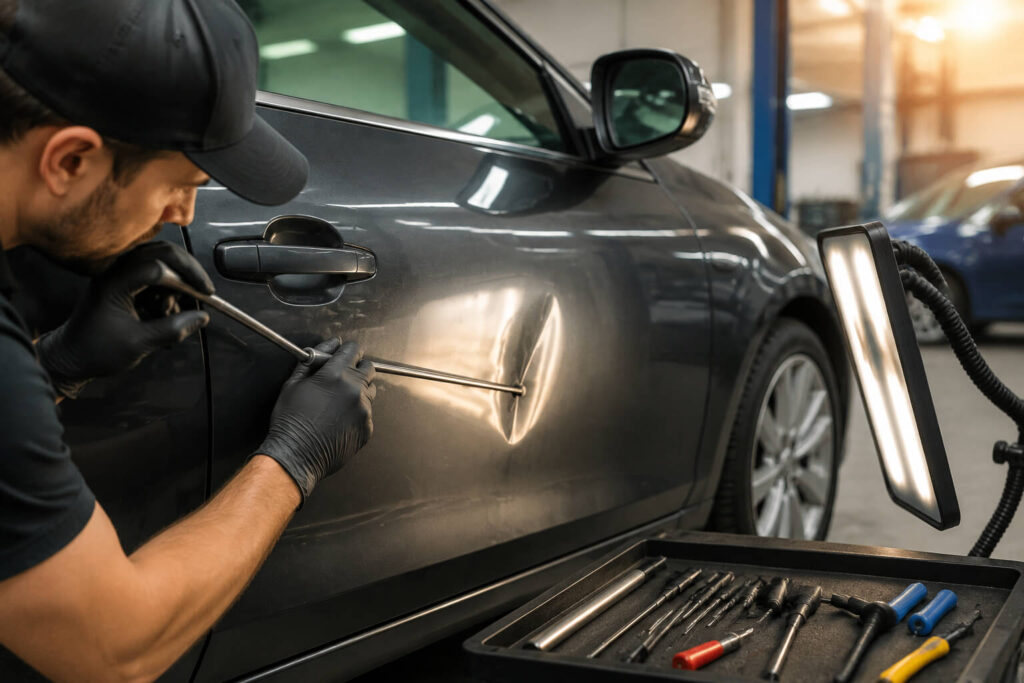
A dent on your vehicle may look like a small cosmetic problem, but the actual repair cost depends on several factors, including the size of the dent, location, paint condition, panel material, and whether the damage can be repaired without repainting.
A small door ding from a parking lot may require a simple paintless dent repair, while a deeper crease with cracked paint may require traditional body repair, refinishing, and color matching.
Many drivers searching for car dent repair near me assume every dent can be fixed the same way. In reality, professional technicians first determine:
- How deep the dent is
- Whether the metal has stretched
- Whether the paint is damaged
- Whether the panel can be accessed from behind
- Whether the vehicle has aluminum or high-strength steel panels
- Whether the repair requires repainting
Understanding the difference between paintless dent repair (PDR) and traditional dent repair can help you choose the right solution and avoid unnecessary repair costs.
For drivers in Cathedral City, CatCity Auto Body provides professional dent repair services for door dings, collision dents, creases, and accident-related body damage.
What Is Car Dent Repair?
Car dent repair is the process of restoring a damaged vehicle panel back to its original shape and appearance.
A dent can happen from many situations, including:
- Parking lot impacts
- Shopping carts
- Car doors hitting another vehicle
- Minor accidents
- Hail storms
- Falling objects
- Road debris
- Fender benders
The repair method depends on the severity of the damage.
Some dents can be repaired without disturbing the original paint. Others require removing damaged paint, reshaping the metal, applying repair materials, and repainting the panel.
The goal of professional dent repair is not only to remove the visible dent but also to restore:
- Panel shape
- Paint protection
- Vehicle appearance
- Factory-like finish
- Long-term durability
How Much Does Car Dent Repair Cost?
The cost of repairing a dent varies depending on the damage.
There is no fixed price because every dent is different.
Common factors that affect dent repair cost include:
- Dent size
- Dent depth
- Dent location
- Paint damage
- Vehicle model
- Panel material
- Repair method
- Labor time
- Need for repainting
- Need for blending surrounding panels
A small shallow dent may be repaired quickly using paintless dent repair, while a large dent with cracked paint may require several repair stages.
A professional estimate should determine whether the vehicle needs:
- Paintless dent repair
- Conventional body repair
- Panel replacement
- Paint refinishing
What Factors Affect Car Dent Repair Cost?
1. Size of the Dent
The size of the dent is one of the biggest pricing factors.
A small dent requires less labor compared with a large damaged area.
Examples:
Small dents:
- Door dings
- Small parking impacts
- Minor hail dents
These may qualify for paintless dent repair if the paint is still intact.
Larger dents:
- Deep door damage
- Large body-panel dents
- Accident-related impacts
These often require more extensive repair.
A technician also considers whether the dent has created tension in the metal. A large shallow dent may sometimes be easier to repair than a smaller sharp crease.
2. Dent Depth and Severity
Two dents of the same size can require different repair methods.
A shallow dent may only affect the surface.
A deeper dent may involve:
- Stretched metal
- Sharp edges
- Broken paint
- Internal panel damage
- Reduced panel strength
Deep dents usually require additional labor because the technician must carefully reshape the metal rather than simply push it back into position.
3. Location of the Dent
The location of the dent can significantly affect repair difficulty.
Some areas are easier to repair, while others require more work.
Common dent locations include:
Door dents
Door dings are among the most common repairs.
A technician may access the back of the panel by removing:
- Door trim
- Interior panels
- Handles
- Speakers
- Protective covers
Fender dents
Fenders can often be repaired, but access may be limited by:
- Wheel liners
- Headlights
- Brackets
- Structural supports
Quarter-panel dents
Quarter panels are more complicated because they are usually attached as part of the vehicle structure.
Repair may require:
- Advanced metal shaping
- More refinishing
- Additional blending
Body-line dents
Dents crossing factory body lines are more challenging because the technician must restore the original contour.
What Is Paintless Dent Repair (PDR)?
Paintless dent repair, commonly known as PDR, is a repair technique that removes dents without sanding, filling, or repainting the damaged area.
Instead of covering the damage with body filler and new paint, technicians carefully massage the metal back into its original position.
PDR is designed to preserve the vehicle’s original factory finish.
A technician may use:
- Specialized metal rods
- Dent-pulling tools
- Glue tabs
- Precision lighting
- Controlled pressure techniques
The process requires skill because excessive pressure can create additional damage.
When Does Paintless Dent Repair Work?
PDR is usually effective when:
- The paint is not cracked
- The dent is shallow
- The metal has not stretched significantly
- The damage is away from complicated edges
- The panel can be accessed properly
Common PDR repairs include:
- Door dings
- Small parking dents
- Minor hail damage
- Shallow body-panel dents
The biggest advantage of PDR is that it preserves the original paint.
Benefits include:
- Lower repair cost
- Faster turnaround
- No repainting
- Original factory finish remains
- Better resale protection
When Does PDR Not Work?
Paintless dent repair is not suitable for every dent.
Traditional repair may be required when:
- Paint is cracked
- Paint is missing
- Metal is stretched
- The dent has sharp creases
- The panel edge is damaged
- The impact caused structural damage
- Previous repairs exist
If the paint is damaged, the repair must restore both:
- The shape of the panel
- The protective paint system
In these situations, repainting is usually necessary.
CatCity’s auto painting service helps restore damaged vehicle finishes after dent and collision repairs.
PDR vs Traditional Dent Repair: What Is the Difference?
Understanding the difference between these two methods helps drivers make better repair decisions.
Paintless Dent Repair
PDR focuses on reshaping the existing metal while keeping the original paint.
Advantages:
- No repainting
- Faster repair time
- Lower material costs
- Preserves factory paint
- Good for minor dents
Limitations:
- Not suitable for cracked paint
- Not suitable for severe structural damage
- Requires access and proper dent conditions
Traditional Dent Repair
Traditional dent repair involves repairing both the panel and the paint finish.
The process may include:
- Removing damaged paint
- Straightening metal
- Applying body filler if needed
- Sanding the repair area
- Applying primer
- Matching vehicle color
- Applying base coat
- Applying clear coat
- Final polishing
Advantages:
- Works for larger damage
- Repairs cracked paint
- Handles deeper dents
- Restores damaged panels
Limitations:
- Takes longer
- Requires refinishing
- Higher cost
How Does a Body Shop Repair a Dent?
A professional dent repair process usually follows several steps.
Step 1: Damage Inspection
The technician examines:
- Dent size
- Metal condition
- Paint damage
- Panel accessibility
- Previous repairs
The goal is to determine the correct repair method.
Step 2: Determine Repair Method
The technician decides whether the dent needs:
- Paintless dent repair
- Traditional repair
- Panel replacement
This decision depends on safety, appearance, and long-term durability.
Step 3: Metal Repair
For traditional repairs, the technician reshapes the damaged metal.
Tools may include:
- Dent pullers
- Body hammers
- Dollies
- Welding equipment
- Specialized repair tools
The goal is to restore the panel contour before refinishing.
Step 4: Surface Preparation
If repainting is needed, the damaged area is prepared.
This may involve:
- Sanding
- Removing damaged paint
- Applying primer
- Smoothing imperfections
Step 5: Paint Matching
Matching automotive paint is more complex than simply using a factory paint code.
Technicians consider:
- Vehicle age
- Sun exposure
- Existing paint condition
- Metallic particles
- Pearl effects
Modern paint matching may use computerized systems to create a closer match.
Step 6: Refinishing and Quality Inspection
The repaired panel receives:
- Base coat
- Clear coat
- Polishing
- Final inspection
The technician checks:
- Color match
- Panel shape
- Paint texture
- Gloss
- Repair visibility
Does a Dent Always Need Repainting?
No. A dent only needs repainting when the paint system is damaged or the repair process requires refinishing.
A dent may not require painting when:
- The paint is intact
- The metal can be reshaped
- There are no cracks
- The repair qualifies for PDR
Painting may be required when:
- Paint is chipped
- Clear coat is broken
- Bare metal is exposed
- The panel requires filler
- The dent is severe
Can a Dent With Cracked Paint Be Repaired?
Yes, but it usually cannot be repaired through PDR alone.
When paint cracks, the technician must restore the damaged coating system.
The repair may include:
- Dent removal
- Surface preparation
- Primer
- Color matching
- Clear coat
Leaving cracked paint unrepaired may allow:
- Moisture intrusion
- Corrosion
- Additional paint peeling
- Larger repair costs later
How Long Does Car Dent Repair Take?
Repair time depends on the repair method.
Paintless Dent Repair
Small PDR repairs may sometimes be completed within the same day.
Factors affecting time include:
- Dent size
- Number of dents
- Accessibility
- Technician availability
Traditional Dent Repair
Traditional repairs usually take longer because they involve:
- Metal repair
- Surface preparation
- Painting
- Drying time
- Quality inspection
A larger dent requiring repainting may take several days.
Can Insurance Cover Dent Repair?
Insurance coverage depends on how the damage happened.
Possible situations include:
Collision Coverage
May apply when the dent resulted from:
- Vehicle accidents
- Parking collisions
- Impact with another object
Comprehensive Coverage
May apply for:
- Hail damage
- Falling objects
- Certain environmental damage
Coverage depends on:
- Policy terms
- Deductible
- Claim approval
The repair shop can help document the damage and communicate repair information.
Should You Repair a Small Dent?
Many drivers delay small dents because they seem cosmetic.
However, repairing dents early can help prevent:
- Paint cracking
- Rust development
- Reduced resale value
- Larger future repairs
A small dent is usually easier and less expensive to repair before:
- Paint begins failing
- Metal corrosion develops
- Additional damage occurs
Can a Body Shop Repair Multiple Dents at Once?
Yes.
Many customers combine repairs to reduce inconvenience.
A shop may repair:
- Multiple door dings
- Hail damage
- Several parking dents
- Collision-related dents
Combining repairs can sometimes make the process more efficient because preparation and paint work may overlap.
How to Choose a Dent Repair Shop Near You
When searching for car dent repair near me, look for a shop that provides:
- Detailed inspections
- Experience with different dent types
- Paintless dent repair knowledge
- Professional refinishing
- Clear estimates
- Quality reviews
- Warranty information
Ask:
- Is my dent suitable for PDR?
- Will repainting be required?
- Will the repair affect the factory finish?
- Are hidden damages possible?
- What repair method do you recommend and why?
A professional explanation is often a good sign that the shop is focused on proper repair rather than selling unnecessary work.
Dent Repair in Cathedral City, CA
A dent does not always require expensive repainting or panel replacement.
The correct solution depends on the actual condition of the vehicle.
CatCity Auto Body provides dent repair solutions for:
- Door dings
- Parking dents
- Accident-related dents
- Damaged body panels
- Paint-damaged dents
Related services include:
Whether your vehicle has a small parking-lot dent or accident-related body damage, a professional inspection can determine the most effective repair method.
For a dent repair estimate in Cathedral City, contact CatCity Auto Body at 760-324-7117.
Frequently Asked Questions
Dent repair cost depends on dent size, location, depth, paint condition, and repair method. Small dents may qualify for paintless dent repair, while larger dents with paint damage require traditional repair.
Yes. If the paint is intact and the dent is suitable for PDR, the vehicle can often be repaired without repainting.
A technician evaluates whether the paint is intact, the metal is not severely stretched, and the dent location allows proper access.
Insurance may cover dent repair depending on whether the damage came from a covered accident, hail event, or another insured situation.
Sometimes. Minor bumper dents may be repairable, while cracked bumpers or damaged mounting areas may require replacement.
Professional dent repair usually helps maintain vehicle appearance and value, especially when the repair preserves the original finish.
Many deep dents can be repaired, but they may require traditional bodywork instead of paintless dent repair.