
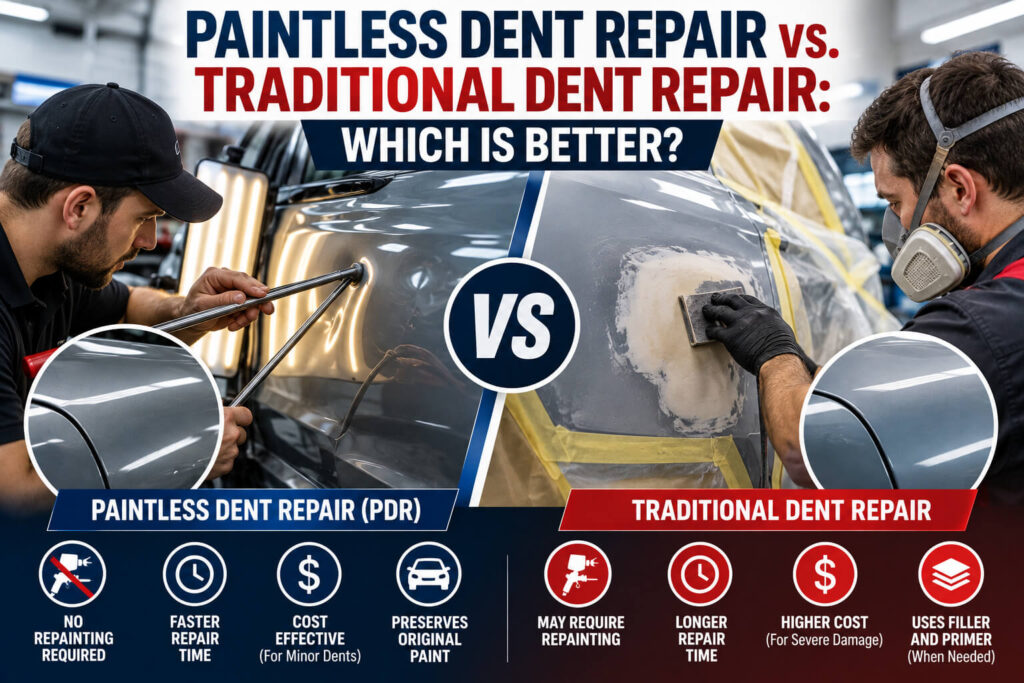
When your car has a dent, the first question is usually simple: How can I get it fixed without making the damage worse?
The answer depends on the type of dent.
Some dents can be restored with paintless dent repair (PDR), while others need traditional auto body repair involving sanding, filler, primer, and paint. Neither method is automatically better for every vehicle.
Paintless dent repair is generally best for suitable dents where the original paint is intact and the metal has not been severely stretched. Traditional dent repair is more appropriate when the paint is damaged, the metal is badly deformed, or the panel cannot be properly restored with PDR.
For drivers in Cathedral City, choosing between the two starts with understanding what happened to the panel.
PDR vs. Traditional Dent Repair at a Glance
| Feature | Paintless Dent Repair | Traditional Dent Repair |
| Original paint | Usually preserved | May require refinishing |
| Body filler | Generally not used | May be used when appropriate |
| Repainting | Usually not required | Often required when paint is damaged |
| Best for | Small to moderate suitable dents | Larger or more severe damage |
| Cracked paint | Usually not suitable | More appropriate |
| Severely stretched metal | Often not suitable | May be repairable |
| Panel replacement | Usually unnecessary | Sometimes necessary |
| Repair approach | Reshapes existing metal | Repairs and refinishes damaged area |
The table gives you the quick comparison, but the condition of the dent is what really determines the best option.
What Is Paintless Dent Repair?
Paintless dent repair is a specialized method for restoring certain dents without disturbing the vehicle’s original paint.
Instead of filling the damaged area and repainting it, a technician carefully manipulates the metal back toward its original shape.
The technician may use specialized rods, picks, lighting, and other tools to identify the lowest points of the dent and gradually restore the panel.
PDR is commonly considered for:
- Parking lot dents
- Door dings
- Small hail dents
- Shallow body-panel dents
- Minor impact dents
- Dents with intact factory paint
The biggest advantage is that the original finish can often remain in place.
For more information about the technique, see CatCity’s complete guide to paintless dent repair.
What Is Traditional Dent Repair?
Traditional dent repair uses a different approach.
Instead of manipulating the metal entirely from behind the panel, the damaged area may be reshaped and prepared for refinishing.
Depending on the damage, the process can involve:
- Removing damaged components
- Straightening the metal
- Repairing the panel
- Applying body filler when appropriate
- Sanding
- Priming
- Matching the paint
- Applying base coat
- Applying clear coat
- Refinishing and polishing
Traditional repair is often necessary when the damage has affected the paint or significantly changed the shape of the panel.
It can also be appropriate when PDR cannot provide the required result.
Which Is Better: PDR or Traditional Dent Repair?
There isn’t one universal winner.
PDR is generally the better choice when the dent is suitable for the technique and the factory paint is still intact.
Traditional repair is generally better when the paint is damaged or the panel has severe deformation that cannot be properly restored through PDR.
Think of it this way:
If the panel can be restored while preserving its existing finish, PDR may make sense. If the panel and finish both need to be rebuilt, traditional body repair may be necessary.
The repair method should follow the damage rather than the other way around.
When PDR Is Usually the Better Option
PDR has several advantages when the damage is suitable.
The Paint Is Intact
This is one of the most important factors.
If the dent has not cracked, chipped, or peeled the paint, a technician may be able to reshape the panel without refinishing it.
The Dent Is Relatively Shallow
Shallow dents can sometimes be restored more easily than severe creases or deep impacts.
The Metal Is Not Severely Stretched
A panel that has been heavily stretched may not return to its original shape cleanly with PDR.
The Technician Can Access the Damaged Area
PDR requires an appropriate way to reach the back of the panel.
Internal reinforcements, insulation, trim, braces, and other components can make access difficult.
When Traditional Dent Repair Makes More Sense
Traditional body repair may be the better choice when the damage goes beyond a simple dent.
Common situations include:
Cracked or Chipped Paint
If the paint has been broken by the impact, the repair may require refinishing.
Deep Creases
A sharp crease can significantly alter the shape of the metal.
Stretched Metal
A strong impact can stretch the panel, making a clean PDR repair difficult or impractical.
Torn Metal
A torn panel cannot simply be pushed back into shape.
Difficult Panel Access
If the back of the damaged area cannot be accessed appropriately, traditional repair may be necessary.
Extensive Collision Damage
A dent that resulted from a larger accident may be connected to other body or structural damage.
In those situations, a broader collision repair service may be more appropriate than treating the dent as an isolated cosmetic issue.
Does PDR Require Repainting?
Usually, no.
The purpose of PDR is to restore the panel while preserving the existing paint.
That’s why it can be particularly useful for dents where the paint is still in good condition.
For example, imagine someone opens a car door into your vehicle in a parking lot.
You have a shallow circular dent in the door, but there is no scratch or paint damage.
If the panel and paint are suitable, PDR may allow the technician to remove the dent without repainting the door.
That can preserve the original factory finish.
Does Traditional Dent Repair Require Repainting?
It depends on the damage.
Traditional body repair does not necessarily mean the entire vehicle needs to be repainted.
The affected panel may be repaired and refinished.
Paint blending may also be used when necessary to create a smoother transition between the repaired area and surrounding paint.
The amount of refinishing depends on:
- Size of the damaged area
- Paint condition
- Vehicle color
- Location of the damage
- Repair method
- Existing finish
If the dent has cracked or removed the paint, auto painting services may become part of the repair.
What If the Dent Has Cracked Paint?
This is where the difference between PDR and traditional repair becomes particularly important.
A dent with cracked paint has two problems:
- The metal has been damaged.
- The finish has also been damaged.
Even if the metal can be pushed back into shape, the cracked paint still needs attention.
Depending on the condition, the repair may involve:
- Metal repair
- Surface preparation
- Sanding
- Primer
- Color matching
- Refinishing
- Clear coat
If you’re dealing with this type of damage, CatCity also has information on whether a dent can be repaired without repainting when the paint is cracked.
Which Method Preserves Factory Paint?
PDR is specifically designed to preserve the original paint when the dent is a suitable candidate.
This can be valuable because factory paint is already matched to the vehicle and has aged with the rest of the finish.
Traditional repair may require refinishing the affected area.
A quality paint repair can produce an excellent result, but it is still a different process from preserving the original finish.
For some vehicle owners, keeping the original paint is an important consideration.
Is PDR Cheaper Than Traditional Dent Repair?
It can be, but not always.
PDR often involves less material and fewer refinishing steps.
Traditional body repair can involve:
- Bodywork
- Filler
- Sanding
- Primer
- Paint
- Clear coat
- Blending
- Additional labor
However, the final cost depends on the actual damage.
A difficult PDR job involving many dents may require substantial technician time.
Likewise, a relatively straightforward traditional repair may not be as expensive as a large or complex PDR job.
For a better understanding of pricing factors, see CatCity’s guide to car dent repair costs.
Is PDR Faster Than Traditional Dent Repair?
PDR can often require fewer repair stages because there may be no need for traditional body filler, primer, paint, and curing processes.
However, speed should not be the deciding factor.
A technician may spend considerable time carefully working a panel with multiple dents.
Traditional repair can also vary widely depending on:
- Parts availability
- Damage severity
- Paint preparation
- Number of panels
- Paint curing
- Additional repairs
The correct repair is more important than simply choosing the method that appears faster.
Does PDR Work on All Types of Metal?
No.
Vehicle manufacturers use different materials for body panels, including steel and aluminum.
Different materials respond differently to dent repair.
Aluminum, for example, can behave differently from steel when it is deformed.
The technician needs to consider:
- Panel material
- Metal thickness
- Location
- Severity
- Stretching
- Paint condition
Don’t assume that a dent is a PDR candidate simply because it looks small.
Can PDR Fix a Large Dent?
Sometimes.
Size alone does not determine whether PDR is possible.
A relatively large dent with smooth edges and intact paint may sometimes be repairable.
A much smaller dent with a sharp crease, stretched metal, or damaged paint may be more difficult.
Other factors include:
- Depth
- Location
- Metal condition
- Access
- Body lines
- Paint condition
This is why professional inspection matters.
Can Traditional Dent Repair Fix a Deep Dent?
Traditional repair can handle many types of deeper body damage.
The technician may reshape the panel and restore the surface before refinishing it.
However, extremely severe damage may make panel replacement more practical.
The decision can depend on:
- Extent of deformation
- Condition of the metal
- Repair time
- Panel availability
- Overall repair cost
- Quality of the expected result
The objective should always be a proper restoration rather than simply hiding the dent.
What About Dents Near Body Lines?
Body lines can make dent repair more challenging.
A dent crossing a sharp character line may require greater precision because the technician needs to restore both the dent and the original contour of the panel.
This applies to both PDR and conventional repair.
A repair that removes the visible depression but leaves the body line distorted may still be noticeable.
What About Dents Near the Edge of a Panel?
Dents near panel edges can also be more difficult.
The metal may have less flexibility in these areas, and access to the back of the panel can be limited.
For that reason, two dents that look identical in size may require completely different repair approaches depending on where they are located.
What Happens During a PDR Inspection?
A technician generally begins by looking at the dent from different angles and under appropriate lighting.
They may evaluate:
- Dent size
- Dent depth
- Location
- Paint condition
- Metal condition
- Access
- Body lines
- Panel construction
If the dent appears suitable, the technician can determine how to access the damaged area and plan the repair.
The vehicle does not need to be disassembled extensively for every PDR job, although certain components may need to be removed to gain access.
What Happens During Traditional Dent Repair?
Traditional repair usually involves more stages.
The process can include:
Inspection → disassembly → metal repair → surface preparation → primer → paint matching → refinishing → final inspection
The exact process depends on the damage.
For example, a small dent with minor paint damage may require much less work than a collision that has severely deformed an entire panel.
Which Repair Looks More Original?
When a suitable dent is successfully repaired through PDR, the vehicle can retain its original factory paint and panel.
That can be a significant advantage.
Traditional repair can also produce a high-quality result, especially when the bodywork and refinishing are performed properly.
However, the repaired area may involve refinished paint rather than the original finish.
The quality of the technician’s work is important with either method.
Can PDR Be Used After a Minor Collision?
Yes, in some situations.
A minor collision may leave a dent with intact paint and no significant underlying damage.
If the dent meets the requirements for PDR, it may be possible to restore the panel without conventional refinishing.
However, collision damage should not automatically be treated as a simple dent.
If the impact involved a bumper, wheel, suspension, sensor, or structural area, the vehicle should be inspected for additional damage.
When Should You Choose Traditional Body Repair?
Traditional repair is generally worth considering when:
- Paint is cracked or missing
- The metal is badly stretched
- The panel has a severe crease
- The metal is torn
- PDR access is not possible
- The panel has extensive collision damage
- The surrounding area also needs repair
In some cases, a damaged panel may be repaired traditionally.
In others, replacement may be the more appropriate solution.
A Simple Way to Decide Between PDR and Traditional Repair
If you’re standing beside your car wondering which method you need, start with these questions.
Is the paint intact?
Yes: PDR may be possible.
No: Traditional repair and refinishing may be necessary.
Is the dent shallow?
Yes: PDR may be worth considering.
No: Have the damage professionally evaluated.
Is the metal severely stretched or torn?
Yes: Traditional repair or panel replacement may be necessary.
Can the technician access the back of the panel?
Yes: PDR may be possible.
No: Another repair method may be required.
Was the dent caused by a collision?
Yes: Have the surrounding area checked for additional damage.
This isn’t a substitute for an inspection, but it gives you a useful starting point.
PDR vs. Traditional Repair: Which One Is Right for Your Car?
There is no universal answer.
Choose PDR when the dent is suitable, the paint remains intact, and the panel can be restored without conventional refinishing.
Choose traditional dent repair when the paint is damaged, the metal is severely deformed, or the panel requires more extensive bodywork.
The goal is not to choose the most popular method.
The goal is to choose the repair method that can properly restore your vehicle.
Dent Repair in Cathedral City
If you have a dent in your vehicle, don’t assume that you automatically need body filler, repainting, or a replacement panel.
A professional inspection can determine whether the damage is suitable for paintless dent repair or requires conventional auto body work.
CatCity Auto Body provides dent repair in Cathedral City for parking-lot dents, door dings, hail damage, collision-related dents, and other body-panel damage.
Frequently Asked Questions
PDR can be better for suitable dents because it can preserve the original paint and avoid traditional refinishing. Traditional repair is better suited to damage involving cracked paint, severe deformation, stretched metal, or other conditions that make PDR unsuitable.
For a suitable dent, PDR can be a worthwhile option because it may preserve the factory finish and avoid more extensive body and paint work.
When performed correctly on a suitable panel, PDR is designed to preserve the existing paint rather than remove or repaint it.
Usually, cracked paint means the vehicle may need more than PDR. Traditional body repair and refinishing may be required to restore both the panel and the damaged finish.
Not always. The cost depends on the size, location, severity, paint condition, number of panels, labor, and repair method. A complex PDR repair can also require significant labor.
PDR can involve fewer repair stages because traditional sanding, priming, painting, and refinishing may not be necessary. However, the actual repair time depends on the number and complexity of dents.
Sometimes. Dent size alone does not determine whether PDR is possible. Paint condition, metal stretching, location, depth, access, and body lines also matter.