
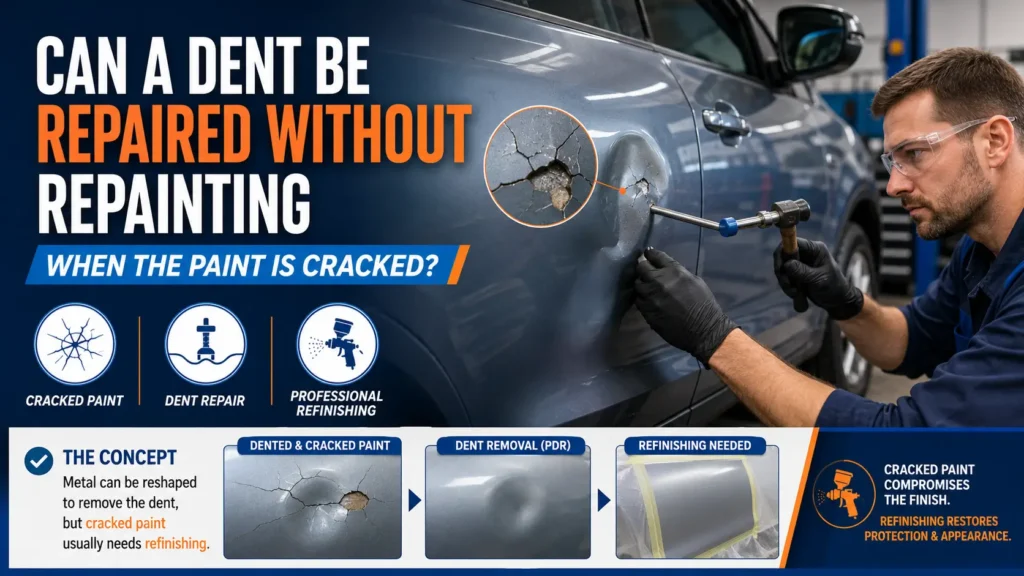
A dent can often be reshaped when the paint is cracked, but the repair usually cannot be completed without repainting the damaged area.
Paintless dent repair, commonly called PDR, is most effective when the factory paint remains flexible, firmly attached and free from cracks. When an impact breaks the clear coat or color layer, reshaping the metal alone will not restore the protective paint finish.
A technician may still use paintless dent-removal tools or glue-pulling techniques to reduce the dent before refinishing. However, the cracked paint must normally be sanded back to a stable edge, and the affected area may require primer, base color and clear coat.
The correct repair depends on:
- The depth and shape of the dent
- Whether the metal has stretched
- The location of the damage
- The number and depth of paint cracks
- The panel material
- Whether bare metal is exposed
- Previous repairs on the panel
- Vehicle-manufacturer repair restrictions
CatCity Auto Body offers both professional dent repair in Cathedral City and automotive painting and refinishing, allowing technicians to choose between paintless repair and conventional bodywork after inspecting the damage.
What Drivers Need to Know About Dents With Cracked Paint
A dent with intact paint may qualify for paintless dent repair. A dent with cracked, chipped or peeling paint generally needs refinishing after the panel has been reshaped.
The typical repair process is:
- Inspect the dent and surrounding paint.
- Determine whether the panel can be repaired.
- Reshape or straighten the damaged metal.
- Remove loose and cracked paint.
- Treat exposed metal where necessary.
- Apply filler or glazing material if needed.
- Prime and sand the repaired area.
- Match and apply the vehicle’s color.
- Apply protective clear coat.
- Inspect and polish the finished panel.
PDR may still be used as one stage of the metal-correction process, but it is no longer a complete “paintless” repair when the coating must be restored.
Why Intact Paint Matters for Paintless Dent Repair
Paintless dent repair is designed to reshape a damaged panel while preserving the existing finish.
Technicians use specialized rods, hand tools, tabs and controlled pressure to gradually move the metal toward its original shape. Because traditional sanding, filler and painting may not be required, PDR can preserve more of the original factory finish.
CatCity describes PDR as a method used for certain dents when the paint remains intact and the damage is suitable for reshaping without conventional refinishing.
Once the paint cracks, several problems arise:
- The original finish is no longer continuous.
- Moisture may reach the primer or metal underneath.
- The crack may spread as the panel is moved.
- Polishing cannot replace missing paint.
- The exposed area may begin to corrode.
- The completed dent repair would remain visibly damaged.
A technician therefore evaluates the paint condition before recommending PDR as the finished repair method.
Can PDR Still Be Used When the Paint Is Cracked?
Sometimes, but not as the only repair procedure.
A technician may use PDR-style tools to improve the panel’s shape before conventional refinishing. This approach can reduce the amount of filler needed and preserve more of the original panel.
For example, the technician may:
- Push a shallow dent outward from behind the panel
- Use glue tabs when rear access is limited
- Reduce a crease before sanding
- Restore the general panel contour
- Finish small low areas through conventional bodywork
Whether this combined method is appropriate depends on the vehicle, panel material and manufacturer requirements. Rivian’s published repair guidance, for example, recognizes PDR and glue-pulling as preferred methods in appropriate situations while placing limits on repairs where the underlying metal is stretched, thinned or cracked. The guidance illustrates why the condition of the metal—not only the paint—must be considered.
This does not mean the same procedure applies to every vehicle. The shop should review vehicle-specific repair information before choosing tools or repair methods.
How Can You Tell Whether the Paint Is Actually Cracked?
Paint damage can be difficult to evaluate in photographs, especially on metallic, pearl or dark-colored finishes.
Signs of cracked automotive paint include:
- A visible line through the clear coat and color
- White or light-colored edges around the crack
- Small chips missing from the impact point
- Paint lifting when the panel is touched
- Fine branching lines around the dent
- Exposed gray primer
- Visible bare metal
- Rust-colored staining
- A rough edge that catches a fingernail
Some apparent cracks may only be paint transfer from another vehicle or object. Paint transfer can sometimes be removed without refinishing when the vehicle’s own finish remains undamaged.
A professional inspection should distinguish among:
- Surface contamination
- Clear-coat scratches
- Deep scratches
- Chipped paint
- Cracked paint
- Broken or stretched metal
What Causes Paint to Crack Around a Dent?
Automotive paint can flex to a limited degree, but a strong or sharply concentrated impact may exceed that flexibility.
Paint is more likely to crack when:
- The dent has a sharp center
- The damage follows a body line
- The metal is deeply creased
- The impact stretches the panel
- The paint is old or brittle
- The panel has been repainted previously
- The vehicle has existing oxidation
- The impact occurs near a panel edge
- Cold conditions reduce coating flexibility
- The object cuts or scrapes the surface
A rounded, shallow door ding may leave the coating intact. A narrow crease from a shopping cart, post or vehicle door is more likely to break the finish.
The appearance of the dent does not always reveal the condition of the metal. A technician must check whether the panel has developed oil-canning, excessive stretching, tears or damage near reinforced areas.
What Happens If Bare Metal Is Exposed?
Exposed steel can begin reacting with oxygen and moisture, which may lead to corrosion.
The risk increases when the vehicle is exposed to:
- Rain or washing water
- Condensation
- Road contamination
- Salts and chemicals
- Dust trapped in the crack
- Prolonged outdoor storage
Even in Cathedral City’s dry climate, damaged paint should not be ignored. Washing, occasional rain, moisture and environmental contamination can still reach the unprotected surface.
Modern vehicle manufacturers apply several protective coatings during production. Collision repair can disturb these layers, so appropriate primers, paint systems and internal corrosion materials may need to be restored. 3M identifies paint systems, protective coatings, seam sealers and cavity wax as important parts of corrosion protection after body repairs.
A small paint chip does not mean the panel will immediately rust through, but delaying repair can allow a limited cosmetic problem to become a larger refinishing issue.
When Is Conventional Dent Repair Needed?
Traditional dent repair is usually more appropriate when the paint is cracked or the panel cannot be fully restored through PDR.
Conventional repair may be recommended when:
- The dent is deep
- The metal is stretched
- The damage has a sharp crease
- Paint is cracked or missing
- Bare metal is visible
- The panel has previous filler
- Access behind the dent is limited
- The edge or flange is damaged
- The panel material has repair restrictions
- The dent is part of larger collision damage
The process does not always involve applying a thick layer of filler. A skilled technician first restores as much of the panel shape as practical through metalworking. Filler or finishing glaze may then be used to correct small remaining low areas and surface irregularities.
3M’s collision-repair procedures describe preparing the damaged area, applying filler within the repair zone, block-sanding the material, feathering the surrounding finish and inspecting the surface before primer and paint.
How a Dent With Cracked Paint Is Professionally Repaired
Damage inspection
The technician inspects the dent under controlled lighting and checks the paint around the impact.
The assessment may include:
- Dent depth
- Metal stretch
- Panel access
- Paint thickness
- Previous repairs
- Corrosion
- Panel material
- Adjacent damage
When the dent resulted from a larger accident, the shop may also inspect nearby panels, mounting areas and vehicle structure.
Removing trim or gaining access
Door trim, lamps, liners or other components may need to be removed so the technician can reach the back of the damaged panel.
Removal decisions must account for:
- Wiring
- Airbags
- intrusion beams
- Sound-deadening materials
- Corrosion protection
- Electronic modules
Technicians should avoid drilling access holes unless the method is permitted and appropriate for the vehicle.
Reshaping the metal
The dent is pushed, pulled or straightened toward its original contour.
The technician may use:
- PDR rods
- Glue-pulling tabs
- Stud-pulling equipment where permitted
- Dollies and body hammers
- Panel-straightening tools
- Controlled cold-straightening methods
OEM repair information must guide the use of heat, welding, pulling equipment and panel-repair methods. I-CAR consistently advises repairers to follow manufacturer-specific requirements when straightening modern steel or aluminum panels.
Removing failed paint
Cracked, loose and unstable coatings are removed until the technician reaches a firmly attached finish.
The repair area is feather-edged so there is not a sharp step between exposed material and the surrounding paint.
Applying filler or finishing glaze
When small low spots remain, an automotive body filler or finishing glaze may be applied to a properly prepared surface.
Body filler is intended to correct dents, low areas and surface imperfections before primer and painting. It should not be used as a substitute for proper metal straightening or to conceal excessive unrepaired damage.
Priming the repaired area
Primer helps:
- Protect the prepared substrate
- Fill sanding marks
- Improve coating adhesion
- Create a uniform surface
- Support corrosion protection
The primer is cured, block-sanded and inspected before color is applied.
Matching and applying the paint
The shop identifies the factory paint code and compares the formula with the vehicle’s current finish.
The painter may use computerized color tools, spray-out cards and tinting to compensate for fading and factory color variants. CatCity’s auto-painting service describes computerized paint matching, individual-panel refinishing and blending into surrounding areas when necessary.
Applying clear coat
The clear coat adds gloss and helps protect the repaired color layer.
Depending on the repair location, clear coat may be applied across the full panel rather than stopped in the middle of a large visible surface.
Reassembly and inspection
The technician reinstalls removed trim and checks:
- Panel shape
- Color match
- Paint texture
- Gloss
- Trim fit
- Warning lights
- Cleanliness
- Visible repair edges
Does the Entire Panel Need to Be Repainted?
Often, yes—but not always.
A small damaged area may be repaired with localized color application. However, the complete panel may need clear coat to produce a durable and visually consistent finish.
Full-panel refinishing is more likely when:
- Cracks extend across a broad area
- The dent is near the center of the panel
- The existing finish is faded
- Clear-coat failure is present
- The repair area is large
- The color is metallic or pearl
- A clear-coat edge would remain visible
- Several chips surround the dent
A shop may also blend base color into an adjacent panel when a direct color difference would otherwise be noticeable.
CatCity’s single-panel auto-painting service is relevant when the dent repair needs professional color matching and refinishing without repainting the entire vehicle.
Can a Door Dent With Cracked Paint Be Repaired?
Yes, in many cases.
A door dent can often be straightened and refinished when:
- The intrusion beam is not damaged
- The door shell is repairable
- The edge or hem flange is intact
- The metal is not excessively stretched
- Hinges and latches remain aligned
The shop may need to remove the interior door trim to inspect the back of the panel and access the dent.
When the damage is close to the front or rear door edge, the painter may recommend blending color into the adjacent fender, door or quarter panel.
Can a Fender Dent With Cracked Paint Be Repaired?
Yes. Bolt-on front fenders are commonly repaired when the damage is moderate and the panel remains structurally usable.
Replacement may be more practical when:
- The fender is severely folded
- The mounting flange is damaged
- Metal is torn
- The wheel opening is distorted
- Previous repair material is extensive
- Repair labor exceeds replacement practicality
Damage near the bumper, headlight or wheel may involve more than the fender. CatCity’s bumper and fender repair service is the appropriate related page when several front-end components are affected.
Can a Dent on an Aluminum Panel Be Repaired?
Sometimes.
Aluminum panels require dedicated tools, controlled repair methods and careful contamination prevention. Repairability depends on the alloy, damage severity and manufacturer guidelines.
Aluminum may be more difficult to reshape after stretching, and certain flanges or heavily damaged areas may require replacement. I-CAR advises technicians to follow OEM procedures and repairability restrictions for aluminum panels.
The shop should confirm whether the damaged hood, door, fender or quarter panel is steel, aluminum or another material before creating the repair plan.
Can Touch-Up Paint Fix a Cracked Dent?
Touch-up paint may cover a very small chip temporarily, but it does not repair the dent or restore a cracked coating system.
Applying touch-up paint over a dent can leave:
- Uneven texture
- Visible crack lines
- Trapped corrosion
- Poor adhesion
- A mismatched color
- Exposed edges around the repair
Touch-up products are better suited to isolated stone chips than dents with spreading paint damage.
When the metal is exposed, the area should be properly cleaned, repaired and protected instead of simply covered.
Can You Leave a Dent With Cracked Paint Unrepaired?
The vehicle may remain drivable when the damage is purely cosmetic, but leaving the paint open can increase the risk of:
- Corrosion
- Spreading paint cracks
- Clear-coat lifting
- Additional chipping
- Moisture intrusion
- Reduced resale appearance
- Higher future repair costs
Damage should be inspected promptly when it is near:
- Door edges
- Wheel openings
- Panel seams
- Lights
- Bumper mounts
- Structural areas
- Sensors or cameras
A dent connected to an accident may also conceal damage beyond the visible panel. CatCity’s collision repair service is appropriate when the impact involved multiple panels or possible hidden damage.
How Much Does It Cost to Repair a Dent With Cracked Paint?
There is no universal price because the cost depends on the repair scope.
Important cost factors include:
- Dent size
- Dent depth
- Panel location
- Steel or aluminum construction
- Metal stretching
- Previous repairs
- Rust
- Paint color
- Metallic or pearl finish
- Required blending
- Trim removal
- Panel repair versus replacement
- Insurance involvement
A shallow dent with one paint chip will usually require less work than a sharp crease extending across a door body line.
A photograph may help with an initial assessment, but the shop may need to inspect the damage in person to determine whether PDR, conventional repair or panel replacement is appropriate.
How Long Does the Repair Take?
A dent with cracked paint may take approximately three to seven working days when the damage is localized and parts are not required.
The process may take longer when:
- Several panels are damaged
- Trim or glass must be removed
- The panel needs replacement
- The color requires blending
- Insurance approval is pending
- Hidden collision damage is found
- Replacement parts are delayed
PDR-only repairs are generally faster because they avoid the refinishing process. Once cracked paint requires sanding, primer, color and clear coat, additional preparation and curing time must be included.
Dent and Paint Repair in Cathedral City, CA
A dent with cracked paint normally requires two parts of the repair:
- Restoring the panel’s shape
- Restoring the protective paint system
CatCity Auto Body provides dent repair in Cathedral City for door dings, creases, hail damage and accident-related dents. When the finish is cracked, chipped or exposed, the repair can be completed with professional auto painting and color matching.
Related service pages include:
- Bumper and fender repair for damage involving nearby exterior panels
- Collision repair for accident damage extending beyond one dent
- Frame straightening when the impact causes alignment or structural concerns
An inspection can determine whether the damage qualifies for PDR, combined metal correction and painting, conventional dent repair or panel replacement.
For a dent and paint assessment in Cathedral City, contact CatCity Auto Body at 760-324-7117.
Frequently Asked Questions
PDR may help reshape the metal, but it will not repair cracked or missing paint. The damaged finish usually needs sanding, primer, base color and clear coat after the dent is corrected.
No. Many steel and aluminum panels with cracked paint can still be repaired. Replacement depends on metal stretching, tears, damaged flanges, panel material and manufacturer restrictions.
Yes. Some dents can be restored through PDR or metal finishing without filler. When small low spots remain after straightening, a limited amount of filler or finishing glaze may be used before primer and paint.
Rust can develop when a crack exposes steel and allows moisture or contamination to reach the metal. Prompt repair and restoration of corrosion protection reduce this risk.
Touch-up paint may temporarily cover a small exposed spot, but it will not correct the dent, loose paint or damaged coating layers. A professional repair is more durable.
Possibly. The decision depends on the size, location, color and condition of the surrounding finish. Some repairs require full-panel clear coat or blending into a neighboring panel.
Neither method is universally better. PDR is ideal for suitable dents with intact paint. Conventional repair is more appropriate when paint is damaged, metal is stretched or the dent cannot be fully corrected through PDR.