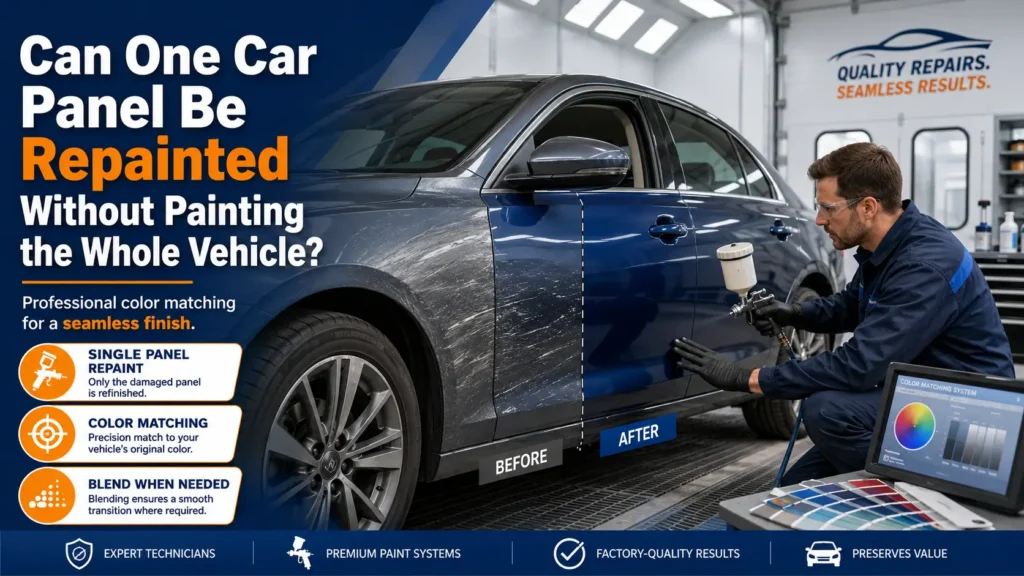
Yes. In many cases, an auto body shop can repaint one damaged car panel without repainting the entire vehicle.
A scratched door, damaged fender, peeling hood or replacement bumper can often be refinished separately. However, achieving a seamless result requires more than finding the original paint code and spraying the new color onto the panel.
Vehicle paint changes over time because of sunlight, weather, previous repairs and normal aging. Metallic and pearl colors can also appear different depending on spray technique, lighting and viewing angle. For these reasons, a technician may need to blend some color into an adjacent panel even though only one panel was physically damaged.
Blending does not necessarily mean the entire vehicle needs painting. It means gradually extending the new base color into a neighboring area so the transition between the original and refinished paint is not noticeable.
When Is Single-Panel Repainting Possible?
One-panel repainting is commonly possible when the damage is limited to a specific body panel and the surrounding paint remains in reasonably good condition.
Examples include:
- A scratched door
- A dented fender
- Peeling clear coat on the hood
- A replaced bumper cover
- Paint damage on a trunk lid
- A keyed quarter panel
- A small collision repair involving one panel
- A faded or oxidized roof panel
- Stone chips affecting one section
The repair facility must first inspect the damaged area and determine whether the panel can be repaired or needs replacement.
When a dent, crease or collision has changed the panel’s shape, the body repair must be completed before painting begins. CatCity’s dent repair service is relevant when the damaged surface must be reshaped before primer, color and clear coat are applied.
A localized cosmetic problem may require only surface preparation and refinishing. More extensive damage may involve metal repair, body filler, primer, panel replacement or adjacent collision work.
Why the New Paint May Not Match the Original Paint Code Exactly
Every vehicle leaves the factory with a paint code that identifies its original color formula. That code provides an essential starting point, but it does not always produce an exact match by itself.
A single factory color may have several variations because of:
- Different manufacturing plants
- Different paint suppliers
- Production-batch variations
- Application differences at the factory
- Model-year changes
- Natural paint aging
- Previous refinishing
- Sun and environmental exposure
CatCity states that its computerized color-matching process accounts for paint fading, environmental exposure and manufacturer variations rather than relying only on a generic paint-code formula.
This is especially important in Cathedral City, where strong sunlight and desert heat may cause exposed panels to age differently. A horizontal hood or roof may fade more noticeably than the shaded lower portion of a door.
A technician therefore evaluates the vehicle’s current color—not only the color it had when it was manufactured.
How Does an Auto Body Shop Match Existing Car Paint?
Professional automotive color matching usually combines technology, visual evaluation and technician experience.
Identifying the factory paint code
The technician begins by locating the manufacturer’s paint code. Depending on the vehicle, it may be found:
- Inside the driver-side door area
- Under the hood
- In the glove compartment
- In the trunk
- On a manufacturer information label
- Through the vehicle identification number
The code identifies the original color family and available formulas.
Scanning the existing finish
A spectrophotometer can measure the paint currently on the vehicle. The device analyzes reflected light and helps the paint-mixing system identify a formula close to the existing finish.
PPG describes spectrophotometer-based systems that analyze automotive color and connect the measurement with paint-management software to improve refinishing efficiency.
The scan can help account for differences caused by aging, fading or production variations.
Selecting a color variant
Paint manufacturers may provide several formula variants under one paint code. The technician compares these options with the vehicle and selects the closest match.
The evaluation may consider:
- Color hue
- Lightness or darkness
- Metallic-flake size
- Pearl effect
- Face color
- Side-tone appearance
- Appearance in sunlight and artificial light
Preparing a spray-out card
A spray-out card is a test panel painted using the selected formula and planned spray technique.
The technician compares the card with the vehicle before painting the actual panel. This allows adjustments to be made without testing the formula directly on the customer’s car.
Tinting the formula
When the first formula is not close enough, the painter may adjust individual toners to create a blendable match.
I-CAR explains that tinting is used to move the mixed color closer to the vehicle, while blending allows the refinished color to transition into the existing finish.
What Is Automotive Paint Blending?
Paint blending is the technique of gradually extending the new base color beyond the main repair area so that the difference between the new and existing finish becomes visually undetectable.
The painter does not apply full hiding color across the entire neighboring panel. Instead, increasingly lighter coats are used to create a gradual transition.
For example, when replacing a front fender, the shop may apply:
- Full base color to the new fender
- A controlled amount of color into the front door
- Clear coat across the refinished panels according to the approved paint procedure
The eye then sees a gradual transition rather than a sharp color change at the gap between the fender and door.
Axalta describes blending as an efficient method for achieving an acceptable automotive color match when the selected formula is close enough to the existing finish.
Does Blending Mean the Adjacent Panel Is Completely Repainted?
Not necessarily.
The adjacent panel may receive only a limited amount of base color. However, its surface must still be properly prepared, and clear coat may need to be applied across the full panel according to the paint system and vehicle-manufacturer requirements.
Base coat and clear coat serve different purposes:
- Base coat provides the visible color.
- Clear coat provides gloss, depth and protection.
Some vehicle manufacturers specifically discourage melting or solvent-blending clear coat within the middle of a panel. Their procedures may call for clear coat to extend to the panel edge to create a durable finish.
The correct process depends on the vehicle, coating system and repair location. A qualified shop should consult the applicable technical information rather than applying one method to every car.
Do Solid, Metallic and Pearl Colors Match Differently?
Yes. The type of finish affects how easily a single panel can be matched.
Solid colors
Solid colors do not contain visible metallic or pearl particles. Black, white, red and other solid colors may sometimes be easier to match than complex effect finishes.
However, even solid colors can show differences caused by fading, formula variation or paint thickness.
Metallic colors
Metallic paint contains small reflective particles.
Its appearance can change according to:
- Spray-gun distance
- Air pressure
- Application speed
- Paint viscosity
- Coat thickness
- Panel orientation
- Drying between coats
A silver or gray fender may look correct when viewed directly but appear lighter or darker from an angle if the metallic particles are oriented differently.
Pearl and tri-coat colors
Pearl and tri-coat finishes may include a base color followed by a translucent effect layer and clear coat.
The number and consistency of effect coats can change the final appearance. A small application difference may create a visible mismatch.
PPG’s refinishing training includes dedicated multi-stage color-repair and transition-layer processes because these finishes require controlled application and blending.
For metallic, pearl and other effect colors, blending an adjacent panel is often the most reliable way to create a seamless repair.
When Can a Panel Be Painted Without Blending?
Blending may not always be necessary.
A shop may be able to refinish only the damaged panel when:
- The mixed color is an extremely close match
- The adjacent panel is separated by trim
- The panels meet at a strong visual break
- The repair is on a bumper separated from the metal body
- The vehicle has a forgiving solid color
- The surrounding paint has not faded significantly
- The panel does not directly border another painted surface
- The customer understands the possible appearance difference
For example, a hood may sometimes be refinished separately because its edges create visible breaks between the fenders. A bumper may also appear slightly different from nearby metal panels even from the factory because plastic and metal substrates can influence color appearance.
The technician should evaluate the vehicle under several lighting conditions before deciding whether blending is necessary.
When Will Adjacent Panels Probably Need Blending?
Blending is more likely when:
- A fender is replaced next to a door
- A door is repaired beside another door or quarter panel
- A quarter panel borders a repaired rear door
- The paint is metallic or pearl
- The color has several factory variants
- The original finish has faded
- The repair lies close to the panel edge
- A direct panel-to-panel color comparison would be visible
- The selected formula is close but not exact
The goal is not to increase the amount of paintwork unnecessarily. The goal is to prevent an obvious mismatch between two panels positioned side by side.
Can a Bumper Be Repainted Without Painting Nearby Panels?
Yes. Bumper covers are frequently refinished separately.
A scratched, cracked or replaced bumper may be repaired and repainted without refinishing the entire fender, hood or quarter panel.
However, color matching can be challenging because bumpers are usually plastic while adjacent body panels are metal. Even when the same formula is used, the angle, substrate and factory application may make the bumper appear slightly different.
Modern bumpers can also contain parking sensors, blind-spot radar or other driver-assistance components. Repair and refinishing procedures may be restricted in sensor transmission areas.
When the damage involves the bumper and nearby panels, CatCity’s bumper and fender repair service is the most relevant internal service page.
Can a Door Be Repainted by Itself?
Yes. A door can often be repaired and refinished independently.
The shop may need to remove or mask:
- Door handles
- Moldings
- Mirrors
- Belt trim
- Weatherstripping
- Emblems
- Interior trim
- Adjacent components
When the damage is near the front or rear edge, the painter may recommend blending into the neighboring fender, door or quarter panel.
A door located between two painted panels can be particularly challenging because any color difference may be visible on both sides.
Can a Hood or Roof Be Repainted Separately?
Yes.
Hoods and roofs are commonly refinished as complete panels when they have:
- Peeling clear coat
- Sun fading
- Oxidation
- Stone chips
- Scratches
- Chemical etching
- Collision damage
These panels are often visually separated by gaps, glass or trim, which may reduce the need for blending into nearby areas.
However, the painter must still match the existing color and gloss. A newly painted hood can appear noticeably richer than heavily faded fenders if the surrounding finish has suffered years of sun exposure.
When Might the Whole Vehicle Need Repainting?
Painting the entire vehicle is generally unnecessary for one damaged panel.
A complete repaint may be considered when:
- Clear coat is failing across several panels
- The entire finish is badly faded
- Multiple previous repairs no longer match
- Rust or paint failure is widespread
- The owner wants a complete color change
- The existing paint is too deteriorated for localized matching
- Restoration work affects most of the exterior
- Numerous panels have dents, scratches and oxidation
The shop should distinguish between the repair that is necessary and a full cosmetic restoration that is optional.
What Happens During Single-Panel Refinishing?
A professional panel-refinishing process may include the following stages.
Damage inspection
The technician evaluates the dent, scratch, paint failure or collision damage and checks adjacent panels for color variation.
Disassembly
Trim, handles, lamps or moldings may be removed to create a cleaner repair edge and prevent overspray.
Panel repair
Dents, cracks or surface defects are corrected. Replacement panels are test-fitted before painting.
Sanding and preparation
The damaged finish is removed or feathered into stable paint. The surface is cleaned and prepared for primer.
Primer and sealer
Primer protects repaired areas, fills sanding marks and creates a stable foundation. Sealer may help produce consistent color coverage.
Color matching
The shop identifies the paint code, scans the finish, selects a formula and prepares a test spray-out.
Base-coat application
Color is applied to the repaired panel and blended where necessary.
Clear-coat application
Clear coat is applied according to the coating-system and vehicle requirements.
Curing and polishing
After the finish cures, minor surface imperfections may be polished.
Reassembly and inspection
The shop reinstalls trim and checks:
- Color match
- Gloss
- Panel texture
- Paint edges
- Overspray
- Panel fit
- Cleanliness
CatCity describes its refinishing process as including surface preparation, computerized color matching, base-coat application, clear-coat protection and quality inspection.
How Long Does Repainting One Car Panel Take?
A single-panel repair may take approximately three to seven working days, depending on the damage and parts required.
The timeline can be affected by:
- Dent or body repair
- Replacement-panel availability
- Primer curing
- Color matching
- Paint blending
- Trim removal
- Multiple-stage finishes
- Insurance approval
- Shop workload
- Final polishing and inspection
A simple cosmetic refinish may be completed faster than a collision-damaged panel that requires metal repair, parts and supplemental insurance approval.
How Much Does It Cost to Repaint One Panel?
There is no universal price for single-panel automotive painting.
Cost depends on:
- Panel size
- Damage severity
- Repair versus replacement
- Vehicle paint color
- Solid, metallic or pearl finish
- Number of color stages
- Adjacent-panel blending
- Trim removal
- Primer requirements
- Previous repairs
- Rust or peeling clear coat
- Insurance involvement
Repainting a small mirror cap is substantially different from repairing and refinishing a dented quarter panel.
A photograph can help a shop understand the general issue, but an in-person inspection usually produces a more reliable estimate.
Will Insurance Pay for Blending Adjacent Panels?
Insurance may cover blending when it is necessary to produce a reasonable color match as part of a covered collision repair.
The repair shop may document:
- The vehicle color
- Paint-code variations
- Adjacent-panel location
- Spray-out results
- Paint-manufacturer recommendations
- Repair procedures
- The reason blending is required
Coverage depends on the policy, accident, insurer’s estimate and supporting documentation.
When collision damage is involved, CatCity’s collision repair service can address both the physical panel damage and the related refinishing plan.
Can You Repaint a Panel With Peeling Clear Coat?
Yes, but the failed clear coat must first be removed until the remaining finish is stable.
New clear coat should not simply be sprayed over loose, flaking material. The shop may need to sand the panel, repair exposed substrate, apply primer, restore the color and apply new clear coat.
When the issue is primarily fading, oxidation or clear-coat failure, CatCity’s auto-painting service is the strongest internal link.
One-Panel Auto Painting in Cathedral City, CA
You do not automatically need to repaint the entire vehicle because one door, fender, hood, roof or bumper is damaged.
A professional inspection can determine:
- Whether the panel can be repaired
- Whether it needs replacement
- Whether the original paint is faded
- Whether adjacent-panel blending is needed
- Whether the finish is solid, metallic or pearl
- Whether the damage extends beneath the paint
- Whether clear-coat failure is present
- Whether the repair involves collision or sensor-related work
CatCity Auto Body provides professional auto painting in Cathedral City using computerized color matching and controlled refinishing procedures. Related damage can also be addressed through its dent repair, bumper and fender repair and collision repair services.
For a panel-painting or vehicle-refinishing estimate, contact CatCity Auto Body at 760-324-7117.
Frequently Asked Questions
Yes. One-panel repainting is common for localized scratches, dents, fading, clear-coat failure and collision damage. Color matching and blending may be needed to make the repair visually seamless.
A professional shop uses the factory paint code, computerized color data, spray-out testing and tinting to create a close match. Blending may be used when a direct panel-to-panel difference would otherwise remain visible.
The shop may blend a small amount of base color into an adjacent panel to create a gradual transition. This is especially common with metallic, pearl or faded finishes.
They can be. Pearl and tri-coat finishes use translucent effect layers, and their appearance changes with the number and thickness of coats. Spray-out testing is particularly important.
Yes. Bumper covers are regularly refinished independently. The technician must still consider color variation, plastic substrate differences and any sensor-related paint restrictions.
Yes. Bumper covers are regularly refinished independently. The technician must still consider color variation, plastic substrate differences and any sensor-related paint restrictions.