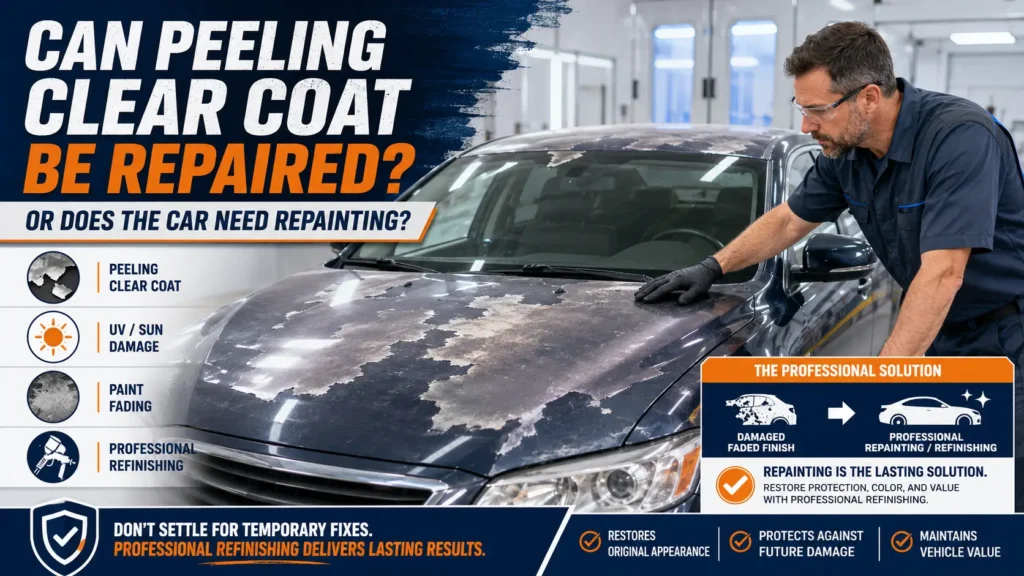
Once automotive clear coat has started peeling, the affected area usually cannot be permanently restored through polishing, waxing or simply spraying new clear coat over the damaged finish.
Peeling indicates that the clear layer has lost adhesion or deteriorated enough to separate from the color coat beneath it. A professional repair generally requires removing the failed material, preparing the surface and refinishing the affected panel. Depending on the condition of the base coat, the shop may need to reapply color before adding a new protective clear coat.
Polishing can improve mild oxidation, haze, swirl marks and shallow surface defects when the clear coat is still intact. It cannot bond loose or flaking clear coat back to the vehicle.
For Cathedral City drivers, early inspection is especially important because intense sunlight, high temperatures and prolonged UV exposure can accelerate fading, oxidation and clear-coat deterioration. CatCity Auto Body identifies peeling clear coat, dullness and fading as common signs of desert-related paint damage.
What Peeling Clear Coat Means for Your Car
Most modern passenger vehicles use a base-coat and clear-coat paint system.
The main layers generally include:
- A prepared metal, plastic or composite surface
- Primer or corrosion-protection layers
- A colored base coat
- A transparent clear coat
The base coat provides the vehicle’s color and visual effect. The clear coat creates gloss and helps protect the color layer from sunlight, moisture, environmental contamination and minor surface abrasion.
When the clear coat begins to fail, it may appear:
- Cloudy
- Chalky
- Milky
- Flaky
- Blistered
- Cracked
- White around the edges
- Rough or uneven
- Separated in thin sheets
Early deterioration may look like fading or dull paint. More advanced failure often produces visible peeling around the hood, roof, trunk lid, upper doors, fenders or other surfaces that receive strong sunlight.
Clear-coat adhesion loss is a recognized paint defect. Axalta’s paint-defect guidance recommends sanding, isolating the damaged area where necessary and refinishing when the clear coat has lost adhesion.
Can Peeling Clear Coat Be Fixed Without Repainting?
In most cases, no.
When the clear coat is actively peeling, a durable repair usually requires refinishing the affected panel. The failed material must be removed until the technician reaches a stable paint edge or sound substrate.
Applying wax, sealant or clear spray over loose material does not correct the underlying adhesion failure. The new product would be placed over an unstable surface, so continued peeling or an uneven appearance would be likely.
The amount of repainting required depends on what remains after the failed clear coat is removed.
Clear coat is damaged but the base color remains stable
When the color layer is still intact and compatible with the repair process, a technician may be able to prepare the panel and restore the clear finish without rebuilding every underlying layer.
However, sanding peeling clear coat can easily disturb or expose the color coat. The shop must evaluate the finish after preparation rather than promise a clear-only repair before seeing the condition underneath.
Base coat is faded, stained or damaged
When the underlying color has changed, oxidized, become uneven or been exposed by sanding, the affected area usually needs new base color before clear coat is applied.
The shop may also need to blend color into part of the panel or an adjacent panel to create a consistent visual transition.
The failure reaches primer or bare metal
When the coating failure exposes primer or metal, the repair becomes more extensive. The technician may need to remove unstable material, treat corrosion, apply primer, restore the base color and finish the panel with clear coat.
Professional auto painting in Cathedral City may include surface preparation, primer, color application and protective clear coat depending on the condition of the vehicle.
Can Buffing or Polishing Fix Clear-Coat Damage?
Buffing and polishing can correct certain defects in an intact clear coat, but they cannot repair peeling.
Professional paint correction may improve:
- Light oxidation
- Fine swirl marks
- Shallow scratches
- Minor haze
- Water spots
- Sanding marks
- Small surface imperfections
3M’s automotive finishing materials are designed to remove fine scratches, sanding marks, swirl marks and surface defects from cured automotive clear coats. These processes improve the surface by leveling or polishing intact material.
Polishing removes a very small amount of material from the upper surface. It cannot replace clear coat that has already detached.
A technician must first determine whether the finish is:
- Contaminated
- Lightly oxidized
- Scratched
- Chemically etched
- Thin but intact
- Cracking or peeling
Polishing a severely deteriorated finish can make the problem more visible or remove more of the remaining protective layer.
Clear-Coat Oxidation Versus Clear-Coat Failure
These terms are often used interchangeably, but they do not always describe the same condition.
Oxidation
Oxidation commonly appears as a dull, faded or chalky finish. The surface may have lost gloss but remain physically attached.
Mild oxidation may sometimes be improved through professional cleaning, polishing or paint correction, provided enough healthy clear coat remains.
Clear-coat failure
Clear-coat failure involves deeper deterioration or adhesion loss. The coating may crack, lift, flake or peel from the color layer.
Once separation has begun, polishing is not a permanent solution. The failed finish needs to be removed and rebuilt.
Base-coat damage
If the peeling exposes the color coat, that layer may fade, stain or deteriorate. The longer it remains unprotected, the more likely the panel will require color refinishing rather than a limited clear-coat repair.
What Causes Automotive Clear Coat to Peel?
Clear-coat peeling can result from environmental exposure, previous repair problems, chemical damage or a combination of factors.
Prolonged UV exposure
Sunlight is a major source of automotive paint deterioration. Horizontal surfaces such as the roof, hood and trunk receive strong, direct UV exposure.
In Cathedral City’s desert climate, prolonged sunlight and high temperatures can contribute to:
- Fading
- Oxidation
- Loss of gloss
- Dry or brittle coatings
- Clear-coat degradation
CatCity’s local desert paint guide specifically identifies UV exposure as a cause of fading, dullness and peeling clear coat.
Heat cycling
Vehicle surfaces expand and contract as they heat during the day and cool at night.
Repeated temperature changes can place stress on an already weakened or poorly bonded finish. Heat can also accelerate the effects of UV exposure and environmental contamination.
Previous poor-quality paintwork
Peeling may develop when a previous refinish repair had problems involving:
- Inadequate sanding
- Surface contamination
- Incorrect material mixing
- Poor adhesion between layers
- Improper drying time
- Incompatible products
- Incorrect film thickness
- Moisture beneath the coating
Clear-coat adhesion failure can occur when the coating does not bond correctly to the layer below. Axalta lists adhesion loss as a defect requiring removal or isolation of the failed coating and refinishing.
Chemical exposure
Harsh cleaners, solvents, fuel spills, industrial fallout and aggressive compounds may damage the finish.
Strong chemicals can stain, soften or degrade clear coat, particularly when the surface is already thin or deteriorated.
Bird droppings, insects and tree sap
Organic contamination can etch into automotive clear coat, especially when it remains on a hot surface.
The damage may begin as spotting or discoloration. Severe or repeated etching can weaken the finish and require refinishing.
Repeated abrasive washing
Automatic brushes, dirty towels and aggressive scrubbing commonly create swirl marks and scratches. These do not normally cause peeling by themselves, but repeated abrasion can reduce the thickness and appearance of an already weakened clear coat.
Stone chips and scratches
A chip or deep scratch can break through the clear and color layers. Once the coating is open, moisture and contamination can reach lower layers.
PPG’s paint-defect guidance notes that stone impact damage can penetrate through the paint system and may require sanding to a stable substrate and rebuilding the finish.
Where Clear-Coat Failure Usually Appears First
The most exposed panels often deteriorate first.
Common locations include:
- Hood
- Roof
- Trunk lid
- Upper fenders
- Spoilers
- Mirror caps
- Door tops
- Quarter-panel shoulders
- Bumper covers
Horizontal surfaces collect heat and receive more direct sunlight. Edges may also begin peeling because the coating is thinner, damaged or poorly adhered in those areas.
A small peeling spot can spread beyond the visibly affected area because the surrounding material may already have weakened adhesion.
Should You Repair Peeling Clear Coat Immediately?
Peeling clear coat is not usually an immediate mechanical safety problem, but delaying repair can increase the amount of refinishing required.
The clear coat helps shield the color layer. Once it begins lifting, the exposed base coat can experience:
- UV fading
- Staining
- Moisture exposure
- Chemical contamination
- Further adhesion loss
- Uneven color
- Surface deterioration
If the damage reaches bare metal, corrosion may begin.
Early evaluation gives the shop a better chance to determine whether the issue is limited to one panel or already affecting a larger area.
Can You Apply New Clear Coat Over Old Clear Coat?
New clear coat can be applied over properly prepared, compatible and stable existing finish. It should not be applied directly over peeling, flaking or poorly adhered material.
A sound refinishing process requires the technician to:
- Remove loose material
- Sand the panel to stable edges
- Clean and decontaminate the surface
- Repair exposed substrate
- Apply primer where required
- Restore base color where necessary
- Apply clear coat according to the product system
Simply spraying clear coat over a peeling finish may temporarily change the appearance, but it does not create a reliable foundation.
The repair may show:
- Visible edges
- Uneven gloss
- Continued peeling
- Trapped contamination
- Poor adhesion
- Color differences
Does the Whole Car Need Repainting?
Usually not.
When peeling is limited to one panel, the shop may be able to refinish that panel and blend the color where necessary.
A full-vehicle repaint may be considered when:
- Several panels have widespread clear-coat failure
- The color has faded unevenly across the vehicle
- Previous repairs are failing in multiple areas
- The owner wants a complete exterior restoration
- Matching isolated panels would produce inconsistent results
- The vehicle has extensive scratches, chips and oxidation
A professional estimate should separate the necessary repair from optional cosmetic restoration.
For example, a peeling roof may need complete roof refinishing without requiring the doors, bumpers and lower body to be repainted.
Can One Panel Be Repainted Without Painting the Entire Vehicle?
Yes. Single-panel refinishing is common when the damage is localized.
The process may include:
- Removing or masking trim
- Sanding away failed clear coat
- Repairing chips or surface damage
- Applying primer where required
- Matching the vehicle color
- Applying the base coat
- Applying clear coat
- Curing and polishing the finish
- Reassembling trim
- Inspecting color and gloss
Color matching can be more difficult when the surrounding paint has faded from years of sun exposure.
The technician may blend color into an adjacent area or panel to reduce a noticeable transition. CatCity’s auto-painting service describes computerized color matching and a refinishing process that includes preparation, color coats and protective clear coat.
Spot Repair Versus Full-Panel Refinishing
A small-area repair may be possible for certain scratches or isolated paint defects, but active peeling often extends farther than the visible edge.
Spot repair may be considered when:
- The defect is very small
- The surrounding finish is stable
- The repair area can be properly prepared
- The paint system supports the process
- The location allows a visually acceptable transition
Full-panel refinishing is often preferred when:
- Peeling covers a broad area
- Several edges are lifting
- The panel is heavily faded
- The base coat is exposed
- The finish has multiple failure points
- A durable clear-coat edge cannot be created
- The repair would otherwise remain visible
A shop should not choose spot repair solely because it is cheaper. The proposed method should create a stable and visually acceptable finish.
How a Body Shop Repairs Peeling Clear Coat
The exact procedure varies with the panel and damage, but a professional clear-coat failure repair generally includes the following stages.
Inspection
The technician examines the size of the failure, paint thickness, previous repair history and condition of the underlying color.
The shop may also inspect for:
- Rust
- Chips
- Dents
- Previous body filler
- Panel damage
- Adjacent fading
- Contamination
Removal of unstable finish
Peeling material is sanded away until the remaining coating is firmly attached.
The technician may need to enlarge the repair area beyond the visible peeling edge because nearby material can be weak.
Surface restoration
Exposed primer, metal or plastic is repaired and prepared.
This may include:
- Corrosion treatment
- Filling small imperfections
- Feather-edge sanding
- Primer surfacer
- Sealing
- Final sanding
Color matching
The shop identifies the paint code and adjusts the formula for the vehicle’s current appearance.
Original paint may have changed through UV exposure, age and previous repairs.
Base-coat application
Color is applied to the repaired area and extended as necessary for consistent coverage.
Clear-coat application
The protective clear layer is applied over the refinished area according to the product system.
Curing, finishing and inspection
After curing, the shop inspects the panel for:
- Gloss
- Color consistency
- Texture
- Dust or surface defects
- Edge quality
- Proper reassembly
Minor finishing defects in cured paint can sometimes be corrected through sanding and polishing. 3M’s professional finishing systems are designed for defects such as fine sanding marks and swirl marks in cured automotive clear coats.
Can DIY Clear-Coat Spray Fix Peeling Paint?
Aerosol clear coat may improve the appearance of a very small, properly prepared area, but it is unlikely to produce a durable, invisible repair over active peeling.
Common DIY problems include:
- Incomplete removal of failed material
- Visible sanding edges
- Poor color match
- Overspray
- Uneven gloss
- Runs or dry spray
- Incorrect curing
- Contamination
- Poor adhesion
- A visible repair boundary
Professional automotive refinishing also requires appropriate respiratory, skin and fire-safety controls. Paint and clear-coat materials should not be sprayed casually in an unventilated garage or residential area.
DIY wax or clear sprays may hide dullness briefly, but they do not restore missing layers.
Will Wax Stop Clear Coat From Peeling?
No.
Wax or sealant can help protect intact automotive paint from contamination and environmental exposure. It cannot rebond failed clear coat.
Applying wax over peeling areas may temporarily make the surface appear darker or glossier, but the loose finish will continue to separate.
Wax is more useful as preventive maintenance after the paint has been professionally restored and fully cured according to the refinishing shop’s instructions.
Can Ceramic Coating Repair Clear-Coat Failure?
No.
A ceramic coating is a protective product applied over a prepared, stable finish. It does not replace clear coat, repair peeling or restore damaged base color.
Applying ceramic coating over failing paint can trap the poor appearance underneath without correcting the adhesion problem.
Paint failure should be repaired before any long-term coating is considered.
How Much Does Peeling Clear-Coat Repair Cost?
There is no reliable flat price because the repair depends on:
- Panel size
- Number of affected panels
- Extent of peeling
- Base-coat condition
- Rust or substrate damage
- Vehicle color
- Metallic or pearl finish
- Trim removal
- Paint blending
- Previous body repairs
- Full-panel versus spot refinishing
A small clear-coat problem on one mirror cap is different from widespread failure across the roof, hood and trunk.
A shop may need to inspect the vehicle in person because photographs do not always show how far adhesion loss has spread.
How Long Does Clear-Coat Repair Take?
A localized panel refinish may require several working days. Multiple failing panels or a full repaint will take longer.
The timeline may include:
- Initial inspection
- Trim removal
- Sanding
- Body repair
- Primer application
- Color matching
- Base-coat application
- Clear-coat application
- Curing
- Polishing
- Reassembly
- Final inspection
The shop should confirm whether the estimate assumes a limited clear-coat issue or a complete panel refinish.
How to Protect New Automotive Paint in Cathedral City
After refinishing, follow the repair shop’s instructions regarding washing, waxing and environmental exposure.
Long-term protective habits include:
- Parking in a garage or shaded area when possible
- Using a quality vehicle cover when appropriate
- Washing dust and contamination regularly
- Removing bird droppings and sap promptly
- Using clean microfiber towels
- Avoiding harsh household cleaners
- Maintaining wax or paint protection
- Repairing chips before they spread
- Scheduling inspection when fading begins
CatCity’s desert paint-protection guide recommends shade, regular cleaning and protective maintenance to reduce UV-related deterioration.
Clear-Coat and Auto-Painting Repair in Cathedral City
When clear coat is actively peeling, the most relevant CatCity service is professional auto painting in Cathedral City.
That service is appropriate for:
- Peeling clear coat
- Faded vehicle paint
- Oxidized finishes
- Scratched panels
- Damaged base coat
- Panel refinishing
- Color matching
- Full-vehicle repainting
When the paint damage is connected to a dent or collision, the vehicle may also need dent repair or collision repair before refinishing.
A proper inspection should determine:
- Whether the clear coat is intact or actively failing
- Whether polishing can improve the finish
- Whether the base color is damaged
- Whether one panel or several panels need refinishing
- Whether corrosion or body damage exists underneath
- Whether paint blending will be required
For an auto-painting or clear-coat repair estimate in Cathedral City, contact CatCity Auto Body at 760-324-7117.
Frequently Asked Questions
Usually not. Once the clear coat is peeling, the unstable finish must be removed. The panel commonly needs refinishing, and new base color may also be required if the underlying paint is damaged.
No. Polishing can improve mild oxidation, haze and shallow defects in intact clear coat. It cannot restore material that has separated or flaked away.
New clear should not be sprayed directly over loose or peeling material. The failed finish must first be removed and the surface properly prepared.
Not always, but the base coat may be faded, exposed or damaged after the clear layer separates. The shop must inspect the panel after preparation to determine whether new color is required.
No. Wax may protect healthy paint, but it cannot restore adhesion or stop an already failing coating.
No. Ceramic coating protects a stable finish. It does not replace clear coat or correct peeling, fading or adhesion failure.
The primary internal link should point to CatCity’sauto-painting service. Secondary links can point todent repair andcollision repair when body damage must be corrected before painting.