
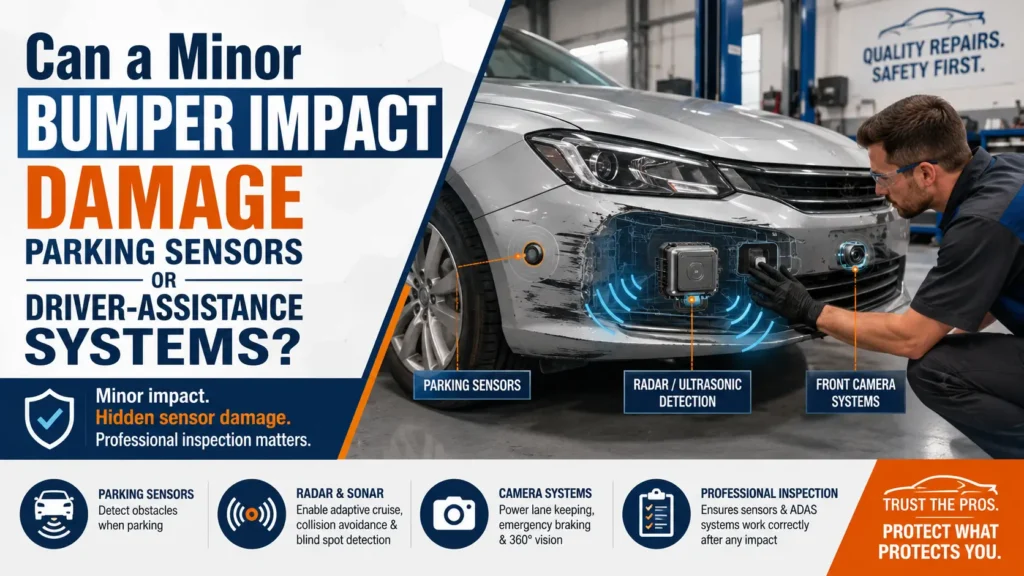
Yes. Even a minor bumper impact can damage, move or interfere with parking sensors, radar units, cameras and other advanced driver-assistance system components.
A modern bumper is no longer simply a painted plastic cover. Depending on the vehicle, the front or rear bumper area may contain ultrasonic parking sensors, blind-spot radar, forward radar, wiring harnesses, cameras and sensor mounting brackets.
A low-speed parking collision may leave only a small dent, scratch or crack on the bumper cover. However, the impact can still break a sensor holder, shift a radar unit from its correct position, pinch wiring or change the shape of the bumper area through which the sensor operates.
The vehicle may need diagnostic scanning, a detailed bumper inspection and, in some cases, ADAS calibration after repairs. The correct process depends on the vehicle’s year, make, model, installed technology and manufacturer repair procedures.
Why Modern Bumper Damage Requires More Attention
Older bumper repairs were often evaluated primarily by looking at the visible cover, reinforcement and mounting components. Today, collision technicians may also need to consider the electronic systems positioned behind or within the bumper.
These systems can assist with:
- Detecting nearby objects
- Warning about vehicles in a blind spot
- Supporting parking maneuvers
- Monitoring rear cross traffic
- Maintaining distance from other vehicles
- Warning about a potential forward collision
- Applying emergency braking in certain situations
NHTSA explains that driver-assistance technologies may provide warnings, momentary assistance or emergency safety interventions while the driver remains responsible for operating the vehicle. These technologies use electronic sensors and related computer systems to monitor the vehicle’s surroundings.
Because some sensors are positioned close to the exterior surface, apparently minor bumper damage should not always be treated as a cosmetic issue.
What Sensors Can Be Located in a Bumper?
The exact equipment differs among vehicles and trim levels. Two vehicles of the same model may not have identical systems.
Common bumper-area components include the following.
Ultrasonic parking sensors
Ultrasonic sensors are the small round devices commonly visible across the front or rear bumper cover.
They send sound waves toward nearby objects and measure the returning signal. The vehicle uses this information to provide audible, visual or vibration alerts during low-speed parking.
An impact may:
- Crack the sensor face
- Push the sensor inward
- Break the mounting holder
- Change its angle
- Disconnect the wiring
- Coat it with paint or repair material
- Distort the bumper around it
Some parking-assistance systems combine bumper-mounted ultrasonic sensors with cameras or radar. I-CAR notes that certain Hyundai and Genesis parking-assistance packages use rear bumper ultrasonic sensors together with a rear camera and shared system inputs. Damage or incorrect calibration of one input can affect more than one function.
Blind-spot monitoring radar
Blind-spot radar units are often positioned behind the left and right corners of the rear bumper cover.
These sensors may support:
- Blind-spot warnings
- Lane-change assistance
- Rear cross-traffic alerts
- Exit warnings on certain vehicles
Because radar operates through the bumper material, the cover’s thickness, shape, paint and repair materials can affect performance.
Some manufacturers restrict repairs near radar transmission zones. For example, current manufacturer guidance summarized by I-CAR includes limits on the use of filler, repainting and substrate repair near specific bumper-mounted sensors. The restrictions vary significantly by automaker and model.
Forward radar sensors
Forward radar may be positioned behind the grille, bumper cover, emblem or lower front fascia.
It can support systems such as:
- Adaptive cruise control
- Forward collision warning
- Automatic emergency braking
- Distance monitoring
NHTSA describes radar, cameras, lidar and other sensors as technologies used to detect vehicles, pedestrians and objects in the vehicle’s path.
A front bumper collision may damage the radar unit directly or move its mounting bracket. Even a small angle change may require inspection and calibration according to the vehicle manufacturer’s procedures.
Cameras
Most backup cameras are mounted in the trunk lid, liftgate or tailgate rather than directly inside the bumper. However, bumper deformation can still affect wiring, nearby mounting areas or systems that combine camera information with parking sensors.
Some vehicles also use front, side or surround-view cameras that work together to create parking and object-detection views.
A camera may require calibration after:
- Replacement
- Removal and installation
- Body-panel repair
- Suspension or alignment work
- Changes to mounting position
- Certain collision events
The calibration trigger depends on the specific manufacturer instructions.
Can a Small Bumper Dent Really Damage a Sensor?
Yes. The visible size of the dent does not necessarily show how much force reached the sensor or its mounting bracket.
A bumper cover is flexible. During an impact, it may compress inward and strike components behind it before partially returning to its original shape.
As a result, a bumper may appear to have only:
- A shallow dent
- Light paint damage
- A small crack
- Minor misalignment
- A scuffed corner
But the hidden damage may include:
- Broken sensor retainers
- Bent radar brackets
- Cracked electrical connectors
- Pinched wiring
- Damaged absorbers
- Loose mounting clips
- Distorted bumper reinforcement
- Displaced sensor modules
This is why technicians may need to remove the bumper cover to evaluate the complete repair area.
California’s Bureau of Automotive Repair notes that much of a collision repair is concealed beneath exterior panels, making it difficult for a consumer to confirm the quality or completeness of the repair from appearance alone.
Warning Signs That Parking Sensors Were Damaged
Parking-assistance problems may appear immediately or become noticeable after the vehicle is driven.
Common warning signs include:
- Continuous beeping when no object is nearby
- No warning sound when approaching an object
- A “parking assist unavailable” message
- A sensor warning on the dashboard
- One sensor behaving differently from the others
- False alerts during rain or normal driving
- Parking graphics displaying an incorrect distance
- The system switching itself off
- Intermittent operation
- A sensor sitting unevenly in the bumper
Dirt, water, ice and surface contamination can also interfere with parking sensors, so a warning does not always prove collision damage.
However, when the symptoms start after a bumper impact, the damaged area should be inspected rather than assuming the sensor only needs cleaning.
Signs That Blind-Spot Monitoring May Be Affected
Possible symptoms of radar or blind-spot system damage include:
- A blind-spot system warning message
- The warning light remaining on without nearby traffic
- Failure to alert when another vehicle enters the blind spot
- Rear cross-traffic alerts appearing at the wrong time
- One side functioning differently from the other
- The system becoming unavailable
- False activations while driving
- Warning indicators appearing after bumper repair
A system can also be affected without producing an obvious dashboard warning.
That is why a visual inspection alone may not be enough. Diagnostic trouble codes, manufacturer test procedures and calibration checks can reveal issues that are not visible from outside the vehicle.
Can the System Be Damaged Without a Warning Light?
Yes.
Electronic modules can store diagnostic trouble codes without immediately illuminating a warning lamp. A sensor may also remain online but provide information from an incorrect angle because its bracket was moved.
The system may appear to function normally during a short test while performing incorrectly in a particular driving situation.
For example, a shifted rear radar unit might:
- Detect vehicles too early
- Detect them too late
- Create false warnings
- Monitor the wrong area
- Fail to recognize cross traffic properly
This is one reason professional collision repair may include pre-repair and post-repair scanning.
A scan can identify system faults, but scanning and calibration are not the same process. A vehicle can have no active diagnostic trouble codes and still require calibration under the manufacturer’s repair instructions.
What Is a Pre-Repair Diagnostic Scan?
A pre-repair scan uses compatible diagnostic equipment to communicate with the vehicle’s electronic control modules before repair work begins.
It may help the technician identify:
- Existing diagnostic trouble codes
- Communication faults
- Damaged sensors
- Disconnected components
- Airbag-system concerns
- Parking-assistance problems
- ADAS-related faults
- Pre-existing electronic conditions
The findings can help the shop develop a more complete collision repair plan.
A pre-scan is especially useful when:
- Warning lights are present
- The vehicle has front or rear impact damage
- Sensors are located in the repair area
- Electrical components must be disconnected
- The bumper cover will be removed
- The vehicle has advanced safety features
The scan results should be interpreted together with physical inspection and manufacturer repair information.
What Is a Post-Repair Scan?
A post-repair scan is completed after repairs and reassembly to check for remaining or newly created faults.
It may confirm that:
- Disconnected components were restored
- Diagnostic codes were addressed
- Modules communicate correctly
- Required systems are available
- No repair-related electronic fault remains
A post-scan does not by itself prove that radar or camera aiming is correct. When calibration is required, the calibration process must also be performed and documented.
What Is ADAS Calibration?
ADAS calibration is the process of aiming, adjusting or teaching a sensor or camera so that the system can correctly interpret the vehicle’s surroundings.
The procedure may involve:
- Manufacturer-compatible diagnostic equipment
- Calibration targets
- A level floor
- Specific lighting conditions
- Precise distances and measurements
- Correct tire pressure
- Proper ride height
- Wheel alignment checks
- A controlled road drive
There are two common categories.
Static calibration
Static calibration is performed while the vehicle remains stationary. The technician positions targets or equipment at manufacturer-specified locations around the vehicle.
The workshop environment may need to meet strict requirements involving:
- Floor level
- Space
- Lighting
- Target position
- Vehicle alignment
- Distance from walls or objects
Dynamic calibration
Dynamic calibration is usually performed by driving the vehicle under specified road and speed conditions while the scan tool initiates or monitors the procedure.
Some vehicles require static calibration, some require dynamic calibration and others require both.
The correct method must come from the vehicle-specific service information, not from a universal rule.
Does Every Bumper Repair Require Calibration?
No. Not every bumper repair automatically requires ADAS calibration.
Calibration requirements depend on:
- Sensor type
- Sensor location
- Vehicle manufacturer
- Model year
- Impact location
- Whether a sensor was removed
- Whether the sensor bracket moved
- Whether the bumper was repaired or replaced
- Whether suspension or alignment changed
- Diagnostic results
- Manufacturer instructions
For example, replacing a bumper cover while leaving an unaffected ultrasonic sensor in its original correctly positioned mount may involve a different process from replacing a radar unit or bent sensor bracket.
However, the shop should verify the calibration requirements rather than assuming none apply.
I-CAR’s repair research shows that calibration triggers can vary even among models from the same manufacturer. Some manufacturers require specific procedures when sensor holders, bumper covers or radar components are replaced.
Can a Bumper Be Repaired Near a Radar Sensor?
Sometimes, but repairability depends heavily on manufacturer restrictions.
A repair that would be acceptable on a bumper without radar may not be permitted within a sensor transmission zone.
Possible restrictions include:
- No plastic repair near the sensor
- No body filler in the radar zone
- Limited paint thickness
- No multiple refinishing cycles
- Replacement required after specific damage
- Replacement required if sensor mounts are damaged
- Calibration required after removal or replacement
For example, recent OEM guidance documented by I-CAR shows that some Mazda vehicles require bumper replacement when damage or repainting affects specific radar areas. Stellantis guidance places limits on repairs near blind-spot sensor mounting zones and warns that repair or misalignment may cause improper system performance.
These examples should not be applied to every vehicle. They demonstrate why the shop must consult the exact repair information for the specific model.
Can Repainting a Bumper Affect Sensors?
Yes, under certain conditions.
Paint, primer, filler and other repair materials can change the way radar or ultrasonic signals pass through the bumper area.
Potential problems include:
- Excessive paint thickness
- Multiple repainting layers
- Metallic content in the finish
- Body filler in a radar transmission zone
- Uneven coating around an ultrasonic sensor
- Paint covering the sensor face
- Incorrect sensor refinishing
Some vehicle manufacturers do not recommend repainting parking sensors because excess material may affect operation. Others allow refinishing only when paint thickness and application requirements are followed.
This makes proper surface preparation and vehicle-specific refinishing information important parts of modern bumper repair.
CatCity’s auto-painting service is relevant when bumper damage requires refinishing and color matching after the sensor-related repair plan has been confirmed.
Can a Broken Sensor Mount Be Repaired?
The answer depends on the manufacturer and sensor design.
A sensor mount must hold the component in the exact intended position. A small change in angle or depth can affect what the sensor detects.
Some manufacturers provide replacement sensor holders or approved installation procedures. Others may require replacement of the bumper cover when the holder is damaged.
For example, I-CAR reports that certain Nissan and Infiniti models require bumper-cover replacement when a specified sonar sensor holder must be replaced. This is model-specific and should not be treated as a general Nissan rule.
A technician should not glue, reshape or improvise a sensor mounting repair without confirming that the method is allowed by the vehicle manufacturer.
What Happens During a Bumper and ADAS Inspection?
A proper inspection may include several steps.
Exterior inspection
The technician examines:
- Cracks and dents
- Bumper alignment
- Sensor position
- Panel gaps
- Lamps
- Mounting points
- Tire clearance
- Visible wiring
- Warning messages
Damage-area disassembly
The bumper cover may be removed to inspect the components behind it.
The shop may check:
- Sensor brackets
- Wiring connectors
- Reinforcement
- Energy absorber
- Crash boxes
- Mounting rails
- Adjacent body panels
- Radar modules
Diagnostic scan
The shop scans the vehicle for fault codes and module communication problems.
Repair-information research
The repair planner identifies:
- Sensor locations
- Restricted repair zones
- Replacement requirements
- Calibration triggers
- Paint limitations
- Scan procedures
Repair or replacement
The bumper cover, brackets, sensors and related parts are repaired or replaced according to the documented repair plan.
Calibration and verification
When required, the sensor or camera is calibrated. The technician then confirms system function and documents the completed process.
Can You Keep Driving With a Sensor Warning?
The vehicle may still move normally, but a warning indicates that one or more assistance features may be unavailable or unreliable.
Remember that ADAS does not replace attentive driving. NHTSA emphasizes that these systems assist the driver, while the driver remains responsible for controlling the vehicle.
When a warning appears after an accident:
- Do not rely on the affected feature.
- Read the owner’s manual warning.
- Check whether the bumper or sensor is obstructed.
- Avoid assuming the system will correct itself.
- Schedule a professional inspection.
- Arrange towing when the vehicle also has unsafe physical damage.
A parking sensor warning may be less urgent than leaking fluid, tire interference or structural damage, but it should still be diagnosed.
Will Insurance Cover Sensor Damage and Calibration?
Collision coverage or another driver’s property-damage liability coverage may apply when the sensor damage resulted from a covered accident.
The estimate may include:
- Diagnostic scanning
- Sensor replacement
- Wiring repair
- Bumper removal
- Bracket replacement
- Calibration
- Bumper refinishing
- Post-repair verification
Coverage depends on the policy, fault, deductible and claim circumstances.
If hidden sensor damage is discovered after disassembly, the body shop may submit a supplemental estimate with photographs, scan reports, manufacturer procedures and calibration documentation.
The vehicle owner should ask:
- Has the insurer approved the diagnostic work?
- Is calibration included in the estimate?
- Is an outside calibration provider involved?
- Could any amount become my responsibility?
- Will I receive calibration documentation?
How Long Does a Sensor-Related Bumper Repair Take?
A minor cosmetic bumper repair may take several working days. Sensor damage can extend the timeline when the shop must diagnose faults, order electronic components or schedule calibration.
Time may be added for:
- Initial scanning
- Bumper disassembly
- Manufacturer repair research
- Sensor or bracket ordering
- Wiring repair
- Paint and curing
- Calibration
- Road testing
- Post-repair scanning
A simple parking-sensor replacement may be completed faster than a repair involving blind-spot radar, structural damage and multiple calibrations.
Parts availability and insurance supplement approval can also affect the completion date.
Bumper Sensor Inspection in Cathedral City, CA
After a front- or rear-bumper impact, the safest approach is to inspect both the visible damage and the electronic systems that may be positioned behind it.
CatCity Auto Body’s bumper and fender repair service is the most relevant service for cracked bumpers, dented bumper covers, broken mounts and adjacent fender damage.
When the impact extends beyond the exterior cover, the vehicle may also require CatCity’s collision repair service for a broader damage assessment and repair plan.
A bumper inspection should help determine:
- Whether the cover is repairable
- Whether the mounting system is secure
- Whether parking sensors were displaced
- Whether radar or camera systems are involved
- Whether diagnostic scanning is appropriate
- Whether calibration is required
- Whether hidden reinforcement or structural damage exists
For an inspection or repair estimate in Cathedral City, contact CatCity Auto Body at 760-324-7117.
Frequently Asked Questions
Can a minor rear-end collision damage parking sensors?
Yes. A low-speed rear impact can crack a sensor, break its holder, damage wiring or change the shape of the bumper around it. The sensor may produce false alerts, stop working or appear normal while sitting at the wrong angle.
Does every bumper have ADAS sensors?
No. Sensor equipment varies by vehicle, model year and trim level. Some bumpers contain only reflectors or lamps, while others include ultrasonic sensors, radar units and related wiring.
Can bumper filler block blind-spot radar?
It can. Some manufacturers prohibit or limit filler and plastic repairs within radar transmission zones because added material may interfere with sensor operation. The restrictions are vehicle-specific.
What does ADAS calibration cost?
There is no universal price. Cost depends on the number and type of systems, calibration method, vehicle model, required equipment and whether additional alignment or diagnostic work is needed.
Can a sensor be damaged without showing a dashboard warning?
Yes. A sensor can be misaligned or perform inaccurately without immediately triggering a visible warning. Diagnostic scanning, physical inspection and calibration checks may be required.
Can I drive while blind-spot monitoring is unavailable?
The vehicle may remain physically drivable, but the affected assistance feature should not be trusted. Use mirrors, shoulder checks and attentive driving, and arrange diagnosis promptly.
Why would a body shop replace a bumper instead of repairing a small dent?
Replacement may be required when the damage affects sensor mounting points, restricted radar zones or areas where the manufacturer does not permit filler, plastic repair or repainting. Severe cracking and poor fit can also make replacement more appropriate.
Does a new bumper always need calibration?
No. Calibration depends on the vehicle, sensor design and repair procedure. The shop should verify the exact requirements using vehicle-specific manufacturer information.
What services should I link to from this article?
The strongest internal link is CatCity’s bumper and fender repair page. The article should also link naturally to collision repair for hidden accident damage and auto painting for bumper refinishing.