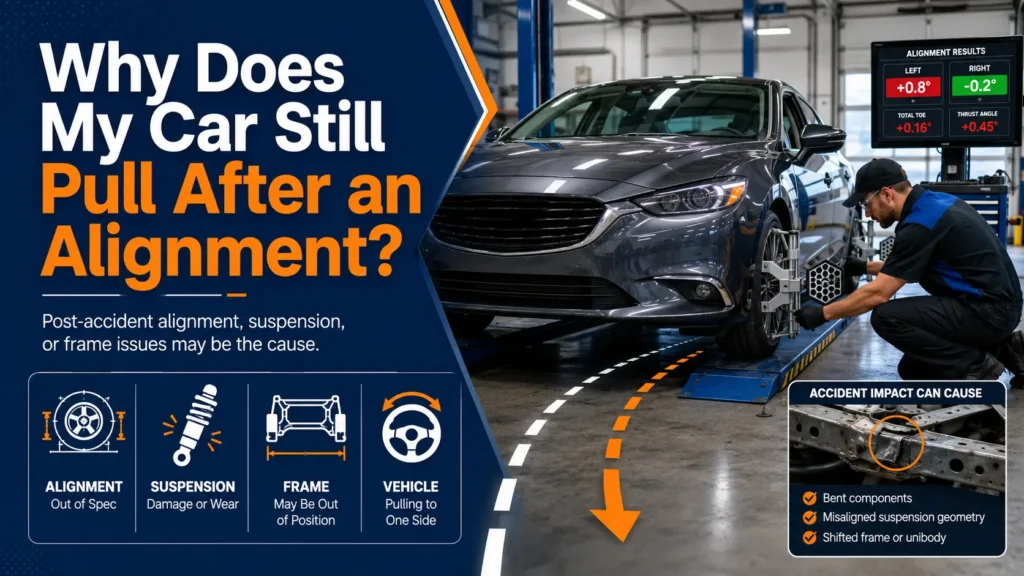
A car that still pulls to one side after a wheel alignment may have a tire problem, an incorrect or incomplete alignment, bent suspension or steering components, brake drag, rear thrust-angle problems, or structural damage left over from the accident.
A wheel alignment adjusts the angles of the wheels. It cannot permanently correct a bent control arm, damaged steering knuckle, shifted subframe or misaligned suspension mounting point.
After a collision, the vehicle’s suspension and structure should be inspected before the final alignment is completed. I-CAR warns that aligning a collision-damaged vehicle before correcting bent suspension parts or structural damage can produce misleading measurements and an incomplete repair. The vehicle’s structure must be dimensionally correct before it can be properly aligned.
A persistent pull should therefore be diagnosed rather than repeatedly adjusted. The technician needs to identify whether the problem comes from the tires, alignment settings, suspension geometry, steering system, brakes or vehicle structure.
What a Persistent Post-Accident Pull Usually Means
When a vehicle continues drifting or pulling after alignment, the alignment itself may not be the root cause.
The problem may involve:
- Unequal tire pressure or tire construction
- Accident-related tire or wheel damage
- Bent suspension components
- A shifted front or rear subframe
- Incorrect camber or caster
- An improper rear thrust angle
- Steering-system damage
- Brake drag on one wheel
- Structural or unibody misalignment
- An alignment performed before collision damage was corrected
Not every slight drift indicates serious frame damage. Road crown, wind and tire characteristics can cause a vehicle to move gradually toward one side.
A strong or consistent pull that began after an accident—especially when accompanied by uneven tire wear, an off-center steering wheel or unusual handling—deserves a complete post-collision inspection.
What Is the Difference Between Drifting and Pulling?
Drivers often use “pull,” “drift” and “tracking problem” to describe the same symptom, but technicians may evaluate them differently.
A drift is usually a gradual movement toward one side. It may be influenced by road slope, tire characteristics or wind.
A pull is generally a stronger tendency that requires the driver to apply noticeable steering pressure to keep the vehicle moving straight.
Road crown is the slight slope built into roads for drainage. It can cause a vehicle to drift toward the lower side of the road. Manufacturers recommend testing a suspected pull on a reasonably level road and, when practical, driving in opposite directions to separate vehicle-related symptoms from road slope or crosswind.
A vehicle that pulls in the same direction on different roads and in both travel directions is more likely to have a tire, brake, alignment, suspension or structural issue.
Why a Wheel Alignment May Not Fix Accident Damage?
A wheel alignment machine measures wheel angles and allows technicians to adjust certain settings. The commonly discussed alignment angles include toe, camber and caster.
However, not every angle is adjustable on every vehicle. More importantly, adjustment cannot compensate safely for every damaged component.
For example, a technician may adjust toe so the alignment screen shows acceptable readings, but the vehicle can still have:
- A bent lower control arm
- A damaged strut
- A shifted suspension cradle
- A bent steering knuckle
- A damaged inner or outer tie rod
- A distorted suspension mounting point
- An incorrect rear thrust angle
- A structurally misaligned unibody
I-CAR states that suspension components bent during a collision can prevent proper alignment. A vehicle may appear to align initially but later develop abnormal tire wear because the underlying damage remains.
The correct order is generally to diagnose and repair collision damage first, verify structural dimensions and then perform the final alignment.
Bent Suspension Components Can Cause a Continued Pull
Suspension components maintain the wheel’s position relative to the body and road. Even a small change in their shape can alter wheel geometry.
Accident-related components that may be damaged include:
- Lower or upper control arms
- Struts and shock absorbers
- Steering knuckles
- Ball joints
- Tie rods
- Wheel hubs and bearings
- Springs
- Trailing arms
- Toe links
- Suspension cradles or subframes
- Mounting brackets
A direct impact against a wheel, curb or another vehicle can bend a suspension part without creating obvious exterior body damage.
Manufacturer alignment guidance shows that unusual steering-axis-inclination measurements can help identify damaged components. For example, a lower-than-expected measurement on one side may indicate a bent lower control arm, while a higher measurement may suggest damage around an upper strut mount. These examples are diagnostic indicators rather than universal conclusions for every vehicle.
Some steering and suspension damage can also be difficult to see. I-CAR notes that steering knuckles and inner tie rods may require specific inspection methods because deformation or looseness is not always obvious during a basic visual check.
A Shifted Subframe May Affect Alignment
Many vehicles use a bolt-on subframe or suspension cradle to support the engine, steering rack and suspension components.
A collision can:
- Shift the subframe on its mounting points
- Bend the cradle
- Damage the mounting bolts
- Distort the surrounding body structure
- Change the position of control-arm mounts
- Affect steering-rack alignment
A shifted subframe can alter camber, caster, toe and wheel position. The alignment technician may be unable to bring all readings into specification, or may obtain acceptable static readings while the vehicle still handles incorrectly.
The repair facility should determine whether the subframe can be repositioned, whether it is damaged or whether the body mounting locations have moved.
Structural Damage Can Remain After a Standard Alignment
Most modern passenger vehicles use unibody construction. The body and structural frame work together rather than existing as completely separate assemblies.
Suspension and steering components attach to specific structural locations. When those mounting points move during a collision, the wheel geometry can change even when the suspension parts themselves appear usable.
Possible structural problems include:
- Shifted front rails
- Distorted apron areas
- Damaged strut towers
- Moved suspension mounting points
- Floor or rocker distortion
- Rear-body misalignment
- Twisted unibody construction
- Crossmember mounting damage
Three-dimensional measuring equipment allows collision technicians to compare multiple structural points with vehicle specifications before, during and after straightening. I-CAR describes three-dimensional measurement as a way to identify and document structural distortion that simple visual inspection or limited point-to-point checks may miss.
CatCity frame-straightening service uses computerized measuring and controlled straightening equipment to evaluate unibody geometry, suspension mounting locations and accident-related structural misalignment.
Rear-Wheel Alignment Can Make the Car Feel Like It Is Pulling
A front-wheel-only alignment may not identify problems involving the rear wheels or rear structure.
The thrust angle describes the direction in which the rear wheels or rear axle direct the vehicle. When that angle is incorrect, the rear of the vehicle may effectively steer away from its intended centerline.
This can produce:
- An off-center steering wheel
- Dog tracking
- Uneven tire wear
- Altered handling
- A vehicle that appears to pull
- Instability during lane changes
I-CAR explains that four-wheel measurements are important because rear toe or structural problems can affect the relationship between the front wheels, rear wheels and vehicle centerline. Rear-wheel readings outside specification may indicate bent suspension parts or unrepaired structural damage.
A four-wheel alignment does not mean every rear angle is adjustable. It means all four wheels are measured so the technician can identify the vehicle’s actual tracking direction.
Tire Damage Can Cause Pulling Even When Alignment Is Correct
Tires can create a lateral force that makes a vehicle pull or drift despite acceptable alignment readings.
Potential tire-related causes include:
- Unequal tire pressure
- Internal belt damage
- Tire conicity
- Ply steer
- Different tire sizes
- Uneven tread depth
- Collision-related sidewall damage
- Irregular wear caused by the previous misalignment
Tire conicity refers to a tire behaving slightly like a cone as it rolls, generating a sideways force. It can exist because of manufacturing variation or develop with irregular wear.
Manufacturers commonly diagnose tire-related pull by checking pressure and condition and, when appropriate, changing tire positions to see whether the direction or severity of the pull changes.
A wheel alignment will not fix an internally damaged tire. The tires and wheels should therefore be inspected as part of any post-accident pull diagnosis.
Could a Bent Wheel Cause the Vehicle to Pull?
Yes. A wheel can bend after striking a curb, pothole or another vehicle during an accident.
A damaged wheel may cause:
- Vibration
- Air-pressure loss
- Irregular tire movement
- Steering-wheel shake
- Uneven contact with the road
- Difficulty obtaining reliable alignment readings
A small cosmetic scrape does not necessarily mean the wheel is bent, while a wheel that looks acceptable from outside may still have lateral or radial runout.
The technician may need to measure wheel runout and inspect the tire bead, sidewall and internal construction.
Brake Drag Can Pull the Vehicle Toward One Side
A vehicle that pulls while driving or braking may have a brake problem rather than an alignment problem.
Brake drag occurs when a brake does not fully release. Possible causes include:
- A sticking caliper
- Damaged caliper hardware
- A restricted brake hose
- Parking-brake problems
- Collision damage around the hub or brake assembly
- Incorrectly installed components
If one brake continues applying force, the vehicle may pull toward the affected side. The wheel may also become hotter than the others, and the driver may notice a burning smell or reduced fuel economy.
Manufacturer diagnostic guidance includes brake drag among the conditions that should be ruled out before attributing every vehicle pull to wheel alignment.
Do not touch a wheel or brake assembly immediately after driving to compare temperature. Brake components can become extremely hot.
Why Is the Steering Wheel Still Off-Center?
An off-center steering wheel after alignment can result from:
- Incorrect front toe adjustment
- The steering wheel not being centered during alignment
- Rear thrust-angle problems
- A shifted steering rack
- Bent tie rods
- Steering-column damage
- Structural misalignment
- Calibration or steering-angle-sensor issues
The steering wheel may look straight on the alignment rack but move off-center once the vehicle follows the rear thrust angle on the road.
I-CAR explains that aligning only the front wheels without accounting for rear-wheel position can leave the steering wheel off-center and make the vehicle seem to pull.
After certain collisions, the steering column itself may also require inspection. Modern energy-absorbing columns can contain components designed to collapse during an impact, and vehicle manufacturers may specify inspection, measurement or replacement procedures after a collision.
Can Alignment Problems Affect ADAS?
Yes. Wheel alignment and steering geometry can affect systems that depend on knowing the vehicle’s direction of travel.
These may include:
- Lane-departure warning
- Lane-keeping assistance
- Adaptive cruise control
- Automatic emergency braking
- Forward collision warning
- Stability-control systems
- Steering-angle-based functions
Cameras and radar sensors may use steering-angle, yaw and wheel-direction information. If the vehicle travels at an angle while the steering wheel or sensor data suggests it is straight, driver-assistance performance may be affected.
I-CAR advises repairers to consult vehicle-specific manufacturer procedures because some vehicles require sensor, camera or steering-angle calibration after wheel alignment, suspension work or collision repair.
Scanning for fault codes and performing a wheel alignment are not substitutes for required ADAS calibration.
Signs the Problem May Be More Than a Basic Alignment
Schedule a broader collision inspection when the vehicle has any of these symptoms after an accident:
- It pulls strongly on different roads.
- The steering wheel remains off-center.
- One wheel sits farther forward or backward in the opening.
- Tires develop rapid or uneven wear.
- Alignment angles cannot be adjusted into specification.
- The vehicle dog-tracks.
- Doors, hood or trunk show uneven gaps.
- Steering feels loose, heavy or inconsistent.
- The car vibrates at road speed.
- New clunks or rubbing sounds appear.
- Dashboard or ADAS warnings remain active.
- The vehicle handles differently while braking.
CatCity lists pulling after alignment, unusual tire wear, off-center steering and misaligned body openings among the warning signs that may justify a structural assessment.
Is It Safe to Keep Driving a Car That Pulls?
A very mild drift caused by road crown may not indicate an immediate mechanical problem. A strong, sudden or worsening pull should not be ignored.
Stop driving and arrange professional assistance when the vehicle:
- Is difficult to keep in its lane
- Pulls sharply during braking
- Has a visibly damaged tire or wheel
- Makes grinding, clunking or scraping sounds
- Has loose steering
- Shows severe vibration
- Has components contacting a tire
- Displays steering, stability-control or brake warnings
- Developed the symptom immediately after a substantial collision
Continuing to drive with damaged suspension or steering components may worsen tire wear and handling. It can also make emergency steering or braking less predictable.
What Should a Post-Accident Diagnosis Include?
A complete diagnosis should proceed systematically instead of assuming another alignment will solve the problem.
Road test
The technician confirms the direction and severity of the pull on a suitable road while considering road crown and wind.
Tire and wheel inspection
The shop checks:
- Tire pressures
- Tread wear
- Tire size and matching
- Sidewall or belt damage
- Wheel damage
- Tire-related pulling forces
Brake inspection
The technician checks for dragging or damaged brake components.
Steering and suspension inspection
Control arms, tie rods, knuckles, struts, springs, bearings, ball joints and mounting points are inspected or measured.
Four-wheel alignment measurement
All wheel angles and the rear thrust angle are recorded. The technician should examine not only whether adjustable angles are green on the screen, but also whether diagnostic measurements suggest bent components.
Structural measurement
When collision history, wheel position or alignment data suggests structural movement, the vehicle is measured against specifications.
Repair and final alignment
Bent or damaged components are corrected or replaced before the final alignment is completed.
Scan and calibration
When required, the shop performs post-repair scanning, steering-angle reset and ADAS calibration according to manufacturer procedures.
Post-Accident Frame and Alignment Inspection in Cathedral City
When a vehicle continues pulling after alignment, repeatedly adjusting wheel angles may not address the real problem.
CatCity Auto Body’s frame-straightening service in Cathedral City is the most relevant service when the accident may have moved the unibody, frame, subframe or suspension mounting points.
Its collision-repair service is appropriate when the handling problem is connected to broader front-end, rear-end or multi-panel accident damage. CatCity states that its collision-repair process can include structural measurement, frame repair and coordination with insurers when necessary.
A professional assessment can determine whether the continued pull comes from:
- Tires or wheels
- Alignment settings
- Suspension damage
- Steering damage
- Rear thrust angle
- Brake drag
- Subframe movement
- Structural misalignment
For a post-accident structural and collision-damage assessment, contact CatCity Auto Body at 760-324-7117.
Frequently Asked Questions
The vehicle may have a damaged tire, bent suspension component, incorrect thrust angle, brake drag, shifted subframe or structural misalignment. An alignment cannot correct a physically damaged part or moved mounting point.
Yes. Structural movement can change the location of steering or suspension mounting points. This can alter wheel geometry and prevent the vehicle from tracking correctly.
Some adjustable measurements may be brought into an acceptable range even when a component is damaged. Diagnostic angles, wheel position, tire wear and physical measurements may reveal the remaining problem.
Not necessarily. It may result from incorrect toe adjustment, an improperly centered steering wheel, rear thrust-angle problems or bent steering parts. Structural damage is one possibility that should be investigated after a collision.
Yes. Unequal pressure, internal damage, tire conicity, ply steer and irregular wear can all cause pulling even when wheel-alignment readings are acceptable.
Yes. A curb impact can damage a tire, wheel, control arm, tie rod, knuckle, strut, bearing, subframe or mounting location.