
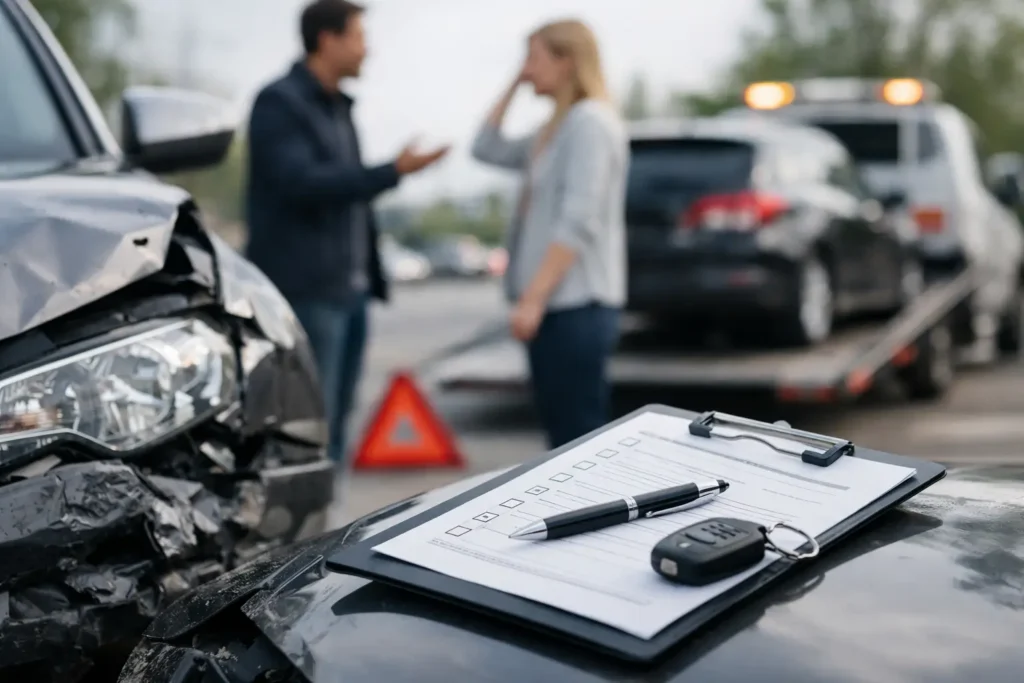
The moments after a collision can feel disorienting, even when the damage appears minor. Knowing what to do after car accident damage helps you protect the people involved, preserve the information your insurer needs, and avoid overlooking repairs that could affect your vehicle’s safety later.
For drivers across Cathedral City and the Coachella Valley, the first priority is always the same: take care of people before taking care of the car. Once everyone is safe, a calm, organized response can make the claims and repair process far less stressful.
1. Get to Safety and Check for Injuries
If your vehicle can be moved and it is safe to do so, pull out of traffic to a shoulder, parking lot, or other protected location. Turn on your hazard lights. If the vehicle cannot be moved, leave it where it is unless staying inside creates a greater risk.
Check yourself, your passengers, and the other parties for injuries. Call 911 immediately if anyone is hurt, if there is a fire, fuel leak, blocked roadway, or substantial vehicle damage. Even after a low-speed impact, pain from whiplash or other injuries may not appear right away. Seek medical attention when you have any concern rather than trying to assess an injury on your own.
Avoid discussing who caused the accident at the scene. You can be courteous and cooperative without making statements about fault. Let law enforcement officers and insurance companies review the facts.
2. Call Law Enforcement When Appropriate
A police report can provide useful documentation, particularly when there are injuries, major damage, suspected impaired driving, an uninsured driver, or disagreement about what happened. Follow the instructions of the responding officer and ask how you can obtain the report number.
Not every minor collision results in an officer coming to the scene. In California, drivers still have reporting responsibilities in certain circumstances, especially when an accident involves injuries or significant property damage. Your insurance carrier can also explain what documentation it needs for your claim.
3. Exchange Information and Document the Scene
Exchange names, contact information, driver’s license numbers, license plate numbers, insurance details, and vehicle descriptions with the other driver. Keep the conversation factual. A photo of an insurance card and driver’s license can prevent transcription errors, but only take photos when it is safe to do so.
Take wide and close-up photographs of the accident scene before vehicles are moved, if possible. Capture the position of the vehicles, road conditions, traffic signals, street signs, skid marks, debris, and every visible area of damage. Photograph both vehicles, not just your own.
It also helps to write down the time, location, weather, direction each vehicle was traveling, and a brief account of what you remember. If witnesses are willing to help, ask for their names and phone numbers. Details are easiest to remember immediately after the crash and may be difficult to reconstruct days later.
4. Decide Whether Your Vehicle Is Safe to Drive
A damaged car is not necessarily a drivable car. A cracked bumper, dented fender, or broken mirror may be obvious, but collision damage can also affect headlights, sensors, tire clearance, steering, suspension, wheel alignment, cooling systems, or the vehicle’s frame.
Do not drive if you notice leaking fluids, a deployed airbag, a loose bumper or panel, rubbing tires, broken lights, steering changes, warning lights, an overheating engine, or a door that will not close securely. A vehicle that pulls to one side or makes unfamiliar noises should also be inspected before it returns to regular use.
When there is any doubt, arrange for towing instead of taking a chance on a short drive. Towing may feel like an added inconvenience, but it can prevent a small problem from turning into additional damage or a roadside safety hazard.
5. Notify Your Insurance Company Promptly
Report the accident to your insurance carrier as soon as practical. Provide accurate information, photos, the police report number if available, and the other driver’s details. Your insurer will open a claim and explain your coverage, deductible, rental options, and next steps.
You are not required to accept a repair decision before you understand the estimate. Ask questions about how the claim will be handled and whether the insurer needs an inspection before repairs begin. Keep copies of claim numbers, emails, repair authorizations, and receipts in one place.
Insurance estimates are often based on visible damage. Once a vehicle is disassembled, a repair facility may find hidden issues behind the bumper, beneath exterior panels, or in structural components. This is normal in collision repair. A qualified shop documents the additional damage and works with the insurer on a supplemental estimate before completing that portion of the repair.
What to Do After Car Accident Damage Before Authorizing Repairs
Before authorizing work, choose a collision repair facility that can explain the repair plan clearly. The lowest initial estimate is not always the best value if it leaves out safety-related work, uses questionable parts, or fails to address damage that is not visible from the outside.
Ask the shop to walk you through the estimate in plain language. You should understand which panels will be repaired or replaced, whether paint blending may be needed, how damaged components will be inspected, and what happens if additional damage is discovered. A detailed estimate gives you a better basis for comparing repair options.
For newer vehicles, ask how the facility handles advanced driver-assistance systems. Cameras, radar sensors, parking sensors, and lane-assist equipment can require inspection or calibration after a collision, even if the impact looked minor. Proper repair means restoring both the appearance and the systems designed to help protect you on the road.
6. Choose Repair Quality Over a Quick Cosmetic Fix
A vehicle can look acceptable while still having unresolved collision damage. This is especially true after a front-end, rear-end, or side impact, where mounting points, reinforcements, suspension parts, and structural areas may be affected behind exterior panels.
Look for a shop with trained technicians, appropriate measuring and repair equipment, and experience with your vehicle’s make and model. I-CAR and ASE credentials are meaningful signs that technicians have invested in current collision-repair training. You should also expect clear communication, a written estimate, and updates as the work progresses.
CatCity Auto Body, Inc. provides free estimates and insurance claim assistance for drivers in Cathedral City, Palm Springs, Palm Desert, Rancho Mirage, and surrounding Coachella Valley communities. Whether the repair involves a dented bumper or more extensive collision damage, the same standard should apply: restore the vehicle carefully, safely, and with attention to the details that matter after you leave the shop.
7. Plan for Transportation While Repairs Are Underway
Ask early about rental vehicle coverage or other transportation options. Rental benefits depend on your policy and the circumstances of the claim, so waiting until repairs have started can create avoidable pressure on your schedule.
Repair time varies based on parts availability, the extent of damage, insurance approval, paint curing, and any necessary mechanical or calibration work. A trustworthy shop will give you a realistic timeline rather than promising a completion date it cannot support. Online repair-status updates and direct communication can make it easier to plan around work, school, appointments, and family obligations.
8. Inspect the Finished Repair and Keep Your Records
When you pick up your vehicle, take a few minutes to inspect it in good lighting. Look at panel gaps, paint color consistency, trim fit, lights, doors, trunk or liftgate operation, and any area that was repaired. Confirm that warning lights are off and that you have received the paperwork for the work completed.
It is reasonable to ask questions if something does not look or feel right. A quality repair facility wants you to leave confident in the result, not rushed through pickup. Save your final invoice, warranty information, claim documents, and photos of the original damage for your records.
A collision disrupts more than your vehicle. It can affect your commute, your family schedule, and your peace of mind. Give yourself permission to slow the process down enough to make safe, informed decisions. The right next step is the one that protects you now and helps ensure your vehicle is ready for the road ahead.