
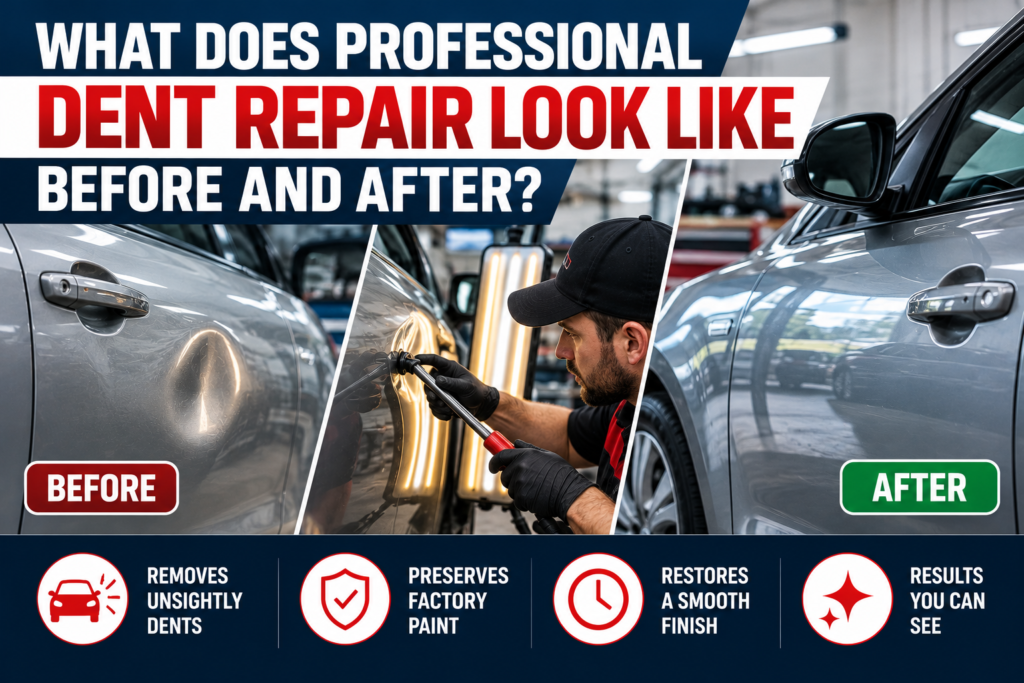
A dent can look like a simple cosmetic problem when you first notice it. But professional dent repair is more than simply pushing the metal back into place.
The repair method depends on the size, depth, location, paint condition, and type of damage. A small door ding with intact paint may be repaired using paintless dent repair, while a deep crease or dent with cracked paint may require conventional bodywork and refinishing.
So what should you actually expect before and after professional dent repair?
Before the repair, a technician evaluates the dent, paint, panel condition, and accessibility. After the repair, the goal is to restore the panel’s original shape, alignment, and finish as closely as practical.
The difference can be dramatic, particularly when the dent is visible under direct light or reflected surfaces.
For vehicle owners in Cathedral City, CatCity Auto Body provides dent repair services for parking-lot dents, door dings, hail damage, collision-related dents, and other body-panel damage.
What Does a Car Dent Look Like Before Repair?
There isn’t one standard appearance for a dent.
A dent may be:
- Small and round
- Wide and shallow
- Deep and narrow
- Sharply creased
- Located on a body line
- Near the edge of a panel
- Surrounded by cracked paint
- Spread across a large section of the panel
Some dents are immediately obvious.
Others are surprisingly difficult to see until light reflects across the panel.
This is why photographs don’t always tell the whole story.
A dent may look minor in a normal photograph but become much more noticeable when viewed under professional inspection lighting.
What Does a Professional Technician Look At?
Before deciding how to repair the dent, a technician needs to understand what actually happened to the panel.
The inspection may consider:
Dent size
How wide is the damaged area?
Dent depth
How far has the panel moved from its original position?
Metal condition
Has the metal been stretched, sharply folded, or otherwise deformed?
Paint condition
Is the original paint still intact?
Dent location
Is the damage near a body line, panel edge, reinforcement, or other difficult area?
Access
Can the technician reach the back of the damaged panel?
Surrounding damage
Is there damage around the dent that suggests a larger collision?
These factors help determine whether PDR, conventional dent repair, or panel replacement is appropriate.
Before and After: What Changes During Dent Repair?
A professional dent repair usually has one main objective:
Make the damaged panel look and function like it should.
That can mean different things depending on the repair method.
For a suitable PDR repair, the transformation may involve:
Visible dent → gradual metal reshaping → restored panel contour → original paint preserved
For traditional body repair, the process may look more like:
Dent → metal repair → surface preparation → primer → paint matching → refinishing → finished panel
The visible result may be similar, but the process behind it is different.
Paintless Dent Repair Before and After
Paintless dent repair is often used when the dent is suitable and the original paint remains intact.
Before PDR, you may see:
- A circular depression
- Door ding
- Hail dent
- Shallow crease
- Distorted reflection
During the repair, the technician carefully manipulates the panel from behind.
The objective isn’t to force the metal into place all at once.
Instead, the technician works gradually and checks the panel continuously.
After a successful PDR repair, the goal is for the panel to regain its original contour while retaining the existing finish.
That means there may be no need for:
- Body filler
- Primer
- Traditional repainting
CatCity explains the process in its complete guide to paintless dent repair in Cathedral City.
What Should a Good PDR Repair Look Like?
A properly completed PDR repair should not simply make the dent “less noticeable.”
The technician should aim to restore the panel’s contour.
When you inspect the finished panel, look at it from different angles and under different lighting.
You should pay attention to:
- Straight reflections
- Body lines
- Panel contours
- Edges
- Adjacent panels
A repaired panel should not have an obvious low spot, high spot, or distorted body line.
This is particularly important on vehicles with strong character lines or highly reflective paint.
Traditional Dent Repair Before and After
Not every dent is suitable for PDR.
When the paint is damaged or the metal has been significantly deformed, conventional auto body repair may be necessary.
Before repair, the vehicle may show:
- Deep dents
- Sharp creases
- Cracked paint
- Chipped paint
- Exposed metal
- Severely distorted panels
The repair process may involve reshaping the metal and preparing the surface before refinishing.
Depending on the damage, the technician may use appropriate body filler, primer, paint, and clear coat as part of the restoration.
Afterward, the panel should have:
- Correct shape
- Proper panel alignment
- Smooth surface
- Appropriate paint color
- Consistent gloss
- Clean transition to adjacent panels
What Does a Repaired Dent Look Like From Different Angles?
One of the easiest ways to evaluate a repair is to move around the vehicle.
Don’t inspect the panel from only one position.
Look at it:
- Straight on
- From the side
- From above
- At a shallow angle
- Under direct lighting
- In natural daylight
Why?
Because body-panel imperfections can appear differently depending on the angle of the light.
A panel can look perfect from one direction and show a remaining distortion from another.
Professional repairers use controlled lighting for this reason.
Why Reflection Matters in Dent Repair
Reflection is an important part of evaluating a vehicle’s bodywork.
A smooth panel should produce a relatively consistent reflection.
A dent changes the shape of the surface, which causes the reflected image to bend or distort.
This makes dents easier to identify.
During PDR, technicians may use specialized lighting to highlight these changes.
The light helps them see where the panel is still low or high and where additional correction is needed.
After the repair, the reflection should become much more consistent with the surrounding panel.
What Does a Repaired Door Look Like?
A professionally repaired door should look natural from both close and normal viewing distances.
Check:
- Door contour
- Body lines
- Panel gaps
- Paint consistency
- Door operation
The door should also open and close normally.
A cosmetic repair isn’t complete if the panel looks better but the door no longer aligns properly.
For a simple door ding with intact paint, PDR may be appropriate.
For a deep collision dent with paint damage, traditional body repair may be necessary.
What Does a Repaired Fender Look Like?
Fenders are especially noticeable because they sit next to the hood, door, headlight, and bumper.
A proper repair should maintain the relationship between those components.
After repair, check:
- Fender-to-hood gap
- Fender-to-door gap
- Wheel-arch shape
- Headlight alignment
- Bumper connection
- Paint consistency
A damaged fender may sometimes be repaired rather than replaced.
In more severe cases, replacement may be appropriate.
CatCity provides bumper and fender repair for vehicles with damaged exterior panels.
What Does a Repaired Hail-Damaged Car Look Like?
Hail damage can create many small dents across a vehicle.
Before repair, you may see:
- Numerous shallow depressions
- Dents across the hood
- Roof dents
- Trunk dents
- Door dents
- Distorted reflections
When the paint remains intact, PDR can often be considered.
The technician may work through the vehicle panel by panel.
The goal is not simply to remove the largest dents.
The entire surface should be evaluated.
After repair, the vehicle should have a consistent panel shape without obvious hail depressions.
If the hail caused paint damage, the repair approach may change.
What If the Paint Is Damaged?
This is one of the biggest differences between PDR and conventional dent repair.
If the dent has cracked or chipped the paint, restoring the metal alone does not restore the complete repair.
The damaged finish may need to be prepared and refinished.
This can involve:
- Repairing the panel
- Preparing the damaged surface
- Priming where appropriate
- Matching the paint
- Applying the color
- Applying clear coat
- Inspecting the finished surface
For vehicles requiring refinishing, CatCity offers auto painting services.
Before and After: Why Paint Matching Matters
Imagine a vehicle with a dented silver door.
The technician repairs the metal, but the replacement paint is noticeably darker than the original finish.
The dent is gone.
But the repair still looks obvious.
That’s why paint matching matters.
A quality refinishing process considers the existing finish and surrounding panels.
Factors can include:
- Factory paint code
- Vehicle age
- Sun exposure
- Existing paint condition
- Metallic content
- Pearl effects
- Color variation
The goal is to make the repaired area blend naturally with the rest of the vehicle.
Can You Tell If a Dent Was Repaired?
Sometimes.
A high-quality repair can be very difficult to notice.
But obvious repair indicators can include:
- Paint color differences
- Uneven texture
- Overspray
- Visible sanding marks
- Distorted body lines
- Uneven panel gaps
- Remaining dents
- Excessive filler
A professional repair should minimize these visual clues.
This is especially important if you’re planning to keep the vehicle for years or eventually sell it.
What Should You Check After Dent Repair?
When you pick up your vehicle, don’t just look at the repaired area for five seconds.
Take a few minutes to inspect the result.
Look at the panel
Check whether the original contour has been restored.
Check the body lines
Make sure they appear straight and consistent.
Compare adjacent panels
Look for noticeable color or gloss differences.
Check the gaps
Doors, fenders, hood, trunk, and bumpers should fit correctly.
Look under different lighting
A repair can appear different in sunlight, shade, and artificial lighting.
Test moving components
If the repaired area involves a door, trunk, hood, or other moving panel, make sure it operates correctly.
What If You Still See a Small Imperfection?
Talk to the repair shop before leaving if something doesn’t look right.
Point out the specific area and ask the technician or service representative to inspect it.
Some imperfections may become visible only under certain lighting conditions, and the technician can determine whether what you’re seeing is normal reflection or a repair issue.
The goal should be clear communication rather than guessing.
Does a Dent Repair Always Look Exactly Like Factory Condition?
A professional repair aims to restore the vehicle as closely as practical to its pre-damage appearance.
However, the final result depends on the original damage.
A severely stretched or creased panel may present different challenges from a shallow parking-lot ding.
Existing paint condition can also affect the final appearance
Dent Repair Before and After: PDR vs. Traditional Repair
Here’s the practical difference:
| Before | Repair approach | Expected result |
| Small dent, paint intact | PDR | Original paint and panel restored |
| Door ding, no paint damage | PDR | Dent removed without traditional repainting |
| Hail dents, paint intact | PDR | Multiple dents may be corrected while preserving finish |
| Deep crease | Traditional repair or PDR depending on condition | Panel contour restored |
| Dent with cracked paint | Traditional body repair | Metal and paint repaired |
| Severely deformed panel | Body repair or replacement | Panel restored or replaced |
| Collision-related dent | Collision inspection and appropriate repair | Visible and underlying damage addressed |
The table is a starting point, not a guarantee.
A technician should inspect the vehicle before selecting the repair method.
Does Professional Dent Repair Increase the Value of a Car?
Repairing visible body damage can improve the overall presentation of a vehicle.
However, it doesn’t mean every repair will increase the vehicle’s market value by the same amount as the repair cost.
A large dent can make a vehicle look poorly maintained.
Removing it can improve the vehicle’s appearance and may make it more appealing to potential buyers.
But the financial benefit depends on:
- Vehicle age
- Mileage
- Existing condition
- Repair cost
- Severity of the damage
- Local market
- Other cosmetic issues
If you’re considering repairs before selling, compare the expected benefit with the repair cost.
Can Dent Repair Prevent Further Problems?
A dent itself isn’t always an immediate mechanical problem.
But damaged paint can create another concern.
If an impact has exposed underlying material, moisture and environmental exposure can contribute to deterioration over time.
A dent can also be part of a larger collision.
For example, a dented quarter panel may accompany bumper, wheel, suspension, or structural damage.
That’s why collision-related dents should be inspected rather than automatically treated as cosmetic-only damage.
If your dent resulted from an accident, collision repair may be the appropriate starting point.
Why You Shouldn’t Judge a Dent Repair by Cost Alone
The cheapest repair isn’t necessarily the best repair.
A repair method should be selected according to the damage.
For example, trying to use PDR on a panel with severely cracked paint may not produce the desired result.
Likewise, repainting a small dent with perfectly intact factory paint may be unnecessary if the panel is a good PDR candidate.
The objective is to use the appropriate repair method and restore the vehicle properly.
What a Professional Dent Repair Should Accomplish
A good dent repair should address more than the obvious depression.
Depending on the damage, the repair should aim to restore:
- Panel shape
- Body lines
- Panel gaps
- Paint finish
- Overall appearance
- Proper operation of affected components
For collision-related damage, the inspection may also need to consider surrounding components.
That broader view is what separates professional repair from a quick cosmetic fix.
Professional Dent Repair in Cathedral City
The “before” picture of a dent can make the damage look simple.
The “after” picture should show a panel that looks natural from multiple angles, with its shape, finish, and alignment properly restored.
Whether the repair involves paintless dent repair or traditional auto body work depends on the actual condition of the damage.
For drivers in Cathedral City, CatCity Auto Body provides professional dent repair along with related services including collision repair, auto painting, bumper and fender repair, and frame straightening.
If you’re not sure whether your dent needs PDR, conventional body repair, or panel replacement, the best place to start is a professional inspection.
Frequently Asked Questions
Before repair, the panel may show a visible depression, crease, distorted reflection, or damaged paint. After professional repair, the goal is to restore the panel’s original contour, alignment, and finish as closely as practical.
A properly completed repair can be difficult to notice, particularly when the damage was suitable for PDR. Paint damage, severe deformation, or poor-quality refinishing can make previous repairs more noticeable.
After successful PDR, the dent should no longer create an obvious distortion in the panel. The original paint remains in place, and the panel should have a smooth, consistent contour.
No. PDR is designed to reshape suitable dents while preserving the existing paint finish.
A properly completed traditional repair should have a smooth panel, correct body lines, appropriate panel gaps, and a paint finish that blends naturally with the surrounding vehicle.
Many suitable hail dents can be repaired effectively, particularly when the original paint remains intact. The final result depends on the severity and location of the hail damage.
Check the repaired panel from several angles and under different lighting. Look at the body lines, reflections, panel gaps, paint color, and overall surface consistency.
Lighting and reflection can reveal subtle differences in panel shape or paint texture. Professional technicians use controlled lighting to identify these details during repair and inspection.
It can often be restored to a high-quality appearance, but cracked paint typically requires additional refinishing work rather than PDR alone.
Neither method is universally better. PDR is often ideal for suitable dents with intact paint, while traditional repair is more appropriate for damaged paint, severe deformation, or other conditions that make PDR unsuitable.
The timeframe depends on the size, number, location, and severity of the dents and the repair method required. A small PDR repair can be very different from a large conventional body repair.
Not always. Suitable dents can sometimes be repaired without repainting through PDR. Paint damage or severe panel deformation may require conventional refinishing.
Yes, depending on the severity and location of the damage. Some fender dents can be repaired, while severely damaged panels may need replacement.