
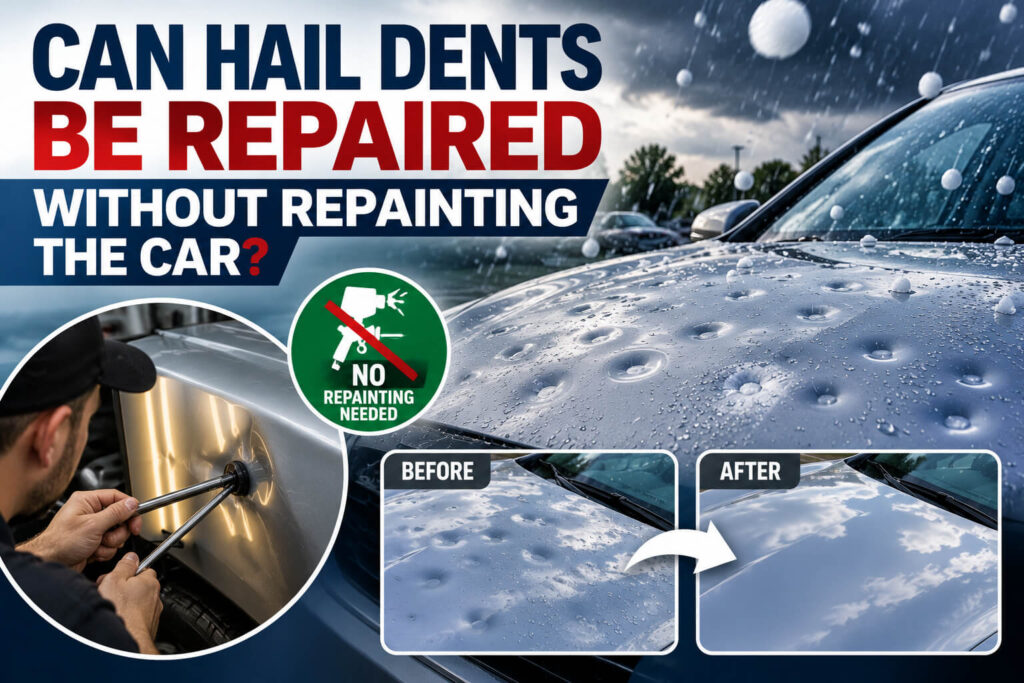
A hailstorm can leave dozens of small dents across a vehicle in just a few minutes. The roof, hood, trunk, doors, fenders, and other exposed panels can all be affected.
But does hail damage mean your car needs to be repainted?
Not necessarily. Many hail dents can be repaired without repainting the vehicle when the original paint is still intact and the metal has not been severely damaged. Paintless dent repair, commonly called PDR, is often used for this type of damage.
PDR allows a technician to carefully reshape the damaged panel while preserving the factory paint finish.
However, not every hail dent qualifies for paintless dent repair. The size and depth of the dents, the condition of the paint, the location of the damage, and the condition of the metal all matter.
If your vehicle has hail damage in Cathedral City, a professional inspection can determine whether PDR or conventional body repair is the better option.
CatCity Auto Body provides dent repair services in Cathedral City for vehicles with hail damage, parking lot dents, collision damage, and other body panel damage.
When Can Hail Dents Be Repaired Without Repainting?
The key factor is the condition of the paint.
If hail creates a dent but does not crack, chip, peel, or break the factory finish, PDR may be possible.
A technician can access the back of the damaged panel and gradually work the metal back into its original shape.
This means the repair can potentially preserve:
- The original factory paint
- The original clear coat
- The original body panel
- The existing color match
- The vehicle’s original finish
This is one reason PDR is commonly considered for hail damage.
The repair does not simply depend on whether a dent looks small. A technician also needs to determine how the metal responded to the impact.
Why Does Hail Damage Work Well for Paintless Dent Repair?
Hail usually creates many small, shallow dents rather than one large collision impact.
That type of damage can be well suited to PDR.
Imagine a vehicle after a moderate hailstorm. The hood may have several small depressions, while the roof and trunk have dozens more.
If the paint remains intact, replacing every affected panel or repainting the entire vehicle may not be necessary.
Instead, a technician may be able to gradually restore the panels while keeping the original finish.
The result can be a cleaner repair with less disruption to the vehicle’s factory paint.
What Does Paintless Dent Repair Do to a Hail Dent?
PDR does not cover the dent with filler or paint.
Instead, the technician works with the existing metal.
Specialized tools are used to apply controlled pressure to the underside of the panel. The technician carefully moves the metal until the dent returns toward its original shape.
This requires patience and precision.
Applying too much pressure in the wrong location can create additional distortion. Professional PDR technicians therefore work gradually, checking the panel from different angles as the repair progresses.
Lighting is also important because subtle changes in the panel surface can be difficult to see under ordinary conditions.
For a more detailed explanation of the technique, see CatCity’s complete guide to paintless dent repair in Cathedral City.
What Hail Damage Can PDR Repair?
PDR can be considered for many types of hail dents.
Common examples include:
Small Round Dents
These are often caused by individual hailstones striking the panel.
Shallow Dents
A shallow depression may be easier to restore when the metal and paint remain intact.
Multiple Small Dents
A vehicle can have numerous hail dents across several panels. PDR can sometimes address multiple areas without repainting each panel.
Dents With Intact Paint
This is one of the most important conditions for PDR.
If the paint remains intact, preserving the original finish may be possible.
When Can Hail Damage Not Be Repaired With PDR?
PDR has limits.
A hail dent may not be a good candidate when the damage has significantly changed the metal or damaged the paint.
Traditional auto body repair may be necessary when you have:
- Cracked paint
- Chipped paint
- Peeling clear coat
- Deep creases
- Torn metal
- Severely stretched metal
- Damage close to difficult panel edges
- Significant deformation
- Existing damage in the same area
In some cases, the panel itself may need to be replaced.
The important point is that PDR is a repair method, not a solution for every type of dent.
A professional assessment should come before deciding how the damage should be repaired.
What If the Hail Dent Has Cracked the Paint?
Cracked paint changes the situation.
When the paint has been broken by the impact, simply reshaping the metal does not restore the entire damaged area.
The repair may require conventional bodywork followed by refinishing.
Depending on the severity, the process can include:
- Repairing the damaged metal
- Preparing the surface
- Applying the appropriate finishing materials
- Priming the repaired area
- Matching the vehicle’s paint
- Applying the finish
- Inspecting the repaired panel
If your hail damage includes cracked or peeling paint, auto painting services may become part of the repair.
Does the Size of the Hailstone Matter?
Yes, but the size of the hailstone is not the only consideration.
Larger hailstones can produce deeper and more severe dents. However, two vehicles exposed to the same storm may have very different levels of damage.
Several factors can influence the result:
- Hailstone size
- Hailstone speed
- Wind conditions
- Impact angle
- Vehicle panel material
- Panel location
- Existing condition of the paint
- Shape and reinforcement of the panel
A hood, for example, may respond differently from a roof or door.
That is why a technician should inspect the actual vehicle rather than estimating the repair method based only on the weather event.
Which Parts of a Car Can Hail Damage?
Hail can affect almost any exposed body panel.
The most common areas include:
Hood
The hood is directly exposed to falling hail and can develop multiple small dents.
Roof
The roof can receive widespread damage during a severe storm.
Trunk
The trunk lid can also collect dents, particularly during storms with large hail.
Doors
Door panels may develop small dents depending on the direction and intensity of the hail.
Fenders
Front and rear fenders can also be affected.
Bumpers
Some hail can damage plastic bumper components, although the repair approach differs from a typical metal body panel.
For significant bumper damage, CatCity also offers bumper and fender repair.
How Do You Know If Your Car Has Hail Damage?
Hail damage is not always obvious from a quick glance.
After a storm, inspect the vehicle in good lighting.
Look for:
- Small circular dents
- Multiple dents across one panel
- Dents on the roof
- Dents on the hood
- Dents on the trunk
- Damaged paint
- Cracked or chipped finish
- Broken exterior trim
- Cracked lights or glass
One useful trick is to look at the reflection of a straight line across the panel.
Small dents can distort the reflection even when the damage is difficult to see directly.
If you suspect hail damage, photograph the vehicle before attempting any repair.
Should You Repair Hail Damage Immediately?
It is a good idea to have significant hail damage inspected rather than ignoring it indefinitely.
The urgency depends on the type of damage.
A small dent with completely intact paint is primarily a cosmetic concern. But if the impact has damaged the paint, exposed the underlying material, cracked a component, or affected other parts of the vehicle, delaying an inspection may create additional problems.
There is also another practical reason to document the damage quickly.
If you plan to file an insurance claim, photographs taken soon after the storm can help establish the condition of the vehicle.
Can You Fix Hail Dents Yourself?
DIY dent repair kits are widely available, but hail damage can be more complicated than one isolated dent.
A vehicle may have dozens of dents spread across several panels.
Attempting to repair them yourself can create additional distortion or damage the paint.
The risk increases when:
- The dent is deep
- The panel has a sharp crease
- The paint is damaged
- The dent is near an edge
- You cannot access the back of the panel
- There are many dents
- The vehicle has aluminum body panels
Hail damage is often better evaluated as a complete repair rather than treating every dent as an individual DIY project.
Does PDR Damage the Original Paint?
When performed correctly on a suitable dent, PDR is designed to preserve the existing paint.
That is one of its major advantages.
Traditional body repair can involve sanding, filler, primer, and refinishing. PDR instead focuses on reshaping the panel while leaving the paint system intact.
Keeping the original finish can also help maintain consistency between repaired and unrepaired areas.
However, if the hail impact has already cracked or chipped the paint, preserving that damaged finish may not be possible.
Is PDR Better Than Traditional Hail Damage Repair?
It depends on the vehicle.
For suitable hail dents, PDR can have several advantages:
- Original paint can often be preserved
- Less body filler may be required
- No traditional repainting may be necessary
- The repair can be less invasive
- Factory finish can be retained
- Multiple small dents can potentially be addressed
Traditional body repair has its own role.
It may be necessary when the paint is damaged, the metal is severely deformed, or the panel cannot be properly restored using PDR.
The right question isn’t simply:
“Is PDR better?”
The better question is:
“Is my hail damage a good candidate for PDR?”
What About Aluminum Body Panels?
Modern vehicles can use aluminum for certain body panels.
Aluminum behaves differently from traditional steel and can require different repair techniques.
That doesn’t automatically mean an aluminum panel cannot be repaired.
However, the technician needs to understand the material and evaluate how the impact has affected it.
If your vehicle has aluminum body panels, mention this when discussing the repair and let the technician determine the appropriate approach.
Can Hail Damage Affect More Than the Body Panels?
Yes.
A severe hailstorm can cause damage beyond small dents.
Depending on the storm, inspect:
- Windshield
- Side glass
- Mirrors
- Headlights
- Tail lights
- Trim
- Roof components
- Sunroof
- Exterior cameras and sensors
If a storm has damaged safety or driver assistance components, the vehicle may need more than cosmetic dent repair.
This is another reason not to judge the severity of hail damage solely by counting visible dents.
What Should You Do After a Hailstorm?
If your vehicle has been exposed to significant hail, start with a basic inspection.
First, photograph the damage
Take clear photos of every affected panel.
Next, check the paint
Look closely for chips, cracks, and peeling.
Then inspect the glass
Look for cracks or chips in the windshield and other windows.
Check lights and mirrors
Make sure they are intact and functioning.
Finally, schedule an inspection
A professional body technician can determine whether the vehicle is a candidate for PDR or requires conventional repair.
Hail Damage Repair and Insurance
If the hailstorm caused significant damage, you may consider contacting your insurance company.
Before starting repairs, check your policy and understand your deductible and claim requirements.
Keep records of:
- Photos of the damage
- Date of the storm
- Repair estimates
- Insurance claim information
- Communications with the insurer
- Repair documentation
Insurance coverage varies, so don’t assume every hail damage situation will be handled the same way.
A body shop can explain the repair side of the process, while your insurance company can explain your specific coverage.
If you need help coordinating accident or insurance related repairs, CatCity also provides insurance claim assistance.
How Much Does Hail Dent Repair Cost?
There is no fixed price for hail damage repair.
The final cost can depend on:
- Number of dents
- Size of the dents
- Depth of the damage
- Number of affected panels
- Paint condition
- Panel material
- Accessibility
- Repair method
- Additional damaged components
A vehicle with ten small dents on one panel is very different from a vehicle with dozens of deep dents across the hood, roof, doors, and trunk.
For more information about dent repair pricing, see How Much Does Car Dent Repair Cost?.
PDR or Repainting? Use This Simple Guide
If you’re trying to figure out what type of repair your car may need, start here:
| Damage condition | Possible repair |
| Small dent, paint intact | Paintless dent repair |
| Several shallow hail dents | PDR may be appropriate |
| Deep dent, paint intact | Professional inspection needed |
| Cracked paint | Traditional repair and refinishing may be needed |
| Peeling or missing paint | Body repair and repainting |
| Severely stretched metal | Traditional repair or panel replacement |
| Torn panel | Panel repair or replacement |
| Damaged bumper | Bumper repair or replacement depending on condition |
This table is only a starting point.
The actual repair method should be determined after inspecting the vehicle.
Why Professional Hail Dent Repair Makes Sense?
Hail damage can look simple because the dents are often small.
The challenge is that there may be many of them.
A technician has to consider the overall condition of each panel and determine whether the metal can be restored without damaging the finish.
Professional repair also helps avoid a common mistake: treating every dent as though it needs the same repair.
One panel might be an excellent candidate for PDR while another panel may require conventional body repair.
The repair plan should follow the condition of the vehicle.
Hail Dent Repair in Cathedral City
Hail damage does not automatically mean your vehicle needs to be repainted.
If the dents are relatively shallow, the metal is suitable for repair, and the original paint remains intact, paintless dent repair may be an effective option for restoring the vehicle without traditional repainting.
When the paint is cracked, the metal is severely deformed, or the panel has suffered extensive damage, conventional auto body repair may be more appropriate.
If your vehicle has hail dents in Cathedral City, start with an inspection rather than guessing which repair method you need.
Frequently Asked Questions
Yes. Many hail dents can be repaired without repainting when the original paint remains intact and the metal can be safely reshaped. Paintless dent repair is commonly used for suitable hail damage.
PDR can be a good option for multiple small or shallow hail dents when the paint is intact and the damaged panels can be accessed properly.
No. Repainting is not automatically necessary. If the original paint is undamaged and the dents are suitable for PDR, the factory finish may be preserved.
Yes. Large or forceful hail can chip, crack, or break the paint. When the finish is damaged, conventional body repair and refinishing may be necessary.
Some deeper dents can be repaired with PDR, but depth alone does not determine whether PDR is appropriate. The technician also needs to evaluate the metal, paint, location, and severity of the damage.
Coverage depends on the vehicle owner’s insurance policy and circumstances. Check your policy or contact your insurance provider to confirm coverage, deductible, and claim requirements.
The timeframe depends heavily on the number and severity of dents and how many panels are affected. A vehicle with widespread hail damage can require substantially more work than one with a few small dents.