
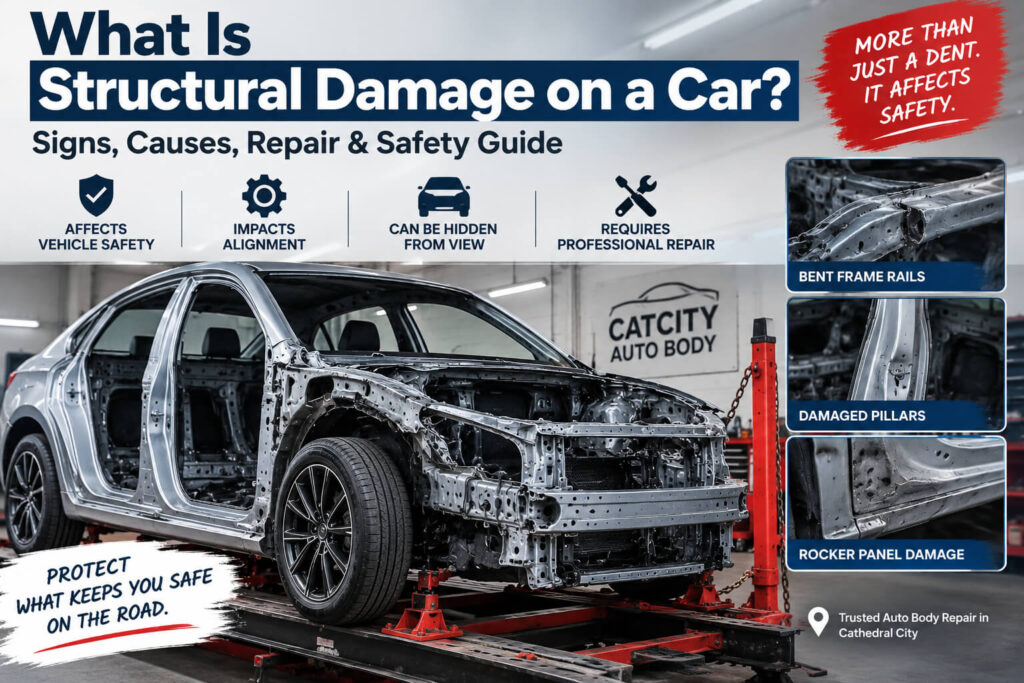
Structural damage on a car means damage to the parts of the vehicle that provide its strength, support, alignment, and crash protection. These components form the underlying structure of the vehicle and are different from cosmetic parts such as paint, trim, or a minor surface dent.
Structural damage can occur when a collision or other major impact bends, crushes, twists, or otherwise changes important structural components.
In modern vehicles, the structure may include parts of the unibody body shell, frame rails, pillars, rocker panels, floor structure, suspension mounting areas, and other reinforced sections.
The important point is that structural damage is not always visible from outside the vehicle. A car may look reasonably normal after an accident while having damage underneath its exterior panels.
For Cathedral City drivers, understanding what structural damage on a car is, how to recognize possible warning signs, and why proper inspection matters can help prevent a minor-looking accident from becoming a larger safety problem.
What Parts of a Car Are Structural?
The exact structural components vary by vehicle design, but important areas can include:
- Front and rear structural rails
- Side rails
- Rocker panels
- A-, B-, and C-pillars
- Floor structure
- Roof structure
- Engine compartment structural areas
- Rear body structure
- Suspension mounting points
- Crossmembers and reinforcements
- Unibody sections
These components work together rather than functioning as isolated pieces.
For example, a collision that damages one part of the structure can sometimes affect the alignment of doors, suspension mounting points, wheels, or other connected components.
What Causes Structural Damage on a Car?
Structural damage most commonly occurs during a significant collision, but several types of impacts can cause it.
1. Front-End Collision
A front-end accident can affect structural rails and supporting areas behind the bumper and front body panels.
Possible damage may involve:
- Front rails
- Engine compartment structure
- Suspension mounting areas
- Front crossmembers
- Reinforcement components
Replacing a bumper or hood does not necessarily mean that everything underneath is undamaged.
2. Side-Impact Collision
A strong impact to the side of a vehicle can affect areas designed to protect the passenger compartment.
Potentially affected components include:
- Door structures
- Rocker panels
- B-pillars
- Side rails
- Floor structure
Side-impact structural damage deserves particular attention because these areas contribute to the vehicle’s occupant protection system.
3. Rear-End Collision
A rear impact can damage more than the bumper cover.
Depending on the severity and location of the impact, it may affect:
- Rear rails
- Trunk floor
- Rear body structure
- Quarter-panel structure
- Crossmembers
A trunk that no longer aligns correctly can sometimes provide an important clue that the collision affected more than the visible exterior.
4. Multiple-Impact Accidents
Structural damage can be more complicated when a vehicle is involved in multiple impacts.
For example, a vehicle could experience a front impact followed by a secondary collision from another direction. In such cases, technicians may need to inspect several structural areas rather than concentrating on one damaged panel.
What Are the Signs of Structural Damage on a Car?
Structural damage can sometimes be difficult to identify without professional equipment. However, several warning signs can indicate that a vehicle needs further inspection.
1. Uneven Panel Gaps
Look at the gaps around the:
- Doors
- Hood
- Trunk
- Fenders
- Quarter panels
If one gap is noticeably different from the corresponding gap on the opposite side, the vehicle may have an alignment issue.
Uneven gaps do not automatically prove structural damage, but they can be a reason to investigate further after an accident.
2. Doors Do Not Close Properly
If a door suddenly becomes difficult to close after a collision, the problem may involve more than the door itself.
Possible causes include:
- Door damage
- Hinge damage
- Body opening misalignment
- Structural movement
A door that requires unusual force to latch should be inspected rather than ignored.
3. The Vehicle Pulls to One Side
A vehicle pulling left or right after an accident can result from several problems, including wheel alignment, suspension damage, or structural misalignment.
If an alignment has been performed but the vehicle continues to behave differently, further inspection may be appropriate.
4. Steering Feels Different
Changes in steering after a collision can be a warning sign.
You may notice:
- Steering wheel no longer sits straight
- Vehicle feels unstable
- Steering response feels different
- Vehicle wanders on the road
These symptoms can have several causes, so they should be properly diagnosed rather than automatically attributed to structural damage.
5. Uneven Tire Wear
If the vehicle develops unusual or uneven tire wear after an accident, the suspension and alignment should be checked.
In some cases, structural misalignment can affect suspension geometry.
However, tire wear can also result from normal alignment or suspension problems, so it is not by itself proof of structural damage.
6. Visible Cracks, Creases, or Wrinkles
Look for unusual deformation around areas such as:
- Door openings
- Pillars
- Floor areas
- Wheel wells
- Structural seams
Wrinkled or folded metal can indicate that significant force was transferred into the vehicle’s structure.
7. New Wind Noise
A vehicle that suddenly develops wind noise after an accident may have:
- Misaligned doors
- Uneven panel gaps
- Damaged seals
- Body deformation
Wind noise alone does not establish structural damage, but it can provide another clue when combined with other post-collision symptoms.
Is Structural Damage the Same as Frame Damage?
Not exactly.
“Structural damage” is a broader term.
A vehicle with a traditional body-on-frame design has a separate frame supporting the body. Damage to that frame is commonly described as frame damage.
Most modern passenger cars and many crossovers use unibody construction, where the body and structural framework are integrated.
That means a vehicle can have structural damage without having a separate traditional frame.
Simple distinction:
Frame damage:
Damage to the separate frame of a body-on-frame vehicle.
Unibody damage:
Damage to the integrated structural body of a unibody vehicle.
Structural damage:
The broader category covering damage to important load-bearing or safety-related vehicle structures.
What Is Unibody Structural Damage?
In a unibody vehicle, the body shell itself performs many structural functions.
Parts such as rails, pillars, rocker panels, floor sections, and reinforced body areas work together to provide strength and occupant protection.
When these areas are bent, crushed, or displaced during a collision, the vehicle may have unibody structural damage.
This is why structural inspection is important even when exterior damage appears relatively limited.
You can learn more about this specific type of damage in our guide:
What Is Unibody Damage? Signs, Causes, Repair Process & Why It Matters
Can Structural Damage Be Repaired?
In many cases, yes. The repairability of structural damage depends on the vehicle, the location and severity of the damage, manufacturer repair procedures, and the condition of the affected components.
A proper structural repair may involve:
- Inspecting the vehicle
- Identifying damaged structural areas
- Measuring the vehicle
- Comparing measurements with appropriate specifications
- Straightening repairable components when permitted
- Replacing components that cannot be safely repaired
- Rechecking measurements
- Completing the remaining collision repairs
The objective is not simply to make the vehicle look straight.
The structural repair needs to restore the vehicle as closely as possible to the appropriate repair specifications.
How Is Structural Damage Diagnosed?
A visual inspection is a useful starting point, but serious structural damage may require more detailed assessment.
A collision repair facility may examine:
- Panel alignment
- Structural mounting points
- Door and trunk openings
- Suspension geometry
- Visible deformation
- Welded and joined areas
- Vehicle measurements
Specialized measuring equipment can help technicians determine whether structural points have moved from their intended positions.
This is particularly important when the vehicle’s exterior damage does not tell the full story.
Can a Car Drive With Structural Damage?
A car may still be able to drive even when it has structural damage. That does not mean it is safe to continue driving normally.
A vehicle can sometimes appear to operate normally after an accident despite having damage that could affect:
- Handling
- Alignment
- Crash performance
- Suspension geometry
- Door or body alignment
- Occupant protection
If a collision was significant, having the vehicle professionally inspected before returning to normal driving is a sensible precaution.
Is Structural Damage Always Visible?
No.
This is one of the most important things to understand about collision damage.
Exterior panels are not always a reliable indicator of what happened underneath them.
For example, a bumper cover may look relatively intact while components behind it have absorbed impact energy.
Likewise, a vehicle may have a noticeable dent but no significant structural damage.
Visible damage and structural damage are not always proportional.
That is why post-accident inspection should consider both the visible exterior and the underlying structure.
Does Structural Damage Total a Car?
Not automatically.
A vehicle is not necessarily considered a total loss simply because structural damage exists.
The decision depends on factors such as:
- Extent of damage
- Repair requirements
- Vehicle value
- Repair costs
- Insurance considerations
- Applicable regulations and procedures
Some structurally damaged vehicles can be properly repaired, while others may not be economically or practically repairable.
An insurance company and qualified repair professionals may be involved in determining the appropriate path.
Does Structural Damage Affect Car Value?
It can.
A vehicle’s accident and repair history may influence how potential buyers, dealerships, and insurers evaluate it.
Structural repairs can be particularly relevant because they involve parts that contribute to the vehicle’s safety and integrity.
Keeping documentation of professional repairs, measurements, replaced components, and related work can be useful for maintaining a clear repair history.
Structural Damage vs. Cosmetic Damage
Understanding the difference helps explain why some accidents require more extensive repairs than others.
| Cosmetic Damage | Structural Damage |
| Scratches | Bent structural components |
| Paint damage | Damaged rails |
| Minor surface dents | Damaged pillars |
| Clear-coat damage | Distorted body structure |
| Small cosmetic imperfections | Damaged mounting points |
| Primarily affects appearance | Can affect safety and vehicle integrity |
A vehicle can have both types of damage after the same collision.
What Should You Do If You Suspect Structural Damage?
If your vehicle has been involved in a significant accident, consider these steps:
1. Don’t judge the damage only by appearance
A vehicle can look better than it actually is.
2. Pay attention to changes in driving behavior
Notice pulling, steering changes, unusual vibrations, or new noises.
3. Check doors, hood, and trunk alignment
Difficulty closing these components can indicate an alignment issue.
4. Have the vehicle professionally inspected
A proper inspection can help determine whether the damage is cosmetic, mechanical, structural, or a combination.
5. Follow manufacturer repair procedures
Structural components are part of the vehicle’s safety design, so repairs should follow appropriate repair information and procedures.
Structural Damage Repair in Cathedral City
If your vehicle has suffered a collision in Cathedral City, determining whether the damage is cosmetic or structural is an important part of the repair process.
CatCity Auto Body can inspect collision damage and help identify body, structural, and related repair needs. A professional assessment can help determine what was damaged and what type of repair may be required.
Structural damage should not be evaluated solely by how the vehicle looks from the outside. If you notice uneven panel gaps, doors that no longer close correctly, changes in handling, or other unusual symptoms after an accident, arrange an inspection.
For related information, see:
- Frame Damage vs. Body Damage: What Cathedral City Drivers Need to Know
- When Does a Car Need Frame Straightening?
- How to Tell If Your Car Has Hidden Damage After an Accident
Frequently Asked Questions
Structural damage is damage to important load-bearing or reinforced parts of a vehicle that contribute to its strength, alignment, and crash protection.
The most common cause is a significant collision, including front-end, rear-end, side-impact, and multiple-impact accidents.
Warning signs can include uneven panel gaps, doors that do not close correctly, changes in steering or handling, unusual tire wear, visible structural creases, and new noises after an accident. These signs do not prove structural damage by themselves and should be professionally evaluated.
Many types of structural damage can be repaired, depending on the vehicle, damage severity, location, and applicable manufacturer repair procedures.
No. Frame damage generally refers to damage to a separate vehicle frame, while structural damage is a broader term that can include damage to a unibody structure.
A structurally damaged vehicle may still be able to move, but driving it does not mean it is safe. Significant collision damage should be professionally inspected before normal use.
Final Takeaway
Structural damage on a car affects the vehicle’s underlying strength, alignment, and safety structure—not simply its appearance.
After an accident, signs such as uneven panel gaps, doors that no longer close correctly, steering changes, unusual tire wear, or visible structural deformation should not be ignored.
Because structural damage can be hidden beneath exterior panels, a professional inspection is the best way to determine whether a vehicle has suffered structural damage and what repairs may be appropriate.
For Cathedral City drivers, identifying and addressing structural damage properly can help protect the vehicle’s safety, performance, and long-term value.