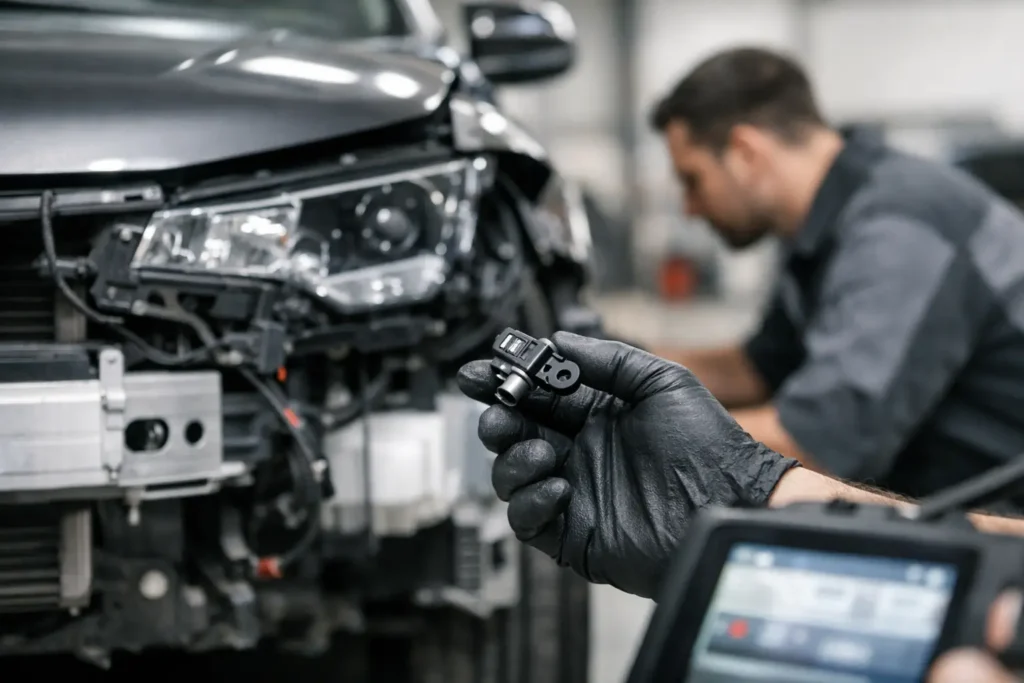
A bumper can look nearly normal after a low-speed parking lot impact, yet the collision sensors behind it may no longer be positioned or operating as intended. Modern vehicles rely on these components to support features such as forward collision warnings, automatic emergency braking, parking assistance, blind-spot alerts, and airbag deployment. That is why a proper post-accident inspection should look beyond paint scratches and visible dents.
For drivers in Cathedral City and throughout the Coachella Valley, understanding what sensors do can make the repair process less stressful. The goal is not simply to make a vehicle look good again. It is to restore the systems that help protect you, your passengers, and others on the road.
What Collision Sensors Do
The phrase collision sensors can describe several different components, depending on the vehicle. Some sensors are designed to detect an impact and help determine whether airbags or seat-belt pretensioners should deploy. Others support driver-assistance systems, often called ADAS, by monitoring the space around the vehicle.
A front-facing camera near the windshield may read lane markings and vehicles ahead. Radar units may be mounted behind the front grille, bumper cover, or rear bumper to monitor traffic, detect objects, or support adaptive cruise control. Ultrasonic parking sensors are commonly installed in bumpers, while blind-spot systems may use radar sensors located behind rear bumper areas.
These parts work with control modules, wiring, brackets, and vehicle software. Even when a sensor itself has not cracked or failed, its angle, mounting position, or communication with the vehicle can be affected by a collision repair.
Why Minor Damage Can Require Major Attention
It is easy to assume that a minor bumper dent is strictly cosmetic. On older vehicles, that may sometimes be true. On many newer cars, however, the bumper is also a mounting location for safety-related equipment.
A small impact can bend a sensor bracket, damage a connector, loosen a mounting point, or alter the shape of the bumper cover in the sensor’s field of view. Paint materials can matter as well. Certain radar systems are designed to function through specific bumper materials and paint thicknesses. Using an incorrect repair method or improper refinishing materials can interfere with performance.
Windshield damage creates another common concern. If a vehicle’s forward camera is mounted near the windshield and the glass must be replaced after an accident, calibration may be required. A camera that is slightly out of alignment can affect how lane-keeping or collision-warning features interpret the road ahead.
This does not mean every dent automatically calls for sensor replacement. The correct repair depends on the vehicle, the location and severity of damage, diagnostic results, and manufacturer repair procedures. What it does mean is that visual appearance alone is not enough to clear a vehicle for safe return to the road.
Warning Lights Are Not the Only Sign
A warning message on the dashboard is a clear reason to schedule an inspection, especially if it mentions airbags, parking assist, automatic braking, radar, or a camera system. But an absence of warning lights should not be treated as proof that every system is working correctly.
Some issues are intermittent. A damaged connector may lose contact over bumps. A sensor may operate but provide inaccurate readings because it is misaligned. A vehicle may also need a calibration procedure after certain repairs, replacements, suspension work, wheel alignment, or structural measurements, even when no dashboard warning is present.
Pay attention if you notice parking alerts behaving inconsistently, a blind-spot indicator failing to activate, unexpected warnings, a camera image that seems obstructed, or driver-assistance features that have been disabled. Avoid relying on those functions until the vehicle has been professionally inspected.
Inspection, Repair, and Calibration Are Different Steps
A quality collision repair process treats diagnosis, physical repair, and calibration as related but distinct tasks. Skipping one step can leave an issue unresolved.
First, technicians inspect visible damage and scan the vehicle for diagnostic trouble codes. A scan can identify communication faults and stored information from the collision, but it does not replace a physical inspection. Wiring, harnesses, mounts, bumper reinforcements, and related components must also be checked.
Next comes the body repair itself. This may include bumper repair or replacement, frame and structural measurement, panel alignment, connector repair, or replacement of damaged sensor components. Repairing the vehicle to manufacturer specifications matters because sensor placement is often highly exact.
Finally, the vehicle may require calibration. Static calibration is performed in a controlled setting with targets, precise measurements, and specialized equipment. Dynamic calibration requires a road test under specified conditions, allowing the system to relearn or verify its operating position. Some vehicles need one method, while others require both.
Calibration is not a generic reset button. Requirements differ by make, model, year, installed options, and repair performed. Qualified technicians follow the appropriate procedures rather than assuming that clearing a warning light is the same as confirming proper function.
Why Low-Cost Shortcuts Can Cost More Later
After an accident, it is understandable to focus on getting back on the road quickly and controlling expenses. However, a quote that addresses only visible body damage may not include every required diagnostic, repair, or calibration operation. The lowest initial estimate is not always the most complete estimate.
For example, an aftermarket bumper cover may fit physically but may not meet the specifications needed for a particular sensor system. Reusing a damaged sensor bracket, painting over a sensor without following the correct process, or ignoring required calibration can create problems that appear later. In some cases, the vehicle may disable an advanced safety feature. In others, the feature may behave unpredictably.
A transparent repair facility should explain what has been found, what procedures are recommended, and why those procedures apply to your vehicle. If additional damage is discovered after disassembly, you should receive a clear update rather than a surprise at pickup.
Questions to Ask After a Collision
You do not need to be an automotive expert to advocate for a safe repair. When discussing your estimate, ask whether the impact area contains cameras, radar, parking sensors, or airbag-related components. Ask whether the vehicle will receive diagnostic scans and whether any calibrations are required after the planned repairs.
It is also reasonable to ask how sensor-related repairs will be documented. A detailed final invoice or repair record can be useful for your files, insurance claim, and future vehicle service. If a warning light remains on after repairs, or a safety feature does not work normally, bring it to the shop’s attention immediately.
Insurance claims can add another layer of uncertainty. Collision-related sensor work is often part of returning a damaged vehicle to pre-accident condition, but coverage and authorization depend on the details of the claim and the documented repair needs. A shop that coordinates directly with insurers can help clarify necessary supplements and keep communication moving.
A Safer Return to the Road Starts With the Right Repair
Modern safety technology has changed what a complete collision repair looks like. Paint matching, dent removal, and panel alignment still matter, but so do the systems concealed behind those finished surfaces. Certified technicians must evaluate the full repair picture, especially when a vehicle has been hit in the bumper, grille, windshield, side panel, or structural areas.
At CatCity Auto Body, every repair receives careful attention, from minor bumper damage to major collision work. If your vehicle has been in an accident in Cathedral City or the surrounding Coachella Valley, request a free estimate and ask for a clear explanation of any sensor inspection or calibration your vehicle may need. That conversation can provide the confidence to drive away knowing the repair addressed more than what you can see.