A car can look fine after an accident and still have damage underneath the surface.
Bumpers, body panels, and paint may hide damage to suspension components, mounting points, structural sections, wiring, sensors, or other parts that are not visible during a quick inspection.
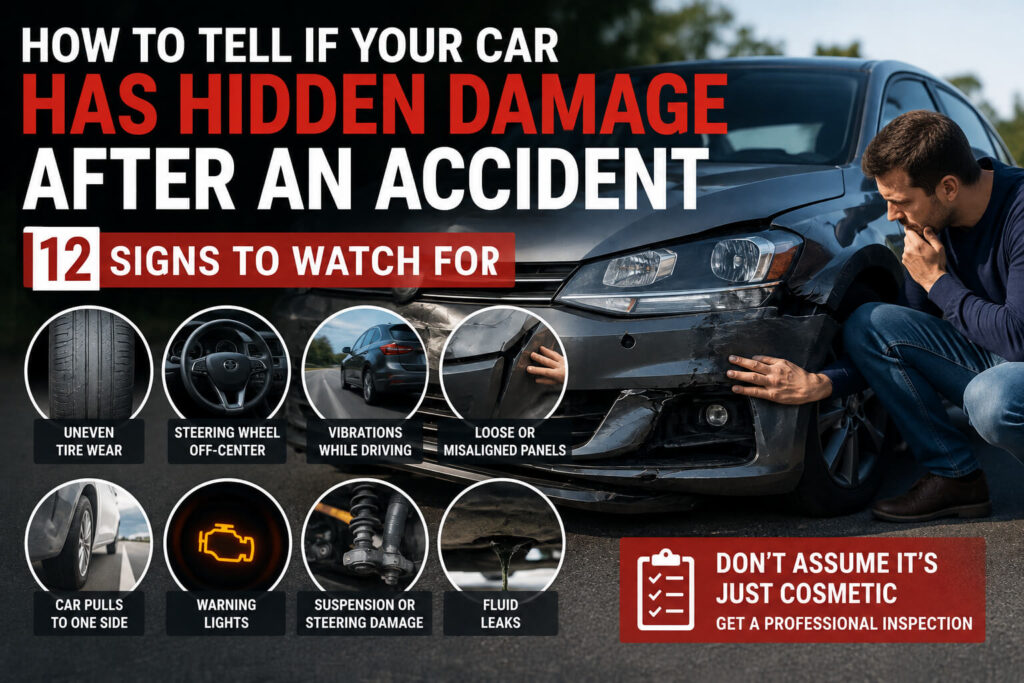
The most common signs of hidden car damage after an accident include pulling to one side, an off-center steering wheel, unusual vibrations, uneven tire wear, loose body panels, new noises, fluid leaks, warning lights, and alignment problems.
Even a low-speed collision can create problems that are not obvious from the outside.
For example, a bumper may only show a small crack, but the impact could have affected the reinforcement behind it. A vehicle that looks straight may also have a bent suspension component or shifted mounting point.
That’s why an accident-damaged vehicle should be properly inspected before you assume it is safe or fully repaired.
If you’re in Cathedral City and notice unusual handling or other symptoms after a crash, CatCity Auto Body provides collision repair and related inspection and repair services.
Can a Car Look Fine but Still Have Hidden Damage?
Yes. A vehicle can have significant internal or structural damage even when the exterior looks relatively normal.
Modern vehicles are built with multiple layers of body panels, reinforcements, brackets, sensors, wiring, and structural components.
An impact can transfer energy from the outer body panel into these components.
Hidden damage can involve:
- Suspension components
- Steering components
- Bumper reinforcements
- Energy absorbers
- Mounting brackets
- Frame or unibody sections
- Subframes
- Wiring
- Parking sensors
- Radar sensors
- Headlight mounting points
- Cooling components
- Wheel and tire assemblies
Some damage becomes visible only after a technician removes the bumper, fender, trim, or other exterior components.
That is why a professional collision damage inspection is more reliable than judging the vehicle based only on how it looks.
12 Signs of Hidden Damage After a Car Accident
1. Your Car Pulls to One Side
One of the biggest warning signs after an accident is a vehicle that suddenly pulls left or right.
If the car tracked straight before the accident but now requires constant steering correction, something may have changed.
Possible causes include:
- Bent suspension components
- Damaged steering parts
- Wheel damage
- Tire damage
- Incorrect wheel alignment
- Shifted suspension mounting points
- Structural damage
A slight drift can sometimes be caused by road crown or tire characteristics.
However, a strong or consistent pull that started after a collision deserves attention.
If the vehicle pulls on different roads or continues pulling after a proper alignment, the shop may need to investigate suspension and structural components rather than simply performing another alignment.
2. The Steering Wheel Is No Longer Straight
An off-center steering wheel is another common post-accident warning sign.
For example, you may be driving straight, but the steering wheel sits noticeably turned to the left or right.
This can happen because of:
- Changed toe settings
- Bent tie rods
- Suspension damage
- Steering component damage
- Rear thrust-angle problems
- Subframe movement
- Structural damage
An off-center wheel does not automatically mean the frame is bent.
However, if the problem appeared immediately after an accident, it should be inspected rather than ignored.
A proper four-wheel alignment and suspension inspection can help determine what changed.
3. Your Car Vibrates While Driving
New vibration after a collision should not be dismissed as normal.
Depending on when the vibration occurs, possible causes include:
- Bent wheel
- Damaged tire
- Suspension damage
- Wheel imbalance
- Bent axle component
- Hub or bearing damage
- Steering component problems
Pay attention to when you feel the vibration.
Vibration at low speeds
This may point toward wheel, tire, or mechanical damage.
Vibration at highway speeds
A bent wheel, tire problem, imbalance, or suspension issue may be involved.
Vibration during braking
Brake components or suspension movement may need inspection.
A technician should determine the source instead of simply balancing the wheels and sending the vehicle back out.
4. Your Tires Are Wearing Unevenly
Uneven tire wear after an accident is an important warning sign.
Look for:
- One tire wearing faster than the others
- Inner-edge wear
- Outer-edge wear
- Feathering
- Cupping
- Uneven tread patterns
Alignment problems can cause abnormal tire wear, but alignment problems can themselves be caused by damaged suspension or structural components.
For example, a bent control arm may change wheel geometry.
If a technician simply adjusts the alignment without identifying the damaged component, the tires may continue wearing incorrectly.
That’s why persistent tire wear after an accident should be investigated at the component level.
5. Your Bumper Is Loose or Doesn’t Sit Correctly
A bumper that appears slightly loose after an accident may have more damage behind it than you can see.
The bumper area can contain:
- Reinforcement bars
- Energy absorbers
- Mounting brackets
- Parking sensors
- Radar sensors
- Wiring
- Fasteners
Possible signs of concealed bumper damage include:
- Uneven bumper gaps
- Bumper pulling away from the body
- Broken clips
- Cracks around mounting points
- Sensors sitting unevenly
- Bumper movement when lightly touched
A bumper cover can sometimes be repaired, but damage to the reinforcement or mounting structure requires a more thorough inspection.
CatCity’s bumper and fender repair service is appropriate for accident-related bumper and fender damage.
6. You Notice New Noises After the Accident
New sounds are another clue that something may have changed.
Listen for:
- Clunking
- Rattling
- Scraping
- Clicking
- Humming
- Squeaking
- Grinding
The location and timing of the noise can help identify the problem.
For example:
A clunk while turning could involve suspension or steering components.
A scraping noise near a wheel could indicate damage around the tire, wheel, brake, or wheel liner.
A rattle behind the bumper could indicate loose or damaged components.
Don’t assume a new noise will disappear on its own.
A collision can loosen fasteners or damage components that become more noticeable as the vehicle moves.
7. Your Doors, Hood, or Trunk Do Not Line Up Correctly
Panel gaps can provide clues about accident damage.
After a collision, check whether:
- The hood sits unevenly
- The trunk does not close normally
- A door requires extra force to close
- Door gaps are wider on one side
- The fender does not line up with the door
- The bumper does not meet adjacent panels evenly
A small cosmetic gap does not necessarily mean structural damage.
However, major or sudden changes in panel alignment can indicate that mounting points or structural sections have moved.
This is especially important when the vehicle has experienced a significant impact.
8. The Vehicle Handles Differently
Sometimes the biggest warning sign is simply that the car doesn’t feel the way it did before the accident.
You may notice:
- Steering feels heavier
- Steering feels loose
- The vehicle wanders
- The car feels unstable during lane changes
- The vehicle leans differently
- Braking feels unusual
- The car does not track straight
- The suspension feels harder or softer on one side
These symptoms can involve suspension, steering, tires, brakes, alignment, or structural components.
If the vehicle’s handling changed immediately after a crash, it’s worth having the entire affected area inspected.
9. Warning Lights Appear on the Dashboard
Some collision damage is electronic rather than purely physical.
A crash can affect:
- Airbag systems
- ABS
- Stability control
- Steering systems
- Parking sensors
- Driver-assistance systems
- Other vehicle control modules
Warning lights should never be ignored after an accident.
Even when the vehicle drives normally, a warning light may indicate a system that needs diagnosis.
A professional collision repair facility can use diagnostic scanning to identify stored fault codes and determine whether additional inspection or repair is required.
10. Parking Sensors or Driver-Assistance Features Behave Differently
A bumper can sustain a relatively minor impact while affecting the technology mounted around it.
Depending on the vehicle, the affected systems may include:
- Parking sensors
- Blind-spot monitoring
- Rear cross-traffic alert
- Forward collision warning
- Automatic emergency braking
- Adaptive cruise control
- Lane-assistance systems
You may notice:
- False sensor warnings
- Sensors not detecting objects
- Warning messages
- Systems becoming unavailable
- Unexpected braking
- Driver-assistance features behaving differently
A sensor doesn’t always need to be visibly broken to be affected.
Its mounting position can change during a collision, which may affect how the system operates.
The repair shop should follow the vehicle manufacturer’s procedures to determine whether scanning, aiming, or calibration is necessary.
11. You Notice Fluid Leaks
Fluid underneath the vehicle after an accident deserves attention.
Depending on the vehicle and location, a leak could involve:
- Engine coolant
- Washer fluid
- Brake fluid
- Transmission fluid
- Engine oil
- Power-steering fluid on applicable vehicles
- Air-conditioning refrigerant
Not every liquid under a car is evidence of collision damage. For example, water from the air-conditioning system can be normal.
However, an unfamiliar fluid leak that appeared after an accident should be inspected.
A front-end impact can damage cooling components, hoses, lines, or reservoirs that may not be obvious from outside.
12. The Vehicle Cannot Be Properly Aligned
Sometimes the strongest evidence of hidden collision damage appears during an alignment.
A vehicle may have difficulty reaching manufacturer specifications because a component or mounting point has been damaged.
Potential causes include:
- Bent control arms
- Damaged steering knuckles
- Bent tie rods
- Shifted subframe
- Damaged suspension mounting points
- Structural misalignment
A vehicle that continues pulling after an alignment may require a deeper inspection.
CatCity’s frame-straightening service can be relevant when accident damage may have affected the vehicle’s structure or suspension mounting points.
Where Is Hidden Collision Damage Usually Found?
Hidden damage can occur in many areas of the vehicle.
Behind the Bumper
A bumper cover may hide:
- Reinforcement
- Energy absorber
- Brackets
- Wiring
- Sensors
Behind the Fender
An impact may affect:
- Inner fender areas
- Suspension components
- Mounting brackets
- Wheel liners
- Nearby structural sections
Under the Vehicle
A collision can affect:
- Suspension
- Steering
- Subframes
- Exhaust components
- Underbody structure
- Fuel or fluid lines
Inside the Vehicle Structure
More significant impacts can affect:
- Frame rails
- Aprons
- Rocker areas
- Floor sections
- Suspension mounting points
- Other unibody structural areas
The exact areas requiring inspection depend on where and how the vehicle was hit.
Can a Bumper Hide Serious Damage?
Yes.
The visible bumper cover is only one part of the bumper assembly.
Behind it may be components designed to absorb or manage crash energy.
An impact can damage these components without making the bumper cover look severely damaged.
This is particularly important when the vehicle has:
- Parking sensors
- Radar
- Advanced driver-assistance systems
- Complex bumper brackets
A professional inspection should determine whether the bumper can be safely repaired or needs replacement.
Can a Minor Accident Cause Frame Damage?
Yes, although not every minor accident causes structural damage.
The possibility depends on factors such as:
- Impact location
- Impact direction
- Vehicle construction
- Collision speed
- What the vehicle struck
- Whether the wheel or suspension was involved
A vehicle does not need to look severely crushed for a structural component or mounting point to move.
Possible signs include:
- Persistent pulling
- Abnormal alignment readings
- Uneven panel gaps
- Wheel position changes
- Steering problems
- Uneven tire wear
When these symptoms appear, structural measurement can help determine whether the vehicle’s dimensions remain within specification.
How Do Body Shops Find Hidden Damage?
Finding hidden collision damage usually involves more than looking at the exterior.
A professional inspection may include several steps.
Visual Inspection
The technician examines:
- Panel gaps
- Paint damage
- Bumper position
- Wheel position
- Tires
- Suspension
- Visible structural areas
Diagnostic Scanning
Electronic systems may be scanned for stored fault codes.
This is especially important when warning lights or safety-system issues appear.
Disassembly
The shop may remove damaged exterior components to inspect what is underneath.
This can reveal damage that could not be seen during the original inspection.
Suspension and Steering Inspection
Technicians inspect components such as:
- Control arms
- Tie rods
- Steering knuckles
- Struts
- Ball joints
- Hubs
- Bearings
Wheel Alignment
Alignment measurements can identify changes in wheel geometry.
However, alignment readings should be interpreted together with the physical inspection.
Structural Measurement
If structural damage is suspected, the vehicle may be measured against manufacturer specifications.
This helps determine whether structural points have moved.
Why a Visual Inspection Is Not Always Enough
A visual inspection is useful, but it has limitations.
For example, you may see a bumper with a small dent and assume that is the entire problem.
A technician may remove the bumper and find a damaged reinforcement or sensor bracket.
Likewise, a car may appear straight while having a suspension component that is slightly bent.
That’s why professional collision repair involves looking beyond the exterior appearance.
Is It Safe to Drive a Car With Hidden Damage?
It depends on the type and severity of the damage.
A cosmetic scratch is very different from:
- Loose steering
- Damaged suspension
- Brake problems
- Severe tire damage
- Structural damage
- Fluid leaks
- Airbag-system faults
If the vehicle has serious handling problems, warning lights, visible mechanical damage, or a damaged tire, avoid unnecessary driving until it can be inspected.
If you’re unsure whether the vehicle is safe, have a qualified professional evaluate it rather than trying to diagnose structural or mechanical damage yourself.
Should You Get Your Car Inspected After a Minor Accident?
It’s a good idea when there is any reason to suspect more than cosmetic damage.
An inspection becomes especially important when:
- A wheel was hit
- The bumper was pushed in
- The vehicle pulls afterward
- The steering wheel is crooked
- New noises appear
- A warning light comes on
- A tire was damaged
- The impact was strong enough to move the vehicle
- You see unusual panel gaps
A professional inspection can help determine whether the vehicle needs simple cosmetic repair or more extensive collision work.
Hidden Damage vs. Cosmetic Damage
Understanding the difference can help you decide how seriously to treat an accident.
Cosmetic damage
Usually affects appearance:
- Scratches
- Minor paint transfer
- Small dents
- Clear-coat damage
- Surface scuffs
Potential hidden damage
May affect vehicle function or safety:
- Bent suspension
- Steering damage
- Structural movement
- Damaged reinforcement
- Sensor problems
- Wiring damage
- Cooling-system damage
The two categories can occur together.
A vehicle may have a large cosmetic scratch with no structural damage, or a relatively small-looking exterior impact with significant hidden damage.
What Should You Do If You Suspect Hidden Damage?
Don’t assume that another alignment or a quick visual inspection will solve the problem.
Instead:
- Stop ignoring new symptoms.
- Document the vehicle’s condition with photos.
- Note when each symptom started.
- Have the tires and wheels inspected.
- Have steering and suspension components checked.
- Ask whether diagnostic scanning is necessary.
- Ask whether structural measurement is appropriate.
- Have damaged bumpers and panels inspected behind the exterior surface.
If the accident involved significant impact, choosing a collision repair facility capable of handling both body and structural damage can make the process easier.
Hidden Collision Damage Inspection in Cathedral City
If your vehicle looks fine after an accident but doesn’t drive the same, don’t assume the problem is only cosmetic.
Symptoms such as pulling, vibration, uneven tire wear, new noises, loose bumpers, warning lights, or an off-center steering wheel can indicate damage that isn’t immediately visible.
CatCity Auto Body provides collision-related services in Cathedral City, including:
If the damage is more than cosmetic, a complete inspection can help identify whether the problem involves the body, suspension, steering, structure, wheels, or electronic systems.
For collision repair assistance in Cathedral City, contact CatCity Auto Body at 760-324-7117.
Frequently Asked Questions
Yes. Collision forces can damage suspension, steering, structural components, wiring, sensors, bumper reinforcements, and other parts that may not be visible from outside.
Common warning signs include pulling to one side, an off-center steering wheel, unusual vibrations, uneven tire wear, new noises, loose bumpers, fluid leaks, warning lights, and changes in vehicle handling.
Yes. Even a relatively low-speed impact can damage a wheel, tire, suspension component, bumper reinforcement, bracket, or sensor depending on where the vehicle was hit.
Yes. The bumper cover can conceal reinforcements, energy absorbers, brackets, wiring, and sensors.
Not necessarily. An off-center steering wheel can result from alignment, steering, suspension, or rear thrust-angle problems. Structural damage is one possibility that should be investigated when the symptom follows an accident.
Yes. Suspension damage, steering problems, incorrect wheel geometry, shifted mounting points, tire damage, and structural misalignment can cause a vehicle to pull.