If you’ve ever been in a car accident — even a minor one — you’ve probably heard your mechanic or body shop technician mention something about the frame or structure of your vehicle. What they’re likely referring to is your car’s unibody construction, a foundational engineering concept that directly impacts how your vehicle is repaired after a collision.
Understanding what unibody construction is, how it works, and why it matters for auto body repair techniques can help you make smarter decisions when your vehicle needs structural work. Whether you’re dealing with a fender bender or significant collision damage, knowing the basics puts you in a better position as a car owner.
What Is Unibody Construction?
Decades ago, most vehicles were built using a body-on-frame design — essentially a separate rigid frame (the chassis) onto which the vehicle’s body was bolted. This design was strong and durable, and it’s still used today in trucks and heavy-duty SUVs.
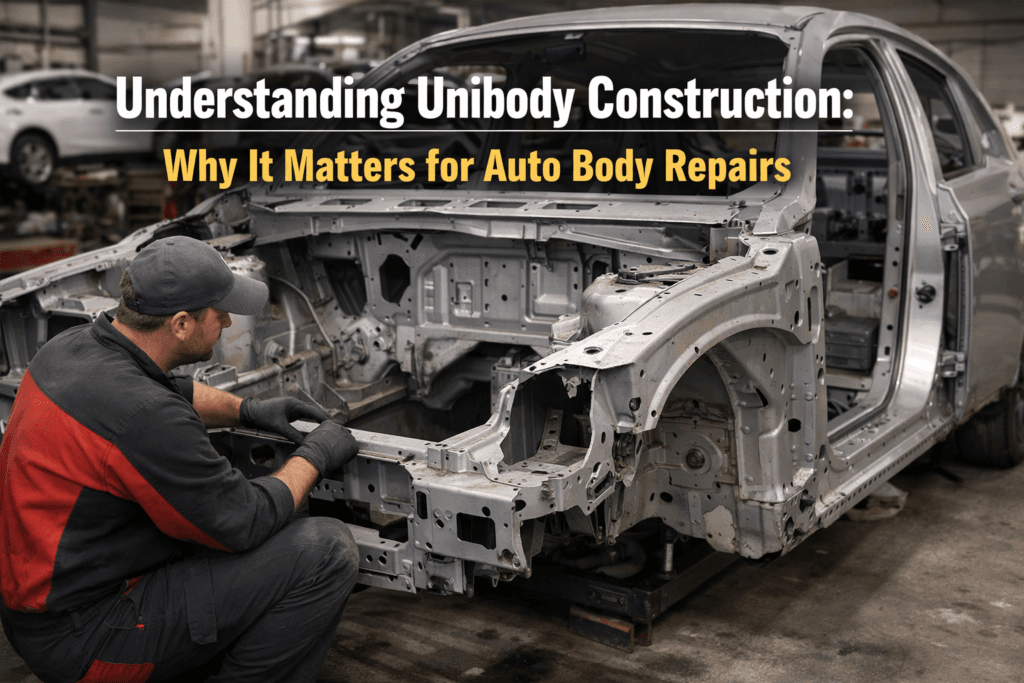
However, the majority of modern passenger cars, crossovers, and many SUVs are built using unibody construction — short for “unitized body.” In this design, the body and the frame are engineered and manufactured as a single integrated structure. There is no separate chassis underneath; instead, the floor pan, pillars, roof rails, and body panels are all welded together to form one continuous, load-bearing unit.
This integrated approach offers several advantages: unibody vehicles are significantly lighter than their body-on-frame counterparts, which improves fuel efficiency. They also tend to have better handling and a lower center of gravity. But perhaps most importantly from a safety standpoint, unibody vehicles are specifically engineered to absorb and redirect crash energy through crumple zones — strategically weakened areas designed to collapse in a controlled manner during a collision, protecting the passenger cabin.
Why Unibody Construction Complicates Auto Body Repairs
While unibody construction is excellent for everyday performance and crash safety, it introduces significant complexity when it comes to vehicle frame repair after an accident.
In a body-on-frame vehicle, damage to the body panels can often be addressed independently of the frame. But in a unibody vehicle, even a moderate collision can send stress and damage rippling through the entire integrated structure — areas that look undamaged on the surface may have experienced subtle but critical deformation.
This is why auto body repair techniques for unibody vehicles require a higher level of skill, specialized equipment, and technical knowledge than many people realize.
1. Damage Is Not Always Visible
One of the most important things to understand about unibody collision damage is that it often hides beneath the surface. A vehicle may look relatively fine cosmetically — a dented bumper, a scraped quarter panel — while the underlying structure has been bent, twisted, or stressed in ways that compromise its integrity.
This is why a thorough post-collision inspection by a certified technician is absolutely essential. Skilled body shop professionals use computerized measuring systems to map out the vehicle’s structural dimensions and compare them against manufacturer specifications. Even millimeter-level deviations in the frame geometry can affect wheel alignment, suspension performance, and — critically — how the vehicle behaves in a future crash.
2. Vehicle Frame Repair Requires Specialized Equipment
Repairing a damaged unibody structure isn’t something that can be done with basic tools. Certified auto body shops use frame straightening equipment — large hydraulic machines that apply precise, measured force to pull or push the unibody structure back into its correct geometry.
This process, often called pulling, must be done carefully and incrementally. Technicians use computerized measuring systems simultaneously during the pull to ensure the vehicle is being brought back to exact factory specifications — not just “close enough.” Improper repairs that leave the frame even slightly out of alignment can create long-term problems with tire wear, handling, and crash performance.
3. Sectioning and Replacement Panels
In cases of severe unibody damage, straightening alone may not be sufficient. Certain sections of the structure may need to be cut out and replaced with new steel. This process — called sectioning — must follow manufacturer-approved procedures precisely. Cutting and welding in the wrong location can weaken structural zones that are critical to the vehicle’s crash protection system.
This is why it matters enormously that the auto body shop you choose employs technicians trained in manufacturer-specific repair procedures. Guesswork in unibody repair isn’t just poor workmanship — it can be a safety hazard.
4. Advanced Driver Assistance Systems (ADAS) Calibration
Modern unibody vehicles are equipped with increasingly sophisticated safety technologies — lane departure warning, automatic emergency braking, blind spot monitoring, and more. Many of these systems rely on sensors and cameras that are mounted within or around the vehicle’s structural components.
After any significant collision and structural repair, these systems must be recalibrated to ensure they function correctly. A vehicle that handles poorly or whose sensors are misaligned after a repair may not protect you the way it was designed to in a future accident.
What to Look for in a Shop That Handles Unibody Repairs
Not every auto body shop is equipped — or qualified — to properly handle unibody vehicle frame repair. Here’s what separates a capable, trustworthy shop from one that might cut corners:
I-CAR Gold Class Certification: The Inter-Industry Conference on Auto Collision Repair (I-CAR) offers a Gold Class designation to shops whose technicians complete ongoing training in the latest repair techniques, including unibody repair. Fewer than 10% of collision repair facilities in the country hold this certification — it’s a strong signal that a shop takes structural repair seriously.
Computerized Measuring Equipment: Any shop claiming to perform proper unibody repairs should have modern computerized measuring systems on-site. Without this equipment, there is no reliable way to verify that a vehicle’s structure has been returned to factory specifications.
OEM Repair Procedures: Reputable shops follow the original equipment manufacturer’s published repair procedures — not generic industry shortcuts. This is especially critical for sectioning, welding, and ADAS recalibration.
Transparency and Documentation: A trustworthy shop will walk you through what structural damage was found, what repairs were performed, and provide documentation of before-and-after measurements. If a shop can’t explain what they did to your vehicle’s structure, that’s a red flag.
Don’t Underestimate Structural Damage
One of the most common mistakes car owners make after an accident is focusing only on cosmetic damage — the dents, the scratched paint, the broken taillights. These are visible, and they’re what everyone sees. But it’s the structural integrity of your vehicle that determines how well it protects you when it matters most.
A car that looks perfect on the outside but has an improperly repaired unibody structure is, in a very real sense, less safe than it was before the accident. The crumple zones that were engineered to protect you may no longer function as designed. The suspension geometry may be off in ways that affect braking and handling. The ADAS systems that could prevent a future accident may not be working correctly.
This is why choosing the right auto body shop for unibody repairs — one with the training, tools, and commitment to do the job properly — isn’t just about getting your car looking good. It’s about getting your car back to being safe.
Trust CatCity Auto Body for Unibody Repair in Cathedral City
At CatCity Auto Body, Inc., we understand that unibody construction repairs demand precision, expertise, and the right equipment. Our I-CAR Gold Class certified technicians are trained in the latest auto body repair techniques and follow OEM-approved procedures on every structural repair we perform. We use computerized measuring systems to verify that every vehicle we repair meets factory specifications — not just visually, but structurally.
If your vehicle has been in a collision, don’t leave its safety to chance. Call us at 760-324-7117 to schedule a free estimate, and let our team assess the full scope of the damage — visible and structural alike. Serving Cathedral City and the greater Coachella Valley, we’re here to get your vehicle back on the road safely and correctly.
CatCity Auto Body, Inc. — Cathedral City’s trusted collision repair experts for over 20 years.