When your vehicle comes out of a collision repair shop, it should drive, handle, and protect you exactly the way it did before the accident. But how does a technician know — with absolute certainty — that your car’s structure has been restored to factory specifications? The answer, in a modern, reputable auto body shop, is laser measuring.
Laser measuring technology has fundamentally transformed the way collision repair professionals assess and correct structural damage. It eliminates guesswork, enables precision that the human eye simply cannot match, and ensures that every repair meets the exact dimensional standards set by the vehicle’s manufacturer. If you’ve never heard of it, or wondered why it matters to you as a car owner, this guide breaks it all down.
What Is Laser Measuring in Auto Body Repair?
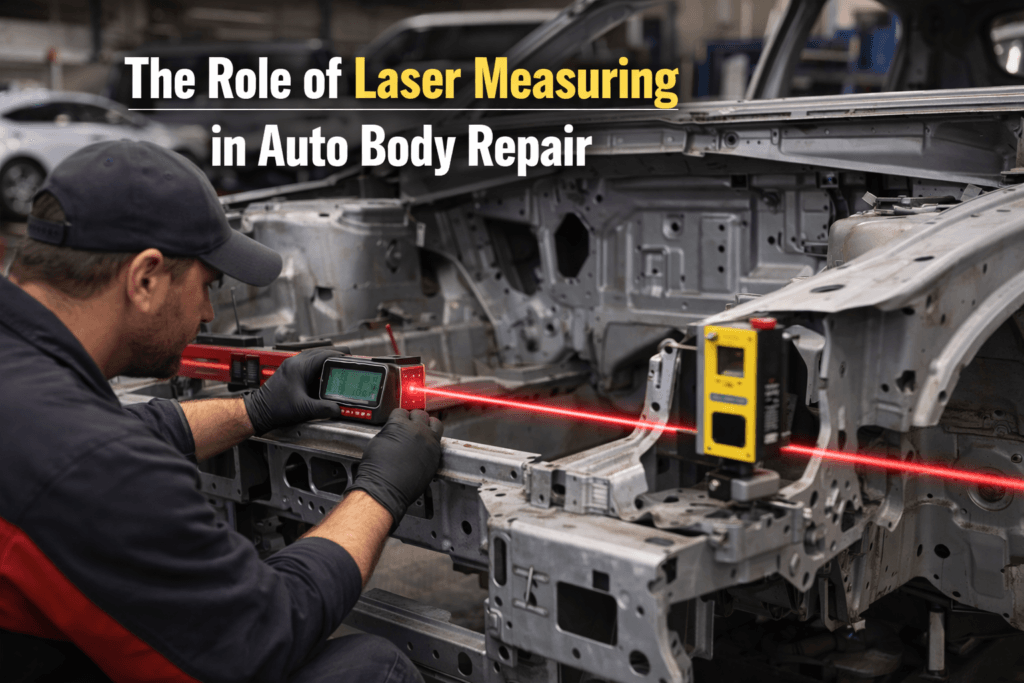
Laser measuring in auto repair is a diagnostic and verification process that uses laser-based technology to precisely map the dimensions of a vehicle’s structural components — the frame, the unibody, the suspension mounting points, and more — and compare those measurements against the manufacturer’s original specifications.
Think of it like a blueprint check. Every vehicle that rolls off a factory production line has exact, documented measurements for every structural reference point. When a car is in a collision, those points can shift, bend, or compress. Laser measuring systems allow technicians to detect exactly where deviations have occurred, by exactly how much, and in which direction — information that is absolutely critical for performing accurate vehicle frame repair.
Modern laser measuring systems work by projecting laser beams onto specific reference points on the vehicle’s underbody. Sensors and software capture the position of each point in three-dimensional space and instantly compare them to the manufacturer’s database. The results are displayed in real time on a computer screen, giving technicians a precise, live picture of the vehicle’s structural geometry as they work.
Why Traditional Measuring Methods Are No Longer Enough
Before advanced laser systems became standard in quality collision repair facilities, technicians relied on manual measuring tools — tape measures, tram gauges, and plumb bobs — to assess structural damage. These methods, while better than nothing, have significant limitations.
Manual measuring is time-consuming, prone to human error, and struggles to capture the three-dimensional complexity of modern vehicle structures. A tape measure can tell you the distance between two points, but it can’t easily tell you if one of those points is also shifted vertically, or twisted slightly out of plane — both of which are common in real-world collision damage.
Modern unibody vehicles are extraordinarily complex structures. They’re built with high-strength steel, aluminum alloys, and advanced materials engineered to behave in very specific ways during a crash. Repairing them properly requires measurement precision measured in millimeters — tolerances that manual tools simply cannot reliably achieve.
Laser measuring auto repair systems solve this problem entirely. They capture hundreds of data points simultaneously, in three dimensions, with millimeter-level accuracy, in a fraction of the time that manual methods require.
The Real-World Impact of Precise Structural Measurement
You might be wondering: does a few millimeters really matter? The answer is an emphatic yes — for several important reasons.
Handling and Alignment
A vehicle’s suspension geometry is calibrated with extraordinary precision at the factory. Even minor deviations in the structural reference points that the suspension mounts to can throw off wheel alignment, causing uneven tire wear, pulling to one side, or unpredictable handling — especially at highway speeds. These problems may not be immediately obvious after a repair, but they develop over time and can become serious safety issues.
Crash Safety Performance
Modern vehicles are engineered with sophisticated crumple zones and load paths — carefully designed structural features that control how crash energy flows through the vehicle and away from the passenger cabin. If structural repairs leave the vehicle even slightly out of specification, these engineered safety systems may not perform as intended in a future collision. A vehicle that looks repaired on the surface but has an imprecisely restored structure may offer significantly less protection in a subsequent accident.
Advanced Driver Assistance Systems (ADAS)
An increasing number of vehicles rely on cameras, radar units, and sensors mounted in precise locations throughout the vehicle’s structure to power safety features like automatic emergency braking, lane keeping assist, and adaptive cruise control. After structural repairs, these systems must be recalibrated. But accurate recalibration starts with an accurately restored structure — if the mounting points are off, the sensors will be misaligned regardless of how carefully the software calibration is performed.
Insurance Documentation
Laser measuring systems generate detailed reports that document the vehicle’s pre-repair condition, the repair process, and the final post-repair measurements. This documentation is valuable not just for quality assurance but for insurance purposes — it provides a clear, data-backed record that repairs were performed correctly and to manufacturer specifications.
How Laser Measuring Works During a Repair
Understanding the role of auto body technology like laser measuring during an actual repair helps illustrate just how integrated it is into the process — it’s not a one-time check at the end, but an ongoing tool used throughout.
Initial Assessment: When a vehicle arrives after a collision, the first step is a full structural measurement. The laser system maps all relevant reference points and identifies every deviation from factory specs. This gives technicians a complete picture of the structural damage — including damage that may not be visible from the outside.
Repair Planning: The measurement data informs the repair plan. Technicians know exactly which points need to be pulled, pushed, or replaced, and by exactly how much. This precision planning prevents over-correction and ensures repairs are targeted and efficient.
Real-Time Monitoring During Frame Straightening: As technicians use hydraulic frame straightening equipment to pull the structure back into alignment, the laser measuring system provides continuous, real-time feedback. Technicians can see on their screen exactly how each pull is affecting the vehicle’s geometry — allowing them to make incremental adjustments with confidence and stop precisely when factory specifications are met.
Final Verification: Once repairs are complete, a final full measurement is performed and documented. This final report confirms that every structural reference point is within the manufacturer’s specified tolerances — giving both the technician and the vehicle owner confidence that the repair was done correctly.
What This Means When Choosing an Auto Body Shop
Not every auto body shop invests in laser measuring technology. It requires significant capital investment in equipment, ongoing software subscriptions for manufacturer specification databases, and trained technicians who know how to use the systems effectively. Shops that skip this investment are, by definition, operating with less precision and less verifiable quality.
When evaluating an auto body shop after a collision, asking whether they use computerized or laser measuring systems is one of the most important questions you can ask. A shop that cannot precisely measure and verify structural repairs cannot genuinely guarantee the safety or quality of their work — no matter how good the paint looks when you pick the car up.
Other indicators of a shop that takes structural repair seriously include I-CAR Gold Class certification, adherence to OEM repair procedures, and the ability to provide written documentation of pre- and post-repair measurements.
CatCity Auto Body: Advanced Repair Technology You Can Trust
At CatCity Auto Body, Inc., we invest in the advanced repair equipment and technology that modern collision repair demands. Our facility uses computerized measuring systems to ensure every structural repair we perform is verified against manufacturer specifications — not eyeballed, not estimated, but precisely confirmed with data.
Our I-CAR Gold Class certified technicians are trained to use these systems as an integral part of every structural repair, from initial damage assessment through final quality verification. We combine auto body technology with decades of hands-on expertise to deliver repairs that restore not just the appearance of your vehicle, but its structural integrity and safety.
If your vehicle has been in a collision, trust the team that has the tools and the training to do the job right. Call CatCity Auto Body, Inc. at 760-324-7117 to schedule your free estimate. Serving Cathedral City and the entire Coachella Valley, we’re committed to getting your vehicle back on the road — safely, correctly, and completely.
CatCity Auto Body, Inc. — Cathedral City’s trusted collision repair experts for over 20 years.