
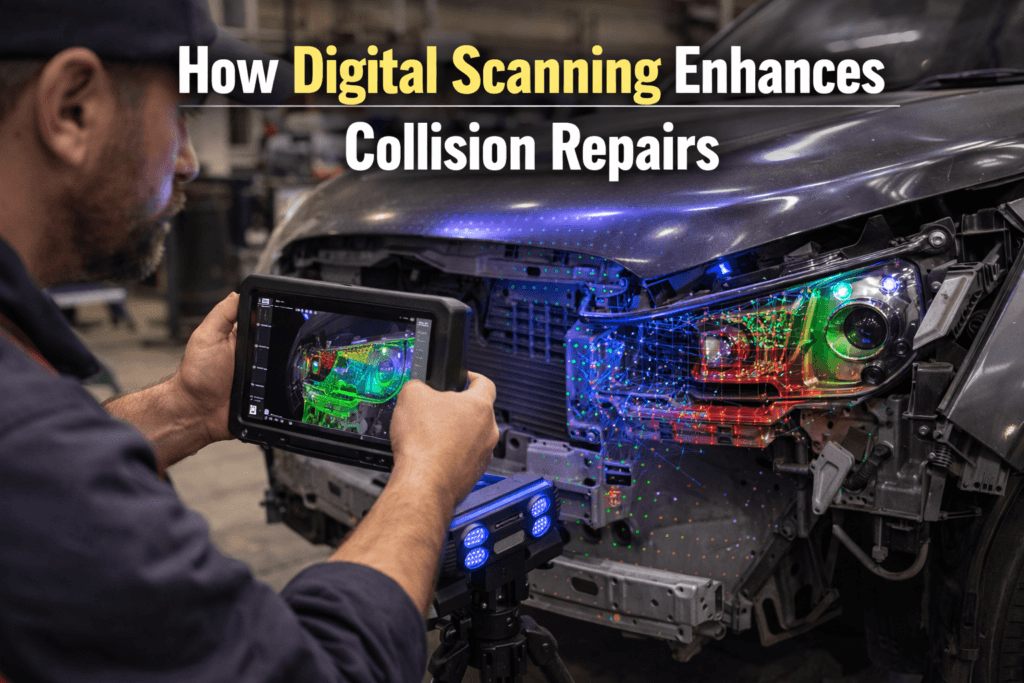
When most people think about auto body repair, they picture dents being hammered out, panels being replaced, and fresh paint being sprayed. What they don’t picture is a technician connecting a sophisticated diagnostic device to their vehicle’s onboard computer system and pulling up a detailed report of every system the collision may have affected. But that’s exactly what happens — or should happen — at a modern, properly equipped collision repair facility.
Digital scanning has become one of the most important tools in the auto body repair process, and yet most car owners have no idea it exists. If your vehicle has been in a collision and the shop didn’t perform a pre- and post-repair scan, there’s a real chance that hidden damage was missed — damage that could affect your safety long after you’ve driven away.
Here’s what digital scanning is, how it works, and why it’s a non-negotiable part of quality collision repair in Cathedral City and beyond.
What Is Digital Scanning in Auto Body Repair?
Modern vehicles are essentially computers on wheels. The average car built in the last decade contains dozens of electronic control units — commonly called ECUs — each responsible for managing a specific system: the engine, transmission, brakes, airbags, steering, and increasingly, advanced safety features like automatic emergency braking and lane departure warning.
These ECUs constantly monitor their respective systems and log data. When something goes wrong — or even when something experiences unusual stress, as happens during a collision — the ECU records a diagnostic trouble code (DTC). These codes don’t always trigger a warning light on your dashboard. They can sit silently in the system, indicating a problem that isn’t yet obvious but will become one.
Digital scanning collision repair involves connecting a professional-grade scan tool to the vehicle’s OBD-II port — the standardized diagnostic interface found in all modern vehicles — and retrieving all stored codes across every system. Advanced scan tools used in collision repair go far beyond what a basic code reader from an auto parts store can do. They communicate with every module in the vehicle, not just the engine, and they can read both active fault codes and pending codes that haven’t yet triggered a dashboard warning.
Pre-Repair Scanning: Understanding the Full Picture
The digital scanning process in a quality collision repair workflow happens at two critical stages. The first is the pre-repair scan, performed before any repair work begins.
This initial scan serves several important purposes. First, it establishes a baseline — a complete picture of every fault code present in the vehicle’s systems immediately after the collision. This is important because some codes may have existed before the accident, while others are directly collision-related. Knowing the difference is essential for accurate repair planning and fair insurance claim documentation.
Second, the pre-repair scan often reveals damage that isn’t visible during a physical inspection. A collision that appears to have only affected the front bumper and hood may have triggered fault codes in the airbag system, the forward collision radar, the ABS module, or the steering angle sensor. Without a scan, these issues would go undetected — and unrepaired.
For auto body diagnostics to be genuinely useful, they must be comprehensive. A partial scan that only checks certain systems can give a false sense of security, leaving critical issues unaddressed.
The Hidden Damage That Scanning Reveals
One of the most important contributions of digital scanning to collision repair is its ability to surface damage that has no visible symptoms — at least not immediately. Here are some of the most common categories of hidden collision damage that scanning detects:
Airbag and Restraint System Faults
Even in collisions where the airbags don’t deploy, the impact can trigger fault codes in the supplemental restraint system (SRS). Sensors, clock springs, and pretensioner circuits can be affected by collision forces. If these faults are not identified and addressed, the airbag system may not function correctly in a subsequent accident — leaving you without a critical layer of protection precisely when you need it most.
ADAS Sensor Disruption
Advanced Driver Assistance Systems rely on cameras, radar units, and ultrasonic sensors mounted throughout the vehicle. A collision — even one that appears minor — can physically displace these sensors or disrupt their calibration. A digital scan will flag any system faults, alerting technicians that recalibration or component replacement is necessary.
ABS and Stability Control Faults
Wheel speed sensors, steering angle sensors, and yaw rate sensors that feed into the ABS and electronic stability control systems are vulnerable to collision damage, especially in front or rear impacts. Faults in these systems can subtly degrade braking performance and stability control — problems that may not be obvious in normal driving but become critical in an emergency situation.
Battery and Electrical System Stress
Collisions subject a vehicle’s electrical system to sudden, significant stress. In hybrid and electric vehicles, this can be particularly consequential — high-voltage battery systems, inverters, and charging components can sustain damage that is entirely invisible without scanning. Identifying these issues before returning a vehicle to service is essential for both performance and safety.
Post-Repair Scanning: Verifying the Work Was Done Right
The second stage of the digital scanning process — equally important as the first — is the post-repair scan, performed after all repair work is complete.
The post-repair scan serves as verification. It confirms that all fault codes identified in the pre-repair scan have been successfully resolved, that no new codes have been introduced during the repair process itself, and that all systems are communicating and functioning as designed.
This step is critical for repair accuracy. It’s entirely possible for well-intentioned repairs to inadvertently introduce new electrical issues — a connector not fully seated, a sensor not properly reinstalled, a module not correctly calibrated after replacement. The post-repair scan catches these issues before the vehicle is returned to the customer, rather than after.
The documentation generated by pre- and post-repair scans also serves an important role in the insurance claims process. It provides objective, data-backed evidence of the damage that was present, the repairs that were performed, and the vehicle’s condition upon completion — protecting both the customer and the shop.
Why Many Shops Skip Scanning — And Why That’s a Problem
Digital scanning requires investment. Professional-grade scan tools capable of accessing all vehicle systems across all makes and models are expensive. Keeping the software updated as new vehicle models are released requires ongoing subscription costs. And interpreting scan results accurately requires trained technicians who understand both the technology and the vehicles they’re working on.
As a result, some collision repair shops either skip scanning entirely or perform only a cursory check. This is a significant problem — not just for repair quality, but for customer safety. A shop that doesn’t scan before beginning repairs may perform cosmetically perfect work while completely missing underlying electronic and structural damage. A shop that doesn’t scan after repairs may return a vehicle to the road with unresolved system faults.
When evaluating a collision repair shop, asking specifically about their scanning process — whether they perform both pre- and post-repair scans, what scan tools they use, and whether they provide documentation — is one of the most important questions you can ask. It’s a direct indicator of whether a shop is committed to complete, safe repairs or just surface-level cosmetic work.
Digital Scanning and Cathedral City’s Driving Conditions
Cathedral City and the broader Coachella Valley present some unique considerations that make thorough auto body diagnostics even more important. The region’s extreme heat puts additional stress on electronic components and battery systems. Desert roads, with their occasional debris and rough surfaces, can be harder on suspension and sensor systems than milder environments.
When a vehicle that already operates in these demanding conditions sustains collision damage, comprehensive digital scanning becomes even more critical. Hidden faults that might take months to manifest in a milder climate can surface much faster under the stress of desert heat and driving conditions. Catching and addressing them immediately — before they compound — protects your vehicle, your safety, and your wallet.
CatCity Auto Body: Complete Diagnostics, Complete Repairs
At CatCity Auto Body, Inc., digital scanning is a standard part of our collision repair process — not an optional add-on. We perform comprehensive pre- and post-repair scans on every vehicle we work on, using professional-grade diagnostic tools that communicate with all vehicle systems.
Our I-CAR Gold Class certified technicians understand how to interpret scan results and integrate that information into a complete, accurate repair plan. We don’t just fix what we can see — we identify and address everything the collision affected, visible or not. That’s what genuine repair accuracy looks like, and it’s the standard every vehicle we touch is held to.
If your vehicle has been in a collision in Cathedral City or anywhere in the Coachella Valley, don’t settle for a shop that only addresses the surface. Call CatCity Auto Body, Inc. at 760-324-7117 to schedule your free estimate and experience the difference that complete, technology-driven collision repair makes.
CatCity Auto Body, Inc. — Cathedral City’s trusted collision repair experts for over 20 years.