When your vehicle needs collision repair, the most visible factors tend to drive the decision — location, price, turnaround time. These are all reasonable things to consider. But there’s one factor that matters more than any of them, and it’s one that most car owners don’t think to ask about: who is actually working on your vehicle, and what are they qualified to do?
The technician performing your repair makes all the difference. A skilled, properly trained, and certified auto body technician brings a level of knowledge, precision, and accountability to the repair process that simply cannot be replicated by someone without formal credentials. In an era where vehicles are more technologically complex than ever before, the gap between certified and uncertified repair work has never been wider — or more consequential.
This is especially true in Cathedral City and the Coachella Valley, where drivers deserve access to repair professionals who are genuinely equipped to handle modern vehicles correctly. Here’s why certification matters, what it actually means, and what you should look for when choosing a collision repair shop.
What Does It Mean to Be a Certified Auto Body Technician?
Certification in the auto body industry isn’t a single credential — it’s a category that encompasses several different programs and designations, each with its own focus and requirements. Understanding the main certifications helps you evaluate what a shop is actually offering when they claim to have certified technicians.
I-CAR Certification
The most widely recognized certification body in the collision repair industry is I-CAR — the Inter-Industry Conference on Auto Collision Repair. I-CAR is a non-profit organization that develops and delivers technical training programs for collision repair professionals, covering everything from structural repair and welding to refinishing and electrical systems.
I-CAR offers individual technician certifications across multiple disciplines, but the most significant shop-level designation is the I-CAR Gold Class certification. To achieve Gold Class status, a shop must ensure that its technicians complete a defined number of training hours each year across key role categories — not just once, but on an ongoing basis. This continuous training requirement is what makes Gold Class meaningful: it ensures technicians stay current with evolving vehicle technology and repair procedures, not just what they learned years ago.
Fewer than 10% of collision repair facilities in the United States hold I-CAR Gold Class certification. When a shop has it, it’s a genuine indicator of sustained commitment to training and technical excellence.
ASE Certification
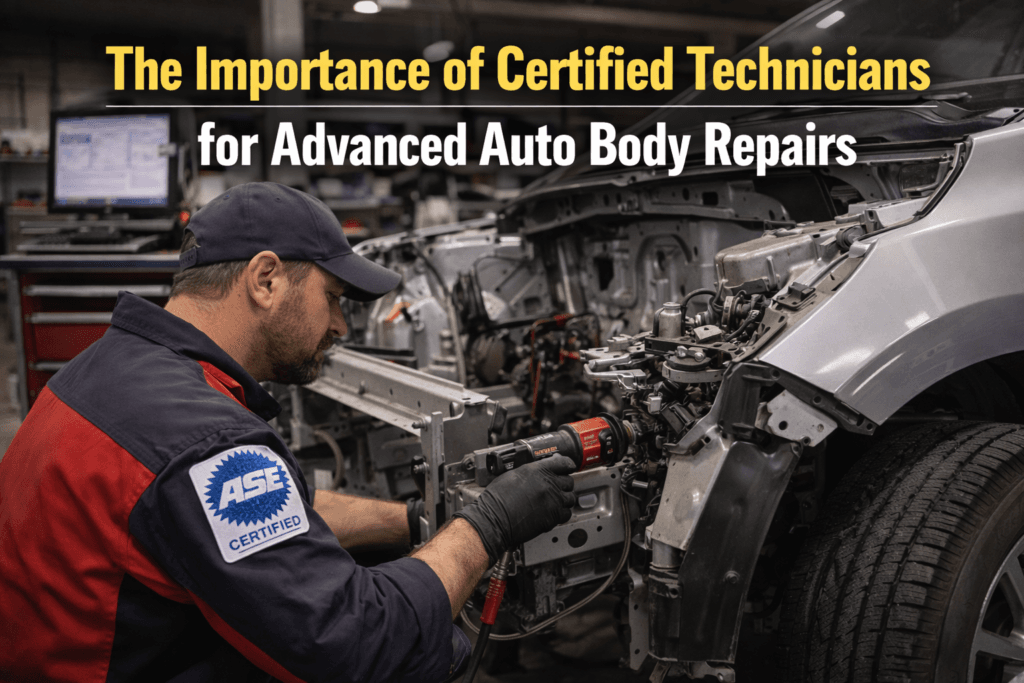
The National Institute for Automotive Service Excellence (ASE) offers certifications relevant to auto body and collision repair, including credentials in non-structural analysis, damage repair, structural analysis, painting, and refinishing. ASE certifications require technicians to pass rigorous written examinations and demonstrate real-world experience before they can be awarded.
ASE-certified technicians have demonstrated tested knowledge of their craft — not just on-the-job experience, but formally evaluated competency in specific technical areas.
Manufacturer-Specific Certifications
Many vehicle manufacturers — including brands like Tesla, Audi, BMW, Ford, and others — offer their own certification programs for collision repair shops and technicians. These programs train technicians specifically on that manufacturer’s vehicles, repair procedures, materials, and approved techniques. Manufacturer certification is particularly important for luxury, performance, and electric vehicles, where repair procedures can differ significantly from standard vehicles and where improper repairs can have serious consequences for safety and warranty coverage.
Why Certification Matters for Repair Quality Standards
Certification isn’t just a piece of paper on the wall. It represents a documented, verified standard of knowledge and capability — and it has direct, real-world implications for the quality and safety of your vehicle’s repair.
Knowledge of Modern Vehicle Construction
Today’s vehicles are dramatically more complex than those from even a decade ago. High-strength steel, aluminum body panels, carbon fiber components, advanced adhesives, and multi-material construction are now common across a wide range of vehicles — not just luxury cars. Each of these materials requires different tools, techniques, and procedures to repair correctly.
A certified collision repair technician has been trained on these materials and knows how to work with them properly. An uncertified technician working from general experience may apply techniques that were appropriate for older, simpler vehicles but are completely wrong — and potentially dangerous — for modern construction. Welding high-strength steel incorrectly, for example, can compromise its structural properties and reduce the protection it provides in a future collision.
Adherence to OEM Repair Procedures
Vehicle manufacturers publish detailed, model-specific repair procedures that specify exactly how structural repairs, panel replacements, welding, and other processes should be performed on their vehicles. These procedures exist because modern vehicles are engineered systems — changing one part of the system incorrectly can affect the behavior of everything connected to it.
Certified technicians are trained to follow these OEM procedures as a matter of standard practice. They know where to find them, how to interpret them, and why deviating from them is a problem. Shops without properly trained technicians are more likely to rely on generic repair methods that may not align with what the manufacturer actually specifies — putting your vehicle’s structural integrity and safety at risk.
Correct Handling of Safety-Critical Systems
Airbags, seatbelt pretensioners, electronic stability control, ABS, and advanced driver assistance systems are all safety-critical components that can be affected by a collision. Repairing, replacing, or recalibrating these systems requires specific knowledge and, in many cases, specific equipment.
A certified technician knows which systems need to be checked after a given type of collision, how to verify they’re functioning correctly, and when recalibration is required. An uncertified technician may not even recognize that certain systems have been affected — leaving you with a vehicle that looks repaired but may fail you in a future emergency.
Proper Welding Technique
Welding is one of the most technically demanding aspects of collision repair, and it’s one where the gap between properly trained and untrained technicians is most consequential. Modern vehicles use multiple types of steel and joining methods — MIG welding, spot welding, adhesive bonding, and combinations thereof. Each application has specific requirements for heat settings, technique, and quality verification.
I-CAR offers dedicated welding qualification programs that test technicians on their ability to perform welds that meet structural standards. A technician who hasn’t completed this training and demonstrated qualifying results has no verified basis for claiming their welds are structurally sound. In the context of vehicle frame repair, that’s an unacceptable risk.
The Risk of Choosing an Uncertified Shop
The collision repair industry is unfortunately not uniformly regulated. In many states, virtually anyone can open an auto body shop without demonstrating any particular level of technical competency. This means the burden falls on the consumer to ask the right questions and evaluate a shop’s actual qualifications.
Choosing an uncertified shop doesn’t always result in an obviously bad repair. The vehicle may look fine when you pick it up. The paint may match, the panels may be straight, and the doors may close correctly. The problems that arise from improperly performed structural repairs, incorrect welding, or missed electronic system faults often don’t surface until later — sometimes much later, and sometimes in the worst possible circumstances.
Beyond safety, choosing an uncertified shop can have financial consequences. Some vehicle manufacturers specify that warranty coverage or certified pre-owned status requires repairs to be performed using approved procedures and materials. An improperly repaired vehicle may also have diminished resale value if the repair quality can’t be documented and verified.
What Certified Technicians in Cathedral City Look Like in Practice
For drivers in Cathedral City and the surrounding Coachella Valley, access to properly certified collision repair professionals means access to repairs that meet genuine repair quality standards — not just a verbal assurance from someone behind a service counter.
Certified technicians in Cathedral City who hold I-CAR Gold Class credentials or ASE certifications have completed structured training programs, passed examinations, and maintained their credentials through continuing education. They work with documented procedures, use appropriate equipment, and are accountable to defined standards of quality.
When you bring your vehicle to a certified shop, you should expect transparency: the ability to ask what certifications the technicians performing your repair hold, what repair procedures they’re following, and what documentation they can provide confirming the work was done correctly. A shop with genuinely certified technicians will welcome these questions — because their credentials are exactly what set them apart.
CatCity Auto Body: Certified Expertise You Can Count On
At CatCity Auto Body, Inc., certification isn’t a marketing claim — it’s the foundation of everything we do. Our shop holds I-CAR Gold Class certification, placing us among fewer than 10% of collision repair facilities in the country that meet this rigorous standard of ongoing technician training and technical excellence.
Our certified technicians follow OEM-approved repair procedures on every vehicle, use manufacturer-specified materials and techniques, and are trained to identify and address both visible and hidden collision damage — structural, mechanical, and electronic. We hold ourselves to the highest repair quality standards in the industry, because we know that the work we do directly affects the safety of the people driving the vehicles we repair.
If you’re looking for certified collision repair in Cathedral City or anywhere in the Coachella Valley, you don’t have to take anyone’s word for it — ask to see the credentials. We’re proud of ours. Call CatCity Auto Body, Inc. at 760-324-7117 to schedule your free estimate, and experience what truly qualified collision repair looks like.
CatCity Auto Body, Inc. — Cathedral City’s trusted collision repair experts for over 20 years.