
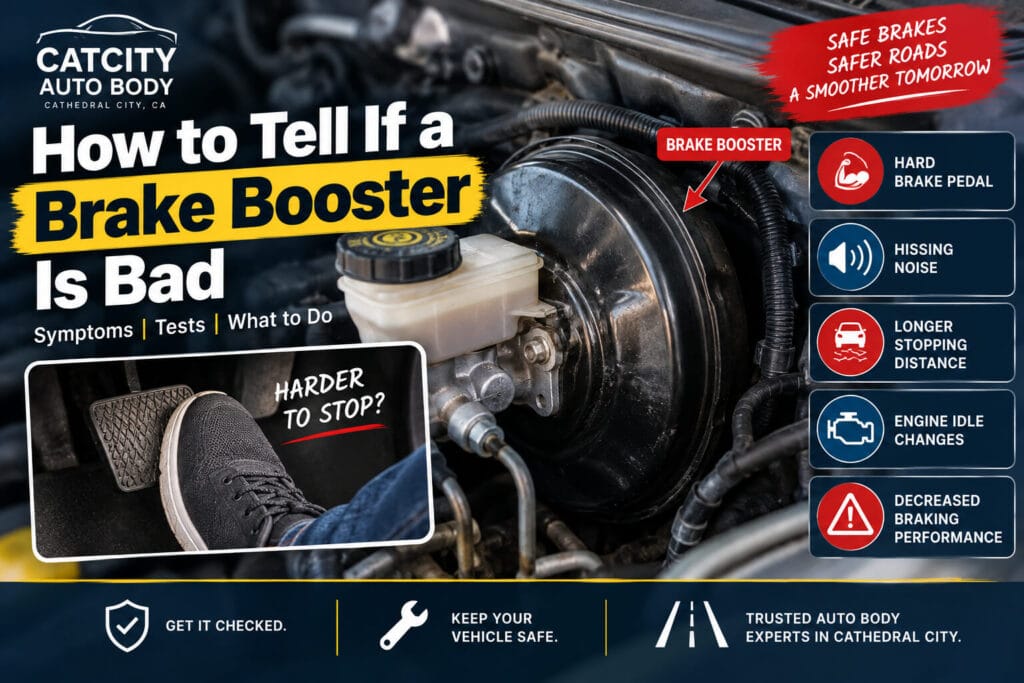
A brake booster helps reduce the amount of force you need to apply to the brake pedal. When it is working properly, pressing the brake pedal should feel relatively smooth and controlled.
When the booster develops a problem, one of the most noticeable symptoms can be a hard brake pedal that requires significantly more effort to stop the vehicle.
Other warning signs can include a hissing sound near the brake pedal, changes in pedal behavior, longer-feeling stopping response, engine performance changes on some vacuum-assisted systems, or other brake-related symptoms.
However, a hard pedal does not automatically prove that the brake booster is defective. Problems with the brake system, vacuum supply, brake lines, calipers, master cylinder, or other components can create similar symptoms.
This guide explains how to tell if a brake booster is bad, what symptoms to look for, how a basic booster test works, and when professional brake inspection is necessary.
What Does a Brake Booster Do?
The brake booster assists the driver’s effort when applying the brakes.
Without booster assistance, significantly more force would generally be required at the pedal.
Many vehicles use a vacuum-assisted brake booster, although some vehicles use hydraulic or electronically controlled brake-assist systems.
In a vacuum-assisted system, the booster uses a pressure difference to multiply the force applied through the brake pedal and assist the master cylinder.
This makes braking easier and helps provide the pedal feel drivers expect.
Because the booster is part of the braking system, a failure should be taken seriously.
What Are the Most Common Signs of a Bad Brake Booster?
Several symptoms may indicate a brake booster problem.
The most common include:
- Hard brake pedal
- Increased effort required to stop
- Hissing sound near the brake pedal
- Brake pedal behavior changes when the engine starts
- Engine idle changes when the brake pedal is pressed
- Longer or less predictable braking response
- Brake warning symptoms or related dashboard alerts
- Vacuum-related problems on applicable systems
Let’s examine these symptoms individually.
1. The Brake Pedal Feels Hard
One of the classic signs of a brake booster problem is a hard or unusually firm brake pedal.
You may notice that the pedal:
- Requires much more force than usual
- Feels unusually stiff
- Does not have the normal assisted feel
- Becomes difficult to press during repeated braking
A hard pedal can occur when the booster is not providing adequate assistance.
However, other brake problems can also cause abnormal pedal feel.
For example, a restriction, mechanical issue, or other brake-system fault may produce similar symptoms.
That is why diagnosis should consider the entire braking system rather than replacing the booster based on pedal feel alone.
2. You Need More Effort to Stop the Car
If you suddenly find yourself pushing much harder on the brake pedal to achieve the same braking response, pay attention.
A functioning brake-assist system reduces the amount of physical effort needed from the driver.
If booster assistance is lost, the brakes may still function mechanically, but the pedal can require substantially more force.
This can become particularly noticeable during:
- Stop-and-go traffic
- Emergency braking
- Repeated braking
- Parking maneuvers
- Driving downhill
A sudden change in braking effort should be investigated promptly.
3. You Hear a Hissing Sound Near the Brake Pedal
A hissing sound around the brake pedal or brake booster area can indicate a vacuum leak on vehicles that use vacuum-assisted braking.
The sound may become noticeable when you press the brake pedal.
Possible causes include:
- Vacuum hose problems
- Booster diaphragm leakage
- Check-valve problems
- Other vacuum-system leaks
A hissing sound does not automatically mean the brake booster itself has failed.
A technician needs to determine where the vacuum is being lost.
4. The Brake Pedal Does Not Behave Normally When the Engine Starts
One basic test for a vacuum-assisted brake booster involves observing what happens to the brake pedal when the engine starts.
With the engine off, press the brake pedal several times until it becomes firm.
Keep moderate pressure on the pedal and start the engine.
On a properly functioning vacuum-assisted system, the pedal will typically move downward slightly as vacuum assistance becomes available.
If the pedal does not change as expected, the booster or its vacuum supply may need inspection.
This test does not apply in exactly the same way to every braking system, particularly vehicles using hydraulic or electronic brake-assist systems.
5. The Engine Idle Changes When You Press the Brake
On some vacuum-assisted vehicles, a brake booster or vacuum hose problem can introduce an unwanted air leak into the engine’s vacuum system.
You may notice:
- Rough idle
- Changes in engine RPM
- Engine hesitation
- Engine nearly stalling when the brake pedal is pressed
This is more relevant to vehicles that use engine vacuum for brake assistance.
Modern vehicles with different brake-assist designs may show different symptoms.
If pressing the brake pedal consistently changes engine behavior, both the brake-assist system and relevant vacuum components should be inspected.
6. Braking Feels Less Predictable
A brake booster problem may change the way the pedal feels.
Instead of the normal pedal response, you may experience:
- Very high pedal effort
- Unusual pedal stiffness
- Delayed-feeling brake response
- A significant change from the vehicle’s normal brake feel
Any sudden change in braking behavior deserves attention.
Brakes are a safety-critical system, so it is not advisable to wait for the problem to become severe before getting it checked.
Hard Brake Pedal vs. Soft Brake Pedal
This distinction is useful when diagnosing brake problems.
Hard brake pedal
A hard pedal can be associated with:
- Brake booster problems
- Loss of vacuum assistance
- Vacuum hose problems
- Certain hydraulic or mechanical faults
Soft or spongy brake pedal
A soft pedal may instead be associated with issues such as:
- Air in the brake system
- Brake fluid problems
- Hydraulic system problems
- Certain brake component failures
These symptoms are not interchangeable.
A hard pedal does not automatically mean the booster is bad, and a soft pedal does not usually point directly to a failed booster.
The entire braking system should be diagnosed based on the specific symptoms.
How to Test a Vacuum Brake Booster
If your vehicle uses a conventional vacuum-assisted brake booster, there is a basic functional test you can perform.
Step 1: Turn the engine off
Make sure the vehicle is safely parked.
Step 2: Press the brake pedal several times
Press the brake pedal repeatedly.
The pedal should gradually become firmer as the stored vacuum assistance is depleted.
Step 3: Hold the pedal down
Apply moderate pressure and keep your foot on the pedal.
Step 4: Start the engine
Start the engine while maintaining pressure on the brake pedal.
Step 5: Observe the pedal
On a functioning vacuum-assisted system, the pedal will generally move down slightly when vacuum assistance becomes available.
If there is no change, the booster, vacuum supply, check valve, or another related component may require inspection.
This is only a basic functional check, not a complete brake-system diagnosis.
Can a Vacuum Hose Cause the Same Symptoms?
Yes.
A damaged or disconnected vacuum hose can prevent a vacuum-assisted brake booster from operating correctly.
Before replacing a booster, a technician may inspect:
- Vacuum hoses
- Hose connections
- Check valve
- Vacuum source
- Booster operation
This is important because replacing an expensive component will not solve the underlying problem if the actual fault is a damaged hose or valve.
What Is a Brake Booster Check Valve?
The check valve helps control vacuum flow between the engine’s vacuum source and the brake booster.
It helps maintain the vacuum needed for brake assistance under appropriate operating conditions.
If the check valve fails, the booster may not retain or receive vacuum correctly.
Potential symptoms can resemble other booster or vacuum problems.
This is another reason diagnosis should include the complete brake-assist system.
Can a Bad Brake Booster Cause the Brake Pedal to Go to the Floor?
A brake pedal that goes to the floor is not the classic symptom of a failed brake booster.
A sinking or excessively soft pedal can indicate other problems within the hydraulic braking system.
Potential causes can include:
- Brake fluid loss
- Air in the hydraulic system
- Master cylinder problems
- Hydraulic leaks
- Other brake-system faults
If the pedal is going unusually low or the vehicle’s braking performance has changed significantly, have the vehicle inspected immediately.
Do not assume that every abnormal pedal symptom is a booster problem.
Can a Bad Brake Booster Cause a Brake Fluid Leak?
The brake booster itself is not generally the component you would identify as the source of a typical hydraulic brake-fluid leak.
Brake fluid leaks are more commonly associated with other parts of the hydraulic system, such as:
- Brake lines
- Hoses
- Calipers
- Wheel cylinders on applicable vehicles
- Master cylinder
- Other hydraulic connections
If you see brake fluid underneath your vehicle or around brake components, the vehicle should be inspected promptly.
Can You Drive With a Bad Brake Booster?
Driving with a suspected brake booster problem is not something to ignore.
A vehicle may still have some braking capability if booster assistance is lost, but significantly greater pedal force may be required.
That can make the vehicle more difficult to stop, particularly in an emergency.
If the brake pedal suddenly becomes very hard, braking performance changes significantly, or you are unsure whether the vehicle can stop safely, avoid unnecessary driving and arrange professional assistance.
A brake problem is not a good condition to test by continuing to drive until it gets worse.
Is a Bad Brake Booster an Emergency?
It depends on the symptoms and severity, but a significant loss of brake assistance should be treated as a serious safety concern.
Seek prompt professional evaluation if you notice:
- Sudden hard brake pedal
- Major change in braking performance
- Very high pedal effort
- Significant hissing from the brake-assist area
- Brake warning lights
- Difficulty stopping normally
- Multiple brake symptoms at the same time
If the vehicle cannot be stopped reliably or the brakes are behaving unpredictably, do not continue driving it.
Can a Brake Booster Fail Suddenly?
It can. Some brake booster problems develop gradually, while others may become apparent suddenly because of a failed hose, valve, diaphragm, or other component.
A gradual problem may initially appear as a subtle change in pedal feel.
For example, you may notice that the brake pedal feels slightly harder than usual.
If the condition progresses, braking effort may become much more noticeable.
This is why paying attention to changes in normal brake behavior can help identify a problem earlier.
Can a Bad Brake Booster Affect Engine Performance?
On vehicles that use engine vacuum for brake assistance, a vacuum leak associated with the brake booster can sometimes affect engine operation.
Possible symptoms include:
- Rough idle
- Engine RPM changes
- Hesitation
- Stalling in severe cases
However, engine performance problems have many possible causes.
If the engine changes behavior specifically when the brake pedal is pressed, mention that symptom during diagnosis because it may help a technician identify a vacuum-related issue.
Brake Booster vs. Master Cylinder: What’s the Difference?
The brake booster and master cylinder perform different jobs.
Brake booster
The booster helps multiply the driver’s pedal force.
Master cylinder
The master cylinder converts pedal force into hydraulic brake pressure.
A problem with either component can affect braking, but their symptoms can differ.
A hard pedal with increased effort may point toward a brake-assist problem, while a soft or sinking pedal can point toward a hydraulic issue.
These are general diagnostic clues, not definitive diagnoses.
What Causes Brake Booster Failure?
Several factors can contribute to brake booster problems.
Possible causes include:
- Normal wear
- Internal diaphragm deterioration
- Vacuum leaks
- Damaged vacuum hoses
- Failed check valve
- Contamination
- Physical damage
- Age-related component deterioration
The specific failure mode depends on the brake system design and vehicle.
How Much Does Brake Booster Repair Cost?
There is no universal price for brake booster repair or replacement.
The total cost can depend on:
- Vehicle make and model
- Type of brake-assist system
- Booster design
- Labor requirements
- Related components
- Diagnostic time
- Whether other brake components also require repair
For some vehicles, the problem may be a relatively inexpensive hose or valve rather than the booster itself.
A proper diagnosis is therefore important before approving a replacement.
What Should You Do If You Suspect a Bad Brake Booster?
If your brake pedal feels different from normal, follow these steps:
1. Take the symptom seriously
Don’t assume a harder pedal is simply part of normal vehicle behavior.
2. Pay attention to other symptoms
Look for hissing, changes in engine idle, warning lights, or changes in stopping behavior.
3. Avoid unnecessary driving
Especially avoid long trips until the problem has been evaluated.
4. Have the brake system inspected
A technician can check the booster, vacuum supply, master cylinder, brake lines, and other relevant components.
5. Repair the actual cause
A proper diagnosis can prevent unnecessary replacement of components that are still functioning correctly.
What If the Brake Booster Problem Started After an Accident?
A collision can affect more than exterior body panels.
Depending on the location and severity of the impact, a vehicle may require inspection of:
- Brake components
- Suspension
- Steering
- Wheels and tires
- Brake lines
- Vacuum components
- Nearby body structure
If braking behavior changed immediately after an accident, don’t assume it is unrelated to the collision.
Our guide on what is structural damage on a car explains why some collision damage can be hidden beneath exterior panels.
For information about identifying less-visible accident damage, see how to tell if your car has hidden damage after an accident.
Brake System Inspection in Cathedral City
Brake problems should be diagnosed based on the entire braking system rather than one symptom.
If your brake pedal has suddenly become hard, you hear an unusual hissing sound, or your vehicle requires substantially more effort to stop, arrange a professional inspection before continuing normal driving.
CatCity Auto Body in Cathedral City can help assess collision-related vehicle damage and identify body or structural concerns that may be associated with an accident. For a brake-system problem unrelated to collision damage, a qualified brake or mechanical repair facility may be the appropriate place for diagnosis and repair.
If the brake problem began after a collision, make sure the inspection considers the broader vehicle condition rather than looking at the booster alone.
Frequently Asked Questions
Common warning signs include a hard brake pedal, increased pedal effort, hissing near the brake pedal, changes in braking behavior, and, on some vacuum-assisted vehicles, engine idle changes when the brake pedal is pressed.
A common symptom is a brake pedal that feels unusually hard and requires significantly more effort to achieve normal braking.
On a vacuum-assisted system, a basic test involves pumping the brake pedal with the engine off, holding moderate pressure on the pedal, and then starting the engine. The pedal should generally move down slightly as vacuum assistance becomes available.
A soft or spongy pedal is not the classic symptom of a failed booster. Hydraulic brake problems, air in the system, fluid loss, or master-cylinder issues can cause a soft pedal.
If brake assistance is significantly reduced, driving can require much more pedal force and may make the vehicle harder to stop. A suspected booster problem should be professionally evaluated rather than ignored.
A hissing noise near the brake pedal or booster area can indicate a vacuum leak on applicable systems. The source could be the booster, hose, check valve, or another vacuum component.
Final Takeaway
The most common clue that a brake booster may be failing is a brake pedal that suddenly becomes unusually hard and requires significantly more effort.
A hissing sound, vacuum-related symptoms, changes in engine idle, or unusual braking behavior can provide additional clues on vehicles that use vacuum-assisted braking.
However, these symptoms do not prove that the booster itself has failed. Vacuum hoses, check valves, the master cylinder, brake lines, and other brake components can produce similar or related symptoms.
Because braking is a critical safety system, don’t continue driving normally simply to see whether the problem gets worse. If your brake pedal has changed significantly or the vehicle is not stopping as expected, have the braking system inspected as soon as possible.