
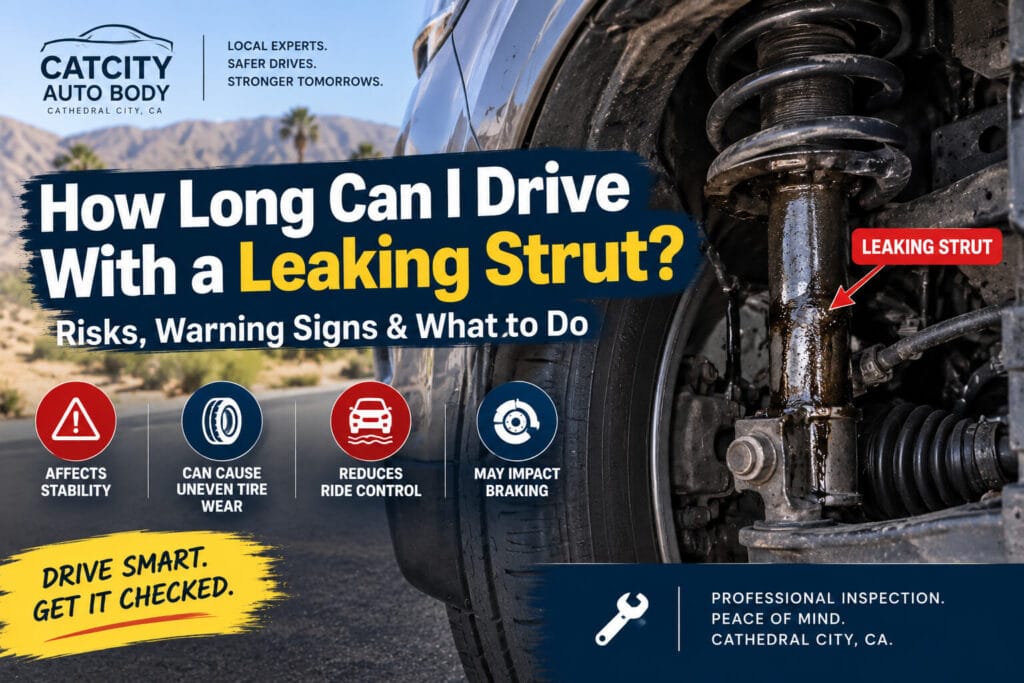
There is no safe number of miles or days that applies to every leaking strut. A vehicle with a slightly damp strut may behave differently from one with significant fluid loss, severe bouncing, uneven tire wear, or poor handling.
A leaking strut should therefore be treated as a suspension problem that needs inspection, rather than something that can safely be driven for a predetermined amount of time.
If the vehicle is still handling normally and the leak is minor, a short trip to a qualified repair facility may be possible. However, if the vehicle is unstable, bouncing excessively, pulling to one side, making unusual suspension noises, or showing signs of severe fluid leakage, continuing to drive can increase the risk of losing control or causing additional tire and suspension problems.
For Cathedral City drivers, this is particularly important before extended highway trips, where suspension problems can become more noticeable at higher speeds.
What Is a Strut?
A strut is a major component of a vehicle’s suspension system.
Many modern vehicles use MacPherson strut suspension, where the strut assembly combines several functions. Depending on the vehicle design, a strut assembly may include the shock absorber, spring, mount, bearing, and other components.
The strut helps control the movement of the suspension when the vehicle travels over bumps, dips, uneven pavement, and other road surfaces.
It also contributes to maintaining consistent tire contact with the road.
This is why a damaged or leaking strut is more than a comfort issue.
A problem with the strut can affect:
- Ride control
- Vehicle stability
- Tire contact with the road
- Braking behavior
- Steering response
- Tire wear
- Overall handling
Why Does a Strut Leak?
A strut contains hydraulic fluid that helps control suspension movement.
Over time, the internal seal around the strut’s piston can deteriorate. When the seal no longer keeps the fluid contained, fluid may begin to escape.
Common reasons for a leaking strut include:
- Normal wear
- Age
- Damaged seals
- Corrosion
- Physical damage
- Severe road impacts
- Collision damage
A strut can also become damaged after hitting a large pothole or other road hazard.
In some cases, a collision may damage suspension components even when the exterior body damage appears relatively minor.
What Does a Leaking Strut Look Like?
A small amount of oil or fluid around the strut does not necessarily mean that the entire suspension system has failed.
However, there is an important difference between light seepage and a significant leak.
Light seepage
You may see a thin film of fluid around the strut body.
The vehicle may still feel relatively normal.
Significant leakage
You may see fluid running down the strut body or accumulating around the component.
The vehicle may also begin showing symptoms such as:
- Excessive bouncing
- Poor handling
- Uneven tire wear
- Nose diving during braking
- Excessive body movement
- Knocking or suspension noises
A technician should determine the severity rather than relying only on how much fluid is visible.
So, How Long Can You Drive With a Leaking Strut?
The safest answer is: only as long as necessary to have it inspected or repaired.
There is no reliable mileage limit such as “50 miles” or “500 miles” that can be applied to every leaking strut.
The condition of the strut can change, and the effect on handling depends on factors such as:
- Amount of fluid loss
- Condition of the other suspension components
- Vehicle type
- Road conditions
- Driving speed
- Tire condition
- Whether one or multiple struts are affected
- Severity of the underlying damage
A vehicle that feels normal today may not behave the same way after additional wear or a difficult road surface.
For that reason, a leaking strut should be inspected as soon as reasonably possible rather than used until a specific mileage threshold is reached.
Can You Drive a Short Distance With a Leaking Strut?
Possibly, depending on its condition.
If the vehicle has only minor seepage and is still:
- Steering normally
- Braking normally
- Maintaining stable handling
- Not excessively bouncing
- Not producing severe suspension noises
- Not showing significant tire wear
a qualified technician may determine that it can be driven a short distance to a repair facility.
However, that is different from saying that it is safe to continue driving for weeks or thousands of miles.
A short trip to get the vehicle inspected is not the same as continuing normal driving with a known suspension problem.
If you’re unsure about the vehicle’s condition, having it transported to a repair facility may be the safer option.
When Should You Stop Driving With a Leaking Strut?
Some symptoms indicate that you should not continue driving normally.
Consider stopping and arranging professional assistance if you notice:
1. Severe Fluid Leakage
If fluid is visibly running down the strut or there is substantial fluid around the component, the suspension should be inspected promptly.
2. Excessive Bouncing
Push-down tests are not a substitute for professional diagnosis, but excessive suspension movement while driving can indicate reduced damping performance.
If the vehicle continues bouncing after bumps or dips, don’t ignore it.
3. Vehicle Becomes Difficult to Control
If the vehicle feels unstable, wanders, or requires constant steering correction, stop driving if it is safe to do so.
Suspension and steering problems can have multiple causes, and the vehicle should be inspected.
4. Strong Pulling or Handling Changes
A vehicle pulling to one side can have several possible causes, including:
- Tire problems
- Alignment issues
- Suspension damage
- Brake problems
- Collision-related damage
A leaking strut may be part of the problem, but it should not automatically be assumed to be the only cause.
5. Severe Knocking or Clunking
A leaking strut combined with loud suspension noises may indicate that additional components are damaged or worn.
The strut assembly includes several components, so a technician should determine the actual source.
6. Uneven or Rapid Tire Wear
If the affected wheel develops unusual tire wear, have the suspension and alignment checked.
A damaged suspension system can affect how the tire contacts the road.
What Happens If You Keep Driving With a Leaking Strut?
Continuing to drive with a leaking strut can allow the suspension problem to progress.
The consequences can vary depending on the severity of the failure, but potential problems include:
Reduced ride control
The suspension may become less effective at controlling wheel movement.
Reduced stability
The vehicle may feel less composed over bumps or uneven surfaces.
Increased tire wear
Poor suspension performance can contribute to uneven tire wear.
Changes in braking behavior
A worn or damaged suspension component can affect how the vehicle responds during braking.
Additional suspension wear
Other suspension components may experience additional stress depending on the condition of the vehicle.
Less predictable handling
The vehicle may respond differently during sudden steering or emergency maneuvers.
The risk is not simply that the car will feel uncomfortable.
The larger concern is whether the vehicle continues to maintain predictable contact and control on the road.
Is a Leaking Strut Dangerous?
It can be, particularly if the leak is significant or the strut’s performance has deteriorated.
A strut is part of the suspension system that helps control wheel and body movement.
When its damping performance is reduced, the vehicle may not respond to bumps, braking, or steering inputs as it normally should.
However, the word “leaking” alone does not tell you exactly how dangerous the condition is.
A technician needs to evaluate the amount of leakage and the overall condition of the suspension.
That is why it is better to think of a leaking strut as a condition requiring inspection, rather than automatically assuming either that it is harmless or that the vehicle must immediately be towed.
Can a Leaking Strut Cause Uneven Tire Wear?
Yes, a worn or damaged strut can contribute to abnormal tire wear.
The suspension helps keep the wheel and tire properly controlled as the vehicle moves over different road surfaces.
When suspension performance deteriorates, the tire may experience abnormal movement.
You may notice:
- Uneven tread
- Cupping or scalloping
- One section of the tire wearing faster
- Different wear between the left and right sides
Tire wear can also result from incorrect tire pressure, wheel alignment, worn suspension components, or other problems.
If uneven tire wear appears together with a leaking strut, the entire suspension and tire system should be evaluated.
Can a Leaking Strut Affect Braking?
It can affect vehicle behavior during braking.
When braking, the vehicle’s weight shifts forward. The suspension helps control this movement.
A damaged or poorly functioning front strut can contribute to excessive front-end movement or less controlled handling.
Potential symptoms may include:
- Excessive nose dive
- Vehicle instability
- Changes in braking feel
- Longer-feeling stopping response under certain conditions
A braking problem should never automatically be attributed to the strut, though.
Brake components, tires, alignment, suspension, and other systems can all contribute to braking behavior.
If braking performance has changed, the vehicle should be professionally inspected.
Can a Leaking Strut Cause a Car to Pull to One Side?
A leaking strut can be associated with handling changes, but a vehicle pulling to one side has many possible causes.
These include:
- Incorrect tire pressure
- Uneven tire wear
- Wheel alignment
- Brake problems
- Suspension damage
- Damaged steering components
- Collision-related structural issues
If pulling began after an accident, don’t assume that replacing the strut alone will solve the problem.
The entire affected area should be inspected.
What Is the Difference Between a Strut and a Shock Absorber?
People often use “strut” and “shock” interchangeably, but they are not always the same component.
Both help control suspension movement, but their role in the vehicle’s suspension design can differ.
A shock absorber is primarily a damping component.
A strut can perform damping functions while also serving as a structural part of the suspension assembly.
The exact design depends on the vehicle.
This is why replacement parts should be identified according to the specific vehicle rather than assuming every suspension component is interchangeable.
Should You Replace One Leaking Strut or Both?
The answer depends on the vehicle and the condition of the suspension.
Struts on the same axle often experience similar operating conditions and may wear at comparable rates.
For that reason, a technician may recommend replacing both struts on the same axle when one has failed or is significantly worn.
However, the correct repair depends on:
- Vehicle manufacturer recommendations
- Age and mileage
- Condition of the opposite strut
- Type of suspension
- Overall vehicle condition
A qualified technician can recommend the appropriate approach after inspection.
How Much Does Strut Replacement Cost?
There is no single price for strut replacement because costs vary significantly between vehicles.
Factors can include:
- Vehicle make and model
- Front vs. rear suspension
- Type of strut assembly
- Parts required
- Labor
- Additional damaged components
- Alignment requirements
If a collision caused the suspension damage, the overall repair may also involve body, steering, wheel, tire, or structural components.
It is better to obtain an inspection and itemized estimate than rely on a generic online price.
For related information, our guide to how to read an auto repair estimate explains some of the terminology you may encounter on a repair estimate.
Can a Pothole Cause a Strut to Leak?
Yes, a severe pothole or road impact can damage suspension components.
A hard impact can place significant force through the:
- Tire
- Wheel
- Strut
- Spring
- Control arm
- Steering components
- Other suspension parts
After hitting a major pothole, pay attention to new symptoms such as:
- Fluid around a strut
- Steering changes
- Pulling
- Vibrations
- Clunking
- Uneven tire wear
A pothole impact can also cause wheel or alignment problems without damaging the strut itself.
Can a Car Accident Cause a Leaking Strut?
Yes. A collision can damage suspension components, depending on where the impact occurred and how much force was involved.
For example, an impact near a wheel or front corner can potentially affect suspension components.
If a strut begins leaking after an accident, it is important to consider the possibility of additional collision-related damage.
The inspection may need to include:
- Wheel
- Tire
- Strut
- Control arm
- Steering components
- Alignment
- Nearby body structure
A visible dent should not automatically be treated as the entire extent of the damage.
Our guide on what structural damage on a car means explains why some collision damage can extend beyond what is visible.
What Should You Do If Your Strut Starts Leaking After an Accident?
If you notice a leaking strut after a collision, avoid assuming that the suspension component is the only problem.
Step 1: Look for obvious symptoms
Check whether the vehicle is:
- Pulling
- Bouncing
- Vibrating
- Making unusual noises
- Showing uneven tire wear
Step 2: Avoid unnecessary long-distance driving
Until the vehicle has been evaluated, avoid treating it as a normal road-trip vehicle.
Step 3: Have the suspension inspected
A professional can determine whether the strut is leaking and whether other components were affected.
Step 4: Check for related collision damage
If the leak followed an accident, the surrounding wheel, suspension, body, and structural areas may need inspection.
Step 5: Follow the repair recommendation
Depending on the diagnosis, the appropriate solution could involve strut replacement, additional suspension work, alignment, or collision repairs.
Is It Safe to Take a Road Trip With a Leaking Strut?
Generally, a known leaking strut is not something you should ignore before a long road trip.
Long-distance driving means:
- More miles
- More highway speeds
- More braking
- More heat
- More road impacts
- More opportunity for an existing problem to worsen
If you are planning to drive from Cathedral City to another city or take a longer desert road trip, have the suspension checked beforehand.
This is especially important if the vehicle is already showing handling or tire-wear symptoms.
For broader road-trip preparation, you can also review our Pre-Trip Auto Maintenance Guide.
What If the Strut Is Only Slightly Wet?
A light film of oil does not necessarily mean the strut has completely failed.
There is an important difference between:
Light seepage:
A small amount of fluid around the shaft or housing with no obvious performance symptoms.
Active leakage:
Fluid visibly running down the component or accumulating around it.
A professional inspection can determine whether the component is still functioning properly or whether replacement is necessary.
If you are unsure whether what you see is normal seepage, don’t rely solely on photographs or online descriptions.
Can You Drive With a Broken Strut?
A completely failed or severely damaged strut is a different situation from minor seepage.
If the vehicle has:
- Severe suspension movement
- Major instability
- Significant fluid loss
- Broken suspension components
- Severe tire contact problems
- Loud impact or suspension noises
continuing to drive may be unsafe.
In that situation, arrange professional assistance rather than attempting to drive a long distance.
Leaking Strut Inspection in Cathedral City
If you notice fluid around a strut, don’t focus only on how many miles you can continue driving.
The more important questions are:
How severe is the leak? Is the strut still controlling suspension movement? Has the vehicle’s handling changed? Are the tires wearing abnormally? Was the vehicle recently involved in an accident?
A qualified automotive professional can inspect the suspension and determine whether the strut requires replacement or whether other components are involved.
For vehicles that have experienced a collision, CatCity Auto Body in Cathedral City can inspect related collision damage and help identify body or structural concerns that may exist around the affected area. If the issue is primarily a mechanical suspension problem, a qualified suspension or mechanical repair facility may be appropriate.
Frequently Asked Questions
There is no universal mileage limit. A leaking strut should be inspected promptly, and driving should generally be limited to what is necessary to have the vehicle evaluated when the vehicle remains stable and controllable.
A small amount of seepage may not mean immediate complete failure, but the strut should still be inspected. Whether you can safely drive depends on the strut’s condition and the vehicle’s handling.
Not every small leak is an emergency, but significant leakage combined with poor handling, excessive bouncing, tire wear, or unusual noises should be treated as a serious suspension problem.
A severely degraded suspension can affect vehicle stability, tire contact, handling, and braking behavior. This is why significant suspension problems should be repaired rather than ignored.
Highway driving places greater demands on the vehicle. If a strut is known to be leaking, it is better to have it inspected before undertaking a long highway trip.
It depends on the vehicle and the condition of the opposite strut. Because struts on the same axle often wear at similar rates, a technician may recommend replacing them as a pair.
Final Takeaway
There is no fixed number of miles you can safely drive with a leaking strut.
A minor seep may not produce the same symptoms as a severely damaged strut, but any known leak deserves inspection. Continuing to drive for an extended period can allow suspension, tire, alignment, or handling problems to develop or worsen.
If your vehicle is bouncing excessively, pulling, vibrating, producing unusual suspension noises, wearing tires unevenly, or showing significant strut fluid leakage, avoid unnecessary driving and arrange a professional inspection.
And if the leaking strut appeared after a collision, don’t look at the strut in isolation. The wheel, suspension, alignment, body, and potentially structural components should be considered as part of the overall damage assessment.