
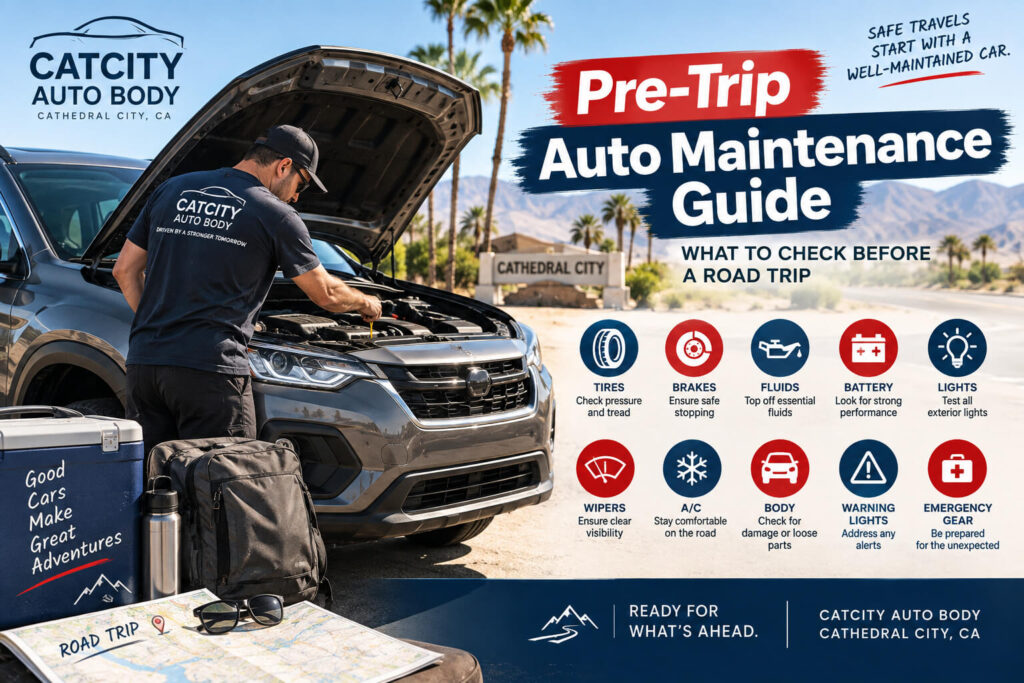
A long road trip puts more time, distance, and heat-related stress on a vehicle than everyday driving. Before leaving Cathedral City for a weekend trip, holiday journey, or longer road adventure, a pre-trip auto maintenance check can help identify problems before they become roadside emergencies.
A pre-trip vehicle check should cover tires, brakes, fluids, lights, battery, windshield visibility, emergency equipment, and the vehicle’s exterior and body condition.
Not every problem requires the same type of repair. Some checks can be completed by the vehicle owner, while mechanical or collision-related concerns should be inspected by a qualified automotive professional.
This guide explains what to check before a road trip and which warning signs should not be ignored.
What Is Pre-Trip Auto Maintenance?
Pre-trip auto maintenance is a series of checks performed before a long drive to identify potential problems that could affect vehicle safety, reliability, comfort, or road-trip readiness.
It is different from routine maintenance performed according to the manufacturer’s service schedule.
A pre-trip check focuses on the vehicle’s current condition.
It asks questions such as:
- Are the tires properly inflated?
- Are there signs of tire damage?
- Are the brakes behaving normally?
- Are all exterior lights working?
- Are fluid levels appropriate?
- Is the battery showing warning signs?
- Are the windshield and wipers ready for changing weather?
- Is there any body damage that could become a problem during the trip?
- Does the vehicle have the necessary emergency equipment?
Pre-Trip Vehicle Maintenance Checklist
Before leaving, work through these major areas:
- Tires and tire pressure
- Brakes
- Engine fluids
- Battery
- Lights
- Windshield and wipers
- Air conditioning
- Steering and suspension
- Vehicle body and exterior
- Emergency equipment
- Spare tire or tire repair equipment
- Warning lights and dashboard messages
Let’s look at each one.
1. Check Your Tires Before a Road Trip
Tires are one of the most important parts of a pre-trip inspection because they are the only components connecting the vehicle to the road.
Before traveling, check:
- Tire pressure
- Tread depth
- Uneven tread wear
- Cracks
- Bulges
- Punctures
- Objects stuck in the tire
- Spare tire condition
Use the vehicle manufacturer’s recommended tire pressure rather than relying only on the number printed on the tire itself.
Also check the spare tire if your vehicle is equipped with one.
A spare that has been sitting unused for years may not be ready when you need it.
Watch for uneven tire wear
Uneven wear can sometimes indicate alignment, suspension, or tire-related problems.
If your vehicle recently experienced a collision and the tires are wearing differently afterward, a professional inspection may be appropriate.
2. Pay Attention to Brake Performance
Brakes should feel predictable and responsive before a long journey.
Warning signs can include:
- Grinding
- Squealing
- Vibrations while braking
- A soft or unusual brake pedal
- Pulling to one side
- Longer stopping distances
Do not ignore a change in braking behavior simply because the vehicle is still stopping.
If you notice a significant brake problem before a road trip, have it evaluated before beginning the journey.
3. Check Essential Vehicle Fluids
Depending on your vehicle, several fluids may need to be checked as part of routine maintenance.
These can include:
- Engine oil
- Coolant
- Brake fluid
- Transmission fluid
- Windshield washer fluid
- Power steering fluid where applicable
Check the owner’s manual for the correct inspection procedure and recommended fluid specifications.
Look for leaks
Fluid underneath the vehicle can be an important warning sign.
Different fluids have different colors, textures, and locations, so don’t assume a leak is harmless simply because the vehicle still drives normally.
A recurring leak should be diagnosed before a long trip.
4. Inspect the Battery
A weak battery can turn a simple road trip into an unexpected roadside problem.
Before traveling, look for:
- Difficulty starting the vehicle
- Corrosion around battery terminals
- Swollen or damaged battery casing
- Repeated jump-starting
- Dashboard battery warnings
If the battery is older or has recently shown signs of weakness, consider having its condition tested before traveling.
5. Test Every Exterior Light
Check all exterior lights, including:
- Headlights
- Brake lights
- Turn signals
- Hazard lights
- Reverse lights
- Parking lights
- License plate lights
Proper lighting helps you see and helps other drivers see your vehicle.
Walk around the vehicle while testing the lights instead of assuming they are all functioning.
6. Inspect the Windshield, Windows, and Wipers
A clear view of the road is essential for safe driving.
Before a long trip, inspect the windshield for:
- Cracks
- Chips
- Large areas of damage
- Damage directly in the driver’s viewing area
Also check the wiper blades.
If they leave streaks, skip across the glass, or fail to clear water effectively, they may need replacement.
Don’t forget the windshield washer fluid.
7. Check the Air Conditioning Before Leaving Cathedral City
For drivers traveling from Cathedral City, a properly functioning air-conditioning system can be especially important during hot-weather travel.
Before a long trip, make sure the system is producing consistent airflow and cooling.
Pay attention to:
- Weak airflow
- Unusual smells
- Unusual noises
- Air that does not cool properly
If the system has recently changed behavior, address the problem before beginning a long drive.
8. Pay Attention to Steering and Suspension
A pre-trip check should also consider how the vehicle feels while driving.
Potential warning signs include:
- Excessive bouncing
- Steering vibration
- Vehicle pulling to one side
- Clunking sounds
- Difficulty keeping the vehicle straight
- Changes in steering response
These symptoms can have multiple causes, including tire, alignment, suspension, or other mechanical issues.
If they appeared after an accident, don’t overlook the possibility of collision-related damage.
9. Inspect the Vehicle’s Body and Exterior
Pre-trip maintenance is not only about mechanical components.
The vehicle’s exterior should also be checked for damage that could affect safety or become worse during travel.
Look for:
- Loose bumper components
- Cracked lights
- Loose trim
- Damaged mirrors
- Loose body panels
- Sharp exposed edges
- Cracked or damaged glass
- Unsecured parts
A loose bumper or body component may become more problematic at highway speeds.
Why Body Damage Matters Before a Road Trip
A small dent is generally a cosmetic issue, but not every visible body problem is purely cosmetic.
For example, after a collision, you may notice:
- Uneven panel gaps
- A door that does not close correctly
- Trunk or liftgate alignment problems
- New wind noise
- Water entering the vehicle
- Changes in vehicle handling
These signs may indicate a problem that deserves further inspection.
For additional information, see our guide on what is structural damage on a car.
10. Check Your Dashboard Warning Lights
Never ignore warning lights simply because the vehicle appears to drive normally.
Before leaving, pay attention to warning indicators related to:
- Engine
- Battery
- Brakes
- Tire pressure
- Airbags
- Traction or stability systems
If a warning light appears unexpectedly, check the owner’s manual or have the vehicle diagnosed before starting a long trip.
11. Check Your Emergency Equipment
A road-trip vehicle should be prepared for unexpected situations.
Depending on your vehicle and travel plans, consider carrying:
- Emergency flashlight
- First-aid kit
- Jumper cables or approved jump starter
- Tire pressure gauge
- Tire repair equipment
- Spare tire and necessary tools
- Reflective warning equipment
- Phone charger
- Drinking water
The exact equipment you need depends on your route, weather, vehicle, and travel conditions.
12. Don’t Forget the Spare Tire
If your vehicle has a spare tire, inspect it before leaving.
Check:
- Tire pressure
- Tire condition
- Storage location
- Jack
- Lug wrench
- Required adapters or tools
A spare tire is not useful if it is flat or the necessary tools are missing.
Some modern vehicles do not include a traditional spare, so understand what your vehicle provides for a flat tire before traveling.
What Should You Check the Day Before a Road Trip?
A simple final inspection can be completed the day before departure.
Day-before checklist:
Exterior
- Check lights
- Check mirrors
- Check windshield
- Check wipers
- Look for loose body components
Tires
- Check pressure
- Inspect tread
- Look for visible damage
- Check spare/tire repair equipment
Under the hood
- Check appropriate fluid levels
- Look for obvious leaks
- Inspect battery condition
Inside the vehicle
- Check dashboard warning lights
- Confirm air conditioning works
- Secure luggage
- Charge your phone
This final check can help catch problems before you are several hours away from home.
How Far in Advance Should You Do Pre-Trip Maintenance?
For a short local trip, a basic inspection shortly before departure may be enough.
For a long road trip, however, it is better to check the vehicle several days before leaving.
This gives you time to address problems if something is discovered.
For example, if you find:
- A damaged tire
- Worn wiper blades
- A warning light
- A fluid leak
- A damaged bumper
- A cracked windshield
- An alignment concern
you have time to arrange the appropriate service instead of discovering the problem on the morning of departure.
Pre-Trip Maintenance for Cathedral City Drivers
Cathedral City’s desert environment can make vehicle preparation particularly important during hot-weather travel.
Before heading out, pay attention to:
- Tire pressure
- Cooling system condition
- Air conditioning
- Battery condition
- Fluid levels
- Exterior paint and body condition
- Windshield condition
High temperatures can place additional demands on certain vehicle components, particularly when combined with extended highway driving.
If your vehicle already has a known problem, don’t wait until the trip begins to find out whether it can handle the journey.
What If Your Car Was Recently in an Accident?
A recent collision changes the way you should approach a pre-trip inspection.
Even if the vehicle has been repaired or appears to drive normally, look for changes such as:
- Uneven panel gaps
- Doors that don’t close normally
- New wind noise
- Water leaks
- Steering changes
- Vehicle pulling
- Unusual vibrations
- New warning lights
These symptoms can sometimes point toward unresolved collision damage.
Our guide on how to tell if your car has hidden damage after an accident explains additional warning signs.
Should You Get a Professional Pre-Trip Inspection?
A professional inspection can be worthwhile if:
- You are planning a long-distance trip
- Your vehicle has recently been in an accident
- You notice unusual noises or handling
- A warning light is active
- The vehicle has a known mechanical or body problem
- You have not driven the vehicle for an extended period
A professional can identify issues that may not be obvious during a quick driveway inspection.
However, a pre-trip inspection does not replace the manufacturer’s scheduled maintenance. Both serve different purposes.
Pre-Trip Auto Maintenance vs. Routine Maintenance
These two terms are sometimes confused.
Routine maintenance
Routine maintenance follows the vehicle manufacturer’s recommended schedule.
It can include services such as:
- Oil changes
- Filter replacement
- Fluid service
- Scheduled inspections
- Other manufacturer-recommended maintenance
Pre-trip maintenance
Pre-trip maintenance focuses on whether the vehicle is currently ready for a specific journey.
It emphasizes:
- Current tire condition
- Fluids
- Lights
- Brakes
- Visibility
- Battery
- Warning lights
- Safety equipment
- Exterior condition
The best approach is to keep up with routine maintenance and perform a pre-trip inspection before longer journeys.
Frequently Asked Questions
A pre-trip auto maintenance check is an inspection performed before a long journey to identify problems involving tires, brakes, fluids, lights, battery, visibility, body condition, and other safety-related areas.
Check tire pressure and condition, brakes, essential fluids, battery, exterior lights, windshield and wipers, air conditioning, steering, suspension, warning lights, spare tire, and emergency equipment.
For a long journey, checking the vehicle several days before departure gives you time to address any problems discovered during the inspection.
Yes. Check tire pressure, tread condition, visible damage, uneven wear, and the condition of the spare tire or tire repair equipment.
No. A pre-trip inspection is an additional safety check and does not replace maintenance recommended by the vehicle manufacturer.
Potentially. Loose body components, damaged lights, cracked glass, improperly closing doors, structural issues, or other collision-related problems may affect safety and should be inspected.
Read More
Final Takeaway
A good pre-trip auto maintenance check should cover the parts of your vehicle that affect safety, reliability, visibility, and road readiness.
Before a long trip, check your tires, brakes, fluids, battery, lights, windshield, wipers, air conditioning, steering, suspension, body condition, warning lights, and emergency equipment.
If your vehicle has recently suffered collision damage, don’t limit the inspection to what you can see. Changes in panel alignment, doors, handling, or unusual noises can indicate problems that deserve professional attention.
A few minutes of preparation before leaving Cathedral City can help you start your trip with greater confidence and reduce the chance of discovering an avoidable vehicle problem miles from home.