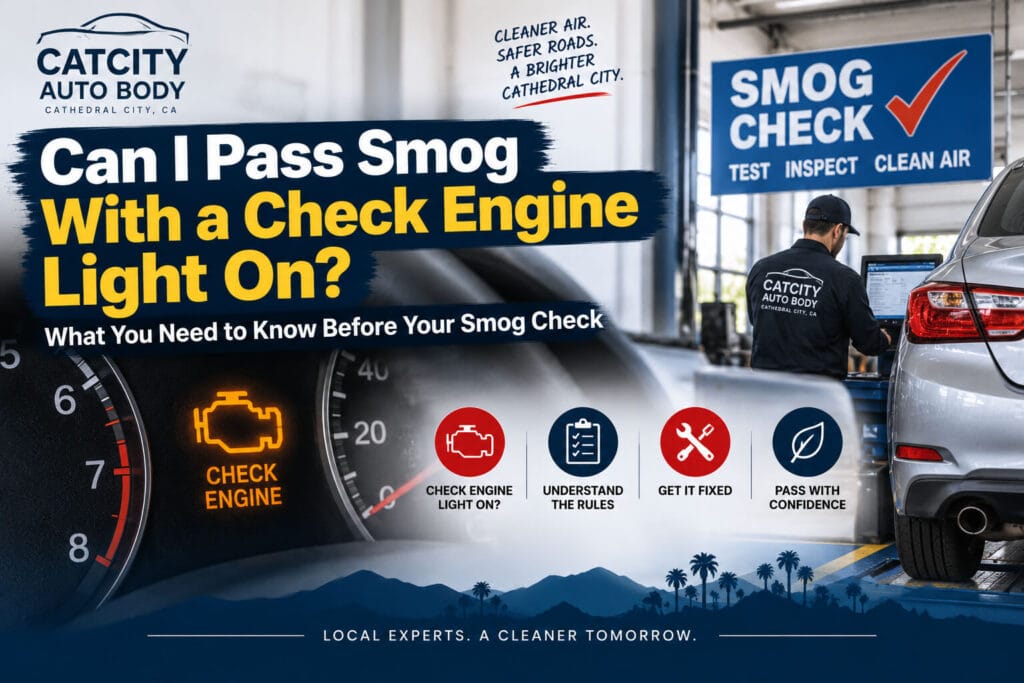
No. In California, a vehicle will not pass a Smog Check while the check engine light, also called the Malfunction Indicator Lamp (MIL), is illuminated with the engine running. California’s Bureau of Automotive Repair (BAR) specifically advises motorists to repair an illuminated check engine light before taking the vehicle for a Smog Check.
The check engine light matters because it can indicate a problem with the vehicle’s emissions system. During a California Smog Check, the vehicle’s onboard diagnostic system is evaluated for emissions-related faults and other requirements.
If your check engine light is currently on, taking the car directly to a Smog Check station may result in a failed inspection.
The better approach is to diagnose the underlying problem, complete the necessary repair, and make sure the vehicle’s emissions monitors are ready before the official inspection.
Why Does the Check Engine Light Cause a Smog Failure?
The check engine light is connected to the vehicle’s onboard diagnostic system.
When the vehicle’s computer detects certain emissions-related problems, it can store a diagnostic trouble code (DTC) and illuminate the malfunction indicator lamp.
For vehicles subject to the applicable OBD inspection, California’s Smog Check evaluates this information as part of determining whether the vehicle meets the program’s requirements. BAR’s inspection guidance states that the MIL should illuminate during the key-on/engine-off check and turn off after the engine starts. If the MIL remains illuminated while the engine is running, the vehicle fails that portion of the inspection.
So, the issue isn’t simply that the dashboard has an orange warning light.
The light can indicate that the vehicle’s emissions-control system has detected a malfunction that needs to be diagnosed.
What Does a Check Engine Light Mean?
A check engine light can be triggered by many different conditions.
Possible causes include:
- Emissions-system faults
- Oxygen sensor problems
- Evaporative emissions system problems
- Catalytic-converter-related faults
- Fuel-system problems
- Ignition or misfire problems
- Air/fuel mixture issues
- Other emissions-related component failures
The exact cause cannot be determined simply by looking at the dashboard light.
A diagnostic scan is generally needed to identify the stored code or codes and determine what should be inspected next.
What If the Check Engine Light Is Flashing?
A flashing check engine light should be treated differently from a steady light.
A flashing MIL can indicate a more urgent engine problem, such as a severe misfire that may cause additional damage if the vehicle continues operating.
If the check engine light is flashing, avoid treating the vehicle as though it is ready for a normal commute or road trip. Depending on the symptoms, professional diagnosis may be needed promptly.
A flashing light is also not a situation where simply clearing the code before a Smog Check is an appropriate solution.
What If the Check Engine Light Is On but the Car Drives Normally?
A vehicle can feel completely normal even when the check engine light is illuminated.
This is because some emissions-related problems may have little immediate effect on:
- Acceleration
- Steering
- Braking
- Ride quality
- Everyday drivability
However, the problem can still cause the vehicle to fail a Smog Check.
Normal driving performance does not guarantee that the vehicle will pass an emissions inspection.
If the light is on, diagnose the cause before scheduling the inspection.
Can I Just Turn Off the Check Engine Light Before the Smog Test?
Simply turning off the light does not necessarily make the vehicle ready to pass.
A scan tool may be able to clear diagnostic trouble codes, and disconnecting a battery can also reset certain OBD information. But doing so can reset the vehicle’s readiness monitors.
These monitors are self-tests performed by the vehicle’s OBD system to determine whether its emissions-control systems are functioning properly.
California has specific readiness-monitor requirements for Smog Checks, and BAR notes that monitors may need to complete after a battery disconnect or emissions repair.
In other words:
Clearing the light is not the same thing as fixing the problem.
What Are OBD Readiness Monitors?
OBD readiness monitors are self-tests performed by the vehicle’s onboard diagnostic system.
They help verify the operation of various emissions-control systems.
After certain events, such as:
- Battery replacement
- Battery disconnection
- Clearing diagnostic codes
- Some emissions repairs
the monitors may return to an incomplete or not ready state.
The vehicle then needs to complete the appropriate drive conditions so the monitors can run again.
BAR explains that monitor completion depends on the vehicle and its operating conditions, and some vehicles may require specific drive cycles.
How Long Should I Drive After a Check Engine Repair?
There is no universal number of miles or minutes that guarantees readiness.
The time required depends on:
- Vehicle make and model
- Model year
- Which monitors need to run
- Driving conditions
- Engine temperature
- Fuel level
- Previous repairs
- The specific emissions system involved
BAR recommends that motorists who recently disconnected or replaced their battery drive the vehicle for a week or two to allow readiness monitors to reset before a Smog Check.
However, this should not be interpreted as a guaranteed schedule for every vehicle.
The vehicle’s scan data should be checked to determine whether the required monitors are ready.
Can I Pass Smog If the Check Engine Light Turned Off by Itself?
It depends on why the light turned off and whether the vehicle’s OBD system is ready.
A check engine light can sometimes turn off when the vehicle no longer detects the condition that triggered it.
However, the vehicle may still have stored information or incomplete readiness monitors that affect the inspection.
For this reason, don’t assume that an extinguished light automatically means the car is ready for Smog Check.
A pre-test diagnostic scan can help identify whether additional work or driving is needed.
What Happens During a California Smog Check?
The exact inspection depends on the vehicle.
California’s Bureau of Automotive Repair states that a Smog Check may include:
- Visual inspection of the emissions-control system
- Functional inspection of emissions components
- OBD testing for most 2000-and-newer vehicles
- Tailpipe emissions testing for applicable pre-2000 vehicles
For OBD-equipped vehicles, the inspection checks information reported by the vehicle’s onboard diagnostic system.
This is why the check engine light and readiness status are important.
Does Every California Vehicle Need a Smog Check?
No.
California has several exemptions and exceptions.
According to BAR, gasoline, hybrid, and alternative-fuel vehicles generally require Smog Checks depending on their model year and registration circumstances, while electric vehicles do not require a Smog Check. Certain newer vehicles also qualify for exemptions from specific Smog Check requirements.
For registration renewal, for example, gasoline, hybrid, and alternative-fuel vehicles that are eight model years old or newer generally do not need a Smog Check and instead pay a smog abatement fee.
Your DMV registration renewal notice can tell you whether a Smog Certification is required.
What Should I Do Before a Smog Check?
If your check engine light is on, use this basic process.
Step 1: Diagnose the warning light
Have the vehicle’s diagnostic system scanned to identify the stored trouble code or codes.
Step 2: Determine the root cause
A diagnostic code identifies a detected condition; it does not always tell you which individual part should automatically be replaced. Further testing may be necessary.
Step 3: Complete the repair
Repair the underlying emissions-related problem according to the vehicle’s appropriate repair information.
Step 4: Check readiness monitors
After repair, make sure the applicable monitors have completed.
Step 5: Consider a pre-inspection
A pretest can help identify potential issues before the official inspection. BAR notes that some stations offer pretests or pre-inspections.
Step 6: Schedule the Smog Check
Once the vehicle is repaired and ready, take it to the appropriate licensed Smog Check station.
Common Mistakes People Make Before Smog Testing
Clearing the code without repairing the vehicle
This may turn off the light temporarily but does not necessarily resolve the underlying emissions problem.
Replacing random parts
A diagnostic trouble code should not automatically be treated as proof that a particular component has failed.
Testing immediately after disconnecting the battery
Resetting the OBD system can leave readiness monitors incomplete.
Ignoring other dashboard warnings
The check engine light is not the only information available from the vehicle’s diagnostic system.
Waiting until registration is almost due
If the vehicle fails, you may need additional time for diagnosis, repair, and retesting.
Planning ahead gives you more time to resolve unexpected problems.
Can a Bad Catalytic Converter Cause a Check Engine Light?
Yes.
A catalytic-converter-related emissions problem can trigger the check engine light.
However, there are many possible reasons for a check engine light, and a diagnostic code associated with the catalytic converter does not automatically mean that replacing the converter is the first or only repair.
Other conditions can sometimes affect catalyst-related diagnostic readings.
A qualified technician should diagnose the underlying cause.
Can a Bad Oxygen Sensor Cause a Smog Failure?
Yes.
Oxygen sensors are part of the vehicle’s emissions and engine-management systems, and a malfunction can trigger diagnostic trouble codes and affect emissions performance.
If the check engine light is illuminated because of an emissions-related oxygen-sensor fault, the vehicle may fail its Smog Check.
Again, diagnosis is important because oxygen-sensor-related codes can have multiple underlying causes.
Can a Loose Gas Cap Cause a Check Engine Light?
It can.
A loose, damaged, or improperly sealing fuel cap can contribute to an evaporative emissions system fault on applicable vehicles.
If the light comes on after refueling, check that the fuel cap is properly installed.
However, if the check engine light remains illuminated, don’t assume the fuel cap is necessarily the cause.
The vehicle should be scanned if the warning persists.
What If My Car Fails the Smog Check?
If the vehicle fails, the Smog Check station provides a Vehicle Inspection Report showing the inspection results.
BAR recommends reviewing the report, completing the necessary repairs, and having the vehicle inspected again. If your registration notice requires a STAR station, the retest must be performed at an appropriate STAR station.
Depending on your situation, California also provides programs and Referee services for certain vehicles and circumstances.
Can I Get a Smog Check With the Check Engine Light Off but Codes Stored?
This situation can be more complicated than simply looking at the dashboard.
For some newer vehicles, permanent diagnostic trouble codes (PDTCs) are also considered during the OBD portion of a Smog Check. BAR states that applicable 2010-and-newer vehicles with a stored permanent diagnostic trouble code can fail the Smog Check even if the malfunction indicator light is not illuminated.
That is another reason not to rely solely on whether the dashboard light is currently visible.
Why You Should Fix the Problem Instead of Only Clearing the Light
The purpose of the Smog Check is to verify that applicable vehicle emissions systems meet California requirements.
If the light is cleared without repairing the underlying issue, the vehicle’s diagnostic system may detect the problem again.
Additionally, resetting the system can leave readiness monitors incomplete.
The result can be:
Clear the light → monitors reset → drive vehicle → fault returns → Smog Check failure
A better approach is:
Diagnose → repair → verify readiness → Smog Check
Check Engine Light and Smog Testing in Cathedral City
If you’re preparing for a California Smog Check in Cathedral City and the check engine light is on, don’t wait until the inspection to find out whether the vehicle will pass.
Start with diagnosis.
A qualified automotive repair professional can scan the vehicle, identify relevant diagnostic information, and determine whether an emissions-related repair is necessary.
CatCity Auto Body in Cathedral City focuses primarily on auto body and collision-related repairs. If your check engine light is connected to mechanical or emissions-system problems rather than collision damage, an appropriate emissions or mechanical repair facility may be the better choice.
If the warning appeared after an accident, however, the vehicle may need a broader inspection because collision damage can affect mechanical, electrical, and emissions-related components.
Frequently Asked Questions
No. California BAR states that a vehicle will not pass a Smog Check with the check engine light illuminated while the engine is running.
Not necessarily. Clearing the code can reset OBD readiness monitors, and the underlying problem may still exist.
There is no universal mileage requirement. The necessary drive time depends on the vehicle and which readiness monitors need to complete. BAR recommends driving for a week or two after a battery disconnect or replacement before a Smog Check.
It may, but the vehicle still needs to meet all applicable Smog Check requirements, including readiness and OBD requirements. A recently extinguished light does not automatically guarantee a passing result.
It means the vehicle’s diagnostic system has detected a condition that may require diagnosis. The exact cause needs to be determined with appropriate diagnostic testing.
A loose or improperly sealing gas cap can contribute to an evaporative-emissions fault on applicable vehicles. If the check engine light remains on, the vehicle should be diagnosed rather than assuming the cap is the only problem.
Review the Vehicle Inspection Report, complete the required repairs, and have the vehicle retested. BAR provides additional options for certain vehicles and repair situations.
Final Takeaway
You cannot pass a California Smog Check with an illuminated check engine light while the engine is running.
If the light is on, the most reliable approach is not to clear it and immediately visit a Smog Check station. Instead:
Diagnose the problem → repair the underlying issue → verify OBD readiness → complete the Smog Check.
And remember that a dashboard light turning off does not automatically mean the vehicle is ready for inspection. Readiness monitors and, for applicable vehicles, permanent diagnostic trouble codes can also affect the result.
For Cathedral City drivers, handling the issue before the registration deadline can give you time to diagnose, repair, and retest the vehicle if necessary.