
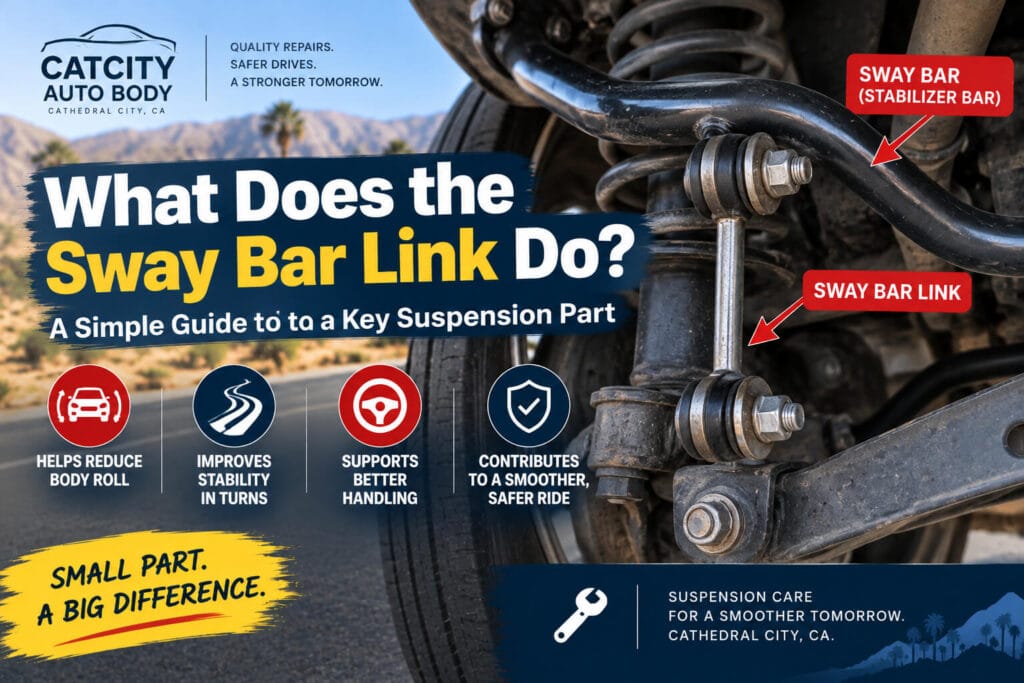
The sway bar link connects the vehicle’s sway bar, also called the stabilizer bar or anti-roll bar, to the suspension assembly. Its job is to transfer suspension movement to the sway bar so the bar can help control body roll when the vehicle turns.
In simple terms, the sway bar link helps the suspension work with the stabilizer bar to keep the vehicle more stable through corners and during changes in direction.
A worn or damaged sway bar link can cause clunking or rattling noises, increased body movement, or changes in handling, although these symptoms can also come from other suspension components.
For Cathedral City drivers, understanding what a sway bar link does can make it easier to recognize suspension problems before they become more noticeable.
What Is a Sway Bar?
Before understanding the link, it helps to understand the sway bar itself.
A sway bar is a metal suspension component that connects the suspension on opposite sides of an axle.
Its primary purpose is to help resist excessive body roll when the vehicle corners.
For example, when a vehicle turns, the body naturally wants to lean toward the outside of the turn.
The sway bar twists in response to the different movements of the suspension on the two sides. This helps resist excessive body movement.
The sway bar link is the connection between the sway bar and the suspension.
What Does a Sway Bar Link Actually Do?
The sway bar link transfers movement between the suspension and the sway bar.
When one side of the suspension moves differently from the other, the link allows the sway bar to respond to that movement.
A simplified sequence looks like this:
Vehicle turns → suspension moves → sway bar link transfers movement → sway bar twists → body roll is resisted
The link therefore plays an important role in allowing the stabilizer bar to perform its function.
It is a relatively small component, but it operates every time the suspension moves.
Where Is the Sway Bar Link Located?
The exact location varies by vehicle and suspension design.
On many vehicles, sway bar links are located near the suspension strut or control-arm area and connect the stabilizer bar to a suspension component.
Depending on the vehicle, the link may use:
- Ball-and-socket joints
- Bushings
- Studs
- Nuts
- Rubber or polyurethane components
Some vehicles use different suspension designs, so the exact arrangement can vary.
If you are looking at your vehicle from underneath, the sway bar is generally a larger bar running across the vehicle, while the sway bar links are the smaller connecting components attached near the suspension.
Why Is the Sway Bar Link Important?
The sway bar link allows the stabilizer bar to interact with the suspension.
A properly functioning link helps the system:
- Control body roll
- Maintain predictable handling
- Connect suspension movement to the sway bar
- Reduce unwanted suspension movement
- Support stable cornering behavior
The sway bar link does not carry out the same function as a shock absorber or strut.
Instead, it is one part of the overall suspension system.
For more information about another suspension component, see our guide on How Long Can I Drive With a Leaking Strut?.
What Happens When a Sway Bar Link Goes Bad?
Sway bar links experience repeated movement as the suspension travels over bumps and through turns.
Over time, joints or bushings can wear.
A damaged or worn link may develop excessive play, allowing unwanted movement between the sway bar and suspension.
The result can be noticeable through:
- Clunking sounds
- Rattling noises
- Increased body movement
- Changes in handling
- Steering or suspension noise over bumps
However, these symptoms are not exclusive to sway bar links.
Other worn suspension components can produce similar noises.
A proper inspection is therefore important before replacing a sway bar link.
7 Common Symptoms of a Bad Sway Bar Link
1. Clunking Noise Over Bumps
One of the most commonly reported symptoms of a worn sway bar link is a clunking or knocking sound when driving over bumps.
The noise may be especially noticeable when:
- Driving over potholes
- Crossing speed bumps
- Driving over uneven pavement
- Entering or exiting driveways
A worn joint can allow the link to move excessively and produce a noticeable noise.
However, control-arm bushings, struts, ball joints, and other suspension components can create similar sounds.
2. Rattling From the Suspension
A loose or worn link may create a rattling sound from one side of the vehicle.
The noise can sometimes be difficult to locate because suspension components are close together.
If you hear a repeated rattle from the front or rear suspension, an inspection can determine which component is responsible.
3. Increased Body Roll
A damaged sway bar link can affect how effectively the stabilizer bar works.
You may notice more body movement while:
- Taking corners
- Changing lanes
- Making quick directional changes
A small amount of body movement is normal, but a noticeable change from the vehicle’s usual handling deserves attention.
4. Less Predictable Cornering
If suspension components are worn, the vehicle may feel different during turns.
You may notice that the vehicle feels:
- Less stable
- More unsettled over uneven corners
- Different when changing lanes
- More prone to body movement
These symptoms can have many possible causes, so they should not automatically be blamed on the sway bar links.
5. Uneven Suspension Noise
Sometimes one side of the vehicle produces a noise while the other side remains quiet.
This can happen when one sway bar link has more wear than the other.
It is useful to tell the technician when and where you hear the noise, because that information can help narrow down the source.
6. Visible Damage or Excessive Play
During a professional inspection, a technician may find:
- Worn joint
- Damaged boot
- Loose connection
- Broken link
- Damaged bushing
- Excessive movement
A visual inspection alone may not always identify a worn link, so the suspension may need to be physically checked for play.
7. Symptoms That Become Worse on Rough Roads
A worn suspension component may be more noticeable on rough pavement.
If the vehicle is quiet on smooth roads but begins clunking over potholes and uneven surfaces, suspension components should be inspected.
This is especially relevant when the noise is new.
Does a Sway Bar Link Affect Steering?
It can affect handling, but it is not the primary component that directly controls steering.
The steering system determines the direction of the wheels.
The sway bar system helps control suspension movement and body roll.
A worn sway bar link can therefore contribute to changes in how the vehicle feels during cornering without being the direct cause of a steering-system failure.
If your steering wheel suddenly feels loose, the vehicle pulls significantly, or steering response changes dramatically, the steering and suspension systems should be inspected rather than assuming the sway bar link is responsible.
Does a Sway Bar Link Affect Alignment?
A sway bar link is generally not an alignment-adjustment component.
However, suspension damage can involve multiple components at the same time.
If a vehicle has experienced a collision, pothole impact, or other significant suspension event, the sway bar link may not be the only part that needs inspection.
If you also notice:
- Uneven tire wear
- Steering-wheel misalignment
- Vehicle pulling
- Changes in handling
the vehicle may need an alignment and a broader suspension inspection.
Can You Drive With a Bad Sway Bar Link?
The answer depends on the condition of the link and the vehicle’s symptoms.
A worn link may initially produce little more than a noise.
However, continuing to drive with a damaged suspension component can allow the problem to worsen and may affect vehicle handling.
You should avoid ignoring a sway bar link problem if you notice:
- Severe suspension noise
- Significant handling changes
- A broken link
- Loose suspension components
- Other steering or suspension symptoms
If the vehicle feels unstable or unsafe, avoid unnecessary driving and arrange a professional inspection.
Is a Broken Sway Bar Link Dangerous?
A broken sway bar link can affect the way the stabilizer bar interacts with the suspension.
The effect depends on the vehicle and the nature of the failure.
A broken link may cause:
- Increased body roll
- Suspension noise
- Reduced handling consistency
- Changes in cornering behavior
It does not necessarily mean the vehicle will immediately lose steering or braking capability.
Nevertheless, because the sway bar is part of the suspension system, a broken or severely damaged link should be inspected and repaired rather than ignored.
What Causes Sway Bar Links to Fail?
Sway bar links can wear for several reasons.
Normal wear
Repeated suspension movement places stress on the joints and bushings.
Rough roads
Potholes and uneven pavement can increase the load placed on suspension components.
Corrosion
Road conditions and moisture can contribute to corrosion of metal components.
Impact damage
A hard impact can bend or damage suspension parts.
Collision damage
A vehicle accident can affect the sway bar, link, control arm, strut, or other nearby components.
Age and mileage
Like other suspension components, links can eventually wear with use.
Can a Pothole Break a Sway Bar Link?
Yes, a severe pothole can damage suspension components, including a sway bar link.
If you hit a major pothole and immediately notice:
- Clunking
- Rattling
- Steering changes
- Pulling
- Vibrations
- Uneven tire wear
the vehicle should be inspected.
A pothole impact can affect more than one component, so replacing the sway bar link without checking the surrounding suspension may not address the entire problem.
Can an Accident Damage a Sway Bar Link?
Yes.
A collision can place abnormal forces on the suspension.
Depending on the location of the impact, damage may involve:
- Sway bar links
- Sway bar
- Struts
- Control arms
- Steering components
- Wheels
- Tires
- Suspension mounting points
If a suspension noise begins after an accident, the entire affected area should be inspected.
This is particularly important because collision damage can sometimes extend beyond what is visible on the outside.
Our guide on What Is Structural Damage on a Car? explains why some collision-related problems may involve underlying vehicle structure.
How Is a Bad Sway Bar Link Diagnosed?
A technician will generally start by listening to the reported symptoms and inspecting the suspension.
Depending on the vehicle, diagnosis may involve:
Visual inspection
The link, joints, bushings, fasteners, and surrounding components are examined for obvious damage.
Checking for play
A worn link may have excessive movement that should not be present.
Inspecting related suspension components
Because multiple components can create similar symptoms, the technician may inspect:
- Struts
- Shocks
- Control arms
- Ball joints
- Bushings
- Sway bar bushings
- Steering components
Road testing
If appropriate and safe, a road test can help reproduce the noise or handling symptom.
How Much Does Sway Bar Link Replacement Cost?
There is no single price for sway bar link replacement.
Cost depends on:
- Vehicle make and model
- Front or rear suspension
- Parts required
- Labor
- Condition of surrounding components
- Whether the link is being replaced after collision damage
A straightforward link replacement can be relatively simple compared with larger suspension repairs.
However, if the link is damaged as part of a collision, additional components may need attention.
The best way to determine the cost is to have the vehicle inspected and receive an itemized estimate.
Should Sway Bar Links Be Replaced in Pairs?
Not every situation requires replacing both links.
However, because links on the same axle often experience similar age, mileage, and road conditions, a technician may recommend replacing both when one has significant wear.
The appropriate approach depends on:
- Condition of the opposite link
- Vehicle manufacturer recommendations
- Age and mileage
- Type of failure
- Overall suspension condition
A professional inspection can determine whether one or both links should be replaced.
Can a Bad Sway Bar Link Cause Uneven Tire Wear?
A sway bar link itself is not usually the primary cause of uneven tire wear.
Uneven tire wear is more commonly associated with issues such as:
- Incorrect tire pressure
- Wheel alignment
- Suspension wear
- Steering problems
- Damaged wheels
- Worn suspension components
However, if a sway bar link problem exists alongside other suspension damage, the overall suspension condition may contribute to handling or tire-related symptoms.
If you notice unusual tire wear and suspension noise at the same time, have the vehicle inspected as a complete system.
Sway Bar Link vs. Sway Bar Bushing
These components are often confused.
Sway bar link
Connects the stabilizer bar to the suspension.
Sway bar bushing
Helps secure the stabilizer bar to the vehicle or suspension structure while allowing controlled movement.
Both can wear and produce suspension noises.
A clunking sound does not automatically identify which component has failed.
Sway Bar Link vs. Strut
A sway bar link and strut perform different functions.
Sway bar link
Connects the stabilizer bar to the suspension and helps transfer suspension movement to the sway bar.
Strut
Provides damping and, depending on the vehicle’s design, serves as an important structural part of the suspension.
A vehicle can have a bad strut, a bad sway bar link, or both.
For more information about strut problems, read How Long Can I Drive With a Leaking Strut?.
What Should You Do If You Hear a Clunking Noise?
Don’t immediately assume that the sway bar link needs replacement.
Instead:
- Notice when the noise occurs.
- Determine whether it happens over bumps, during turns, or during braking.
- Pay attention to which side it appears to come from.
- Check whether the vehicle’s handling has changed.
- Have the suspension professionally inspected.
Providing these details to a technician can make diagnosis easier.
Sway Bar Links and Pre-Trip Vehicle Inspection
If you’re planning a long drive, suspension condition should be part of your vehicle preparation.
Before a road trip, pay attention to:
- Suspension noises
- Steering response
- Tire condition
- Vehicle pulling
- Excessive body movement
- Vibrations
- Recent pothole or collision damage
Our Pre-Trip Auto Maintenance Guide provides a broader checklist for preparing a vehicle before a long journey.
If a new suspension noise has appeared, it is better to have it investigated before traveling long distances.
Sway Bar and Suspension Inspection in Cathedral City
If your vehicle has developed a clunking sound, rattling suspension, increased body roll, or unusual handling, the sway bar links may be one possible source—but they should be checked alongside the other suspension components.
CatCity Auto Body in Cathedral City can inspect collision-related body and suspension concerns and help identify damage that may have occurred after an accident. For a suspension problem unrelated to collision damage, a qualified mechanical or suspension repair facility may be the appropriate place for diagnosis and repair.
If the noise began after a collision or major pothole impact, mention that history during the inspection. The event may have affected more than one suspension component.
Frequently Asked Questions
The sway bar link connects the vehicle’s sway bar to the suspension and transfers suspension movement so the sway bar can help control body roll during cornering.
Common symptoms include clunking or rattling over bumps, increased body movement, and changes in handling. Similar symptoms can also come from other suspension components.
A mildly worn link may initially cause mainly noise, but a damaged or broken link should be inspected and repaired rather than ignored, particularly if handling has changed.
The sway bar link is generally not an alignment-adjustment component. However, other suspension damage occurring at the same time can affect alignment.
Yes. A severe pothole can place substantial force on suspension components and may damage a sway bar link or other nearby parts.
Yes. A worn or damaged link can produce a clunking or knocking noise, particularly when driving over bumps or uneven pavement.
Not necessarily. Depending on the condition of the opposite link, a technician may recommend replacing one or both links.
Final Takeaway
The sway bar link connects the sway bar to the suspension and helps the stabilizer bar control body roll during cornering.
Although it is a relatively small component, a worn or broken sway bar link can produce noticeable suspension noise and may affect the vehicle’s handling.
If you hear a new clunking or rattling sound over bumps, don’t automatically assume the sway bar link is the cause. Struts, shocks, control arms, bushings, ball joints, and other suspension components can produce similar symptoms.
A proper inspection can identify the actual source and determine whether the vehicle needs a sway bar link replacement or a more comprehensive suspension repair.