
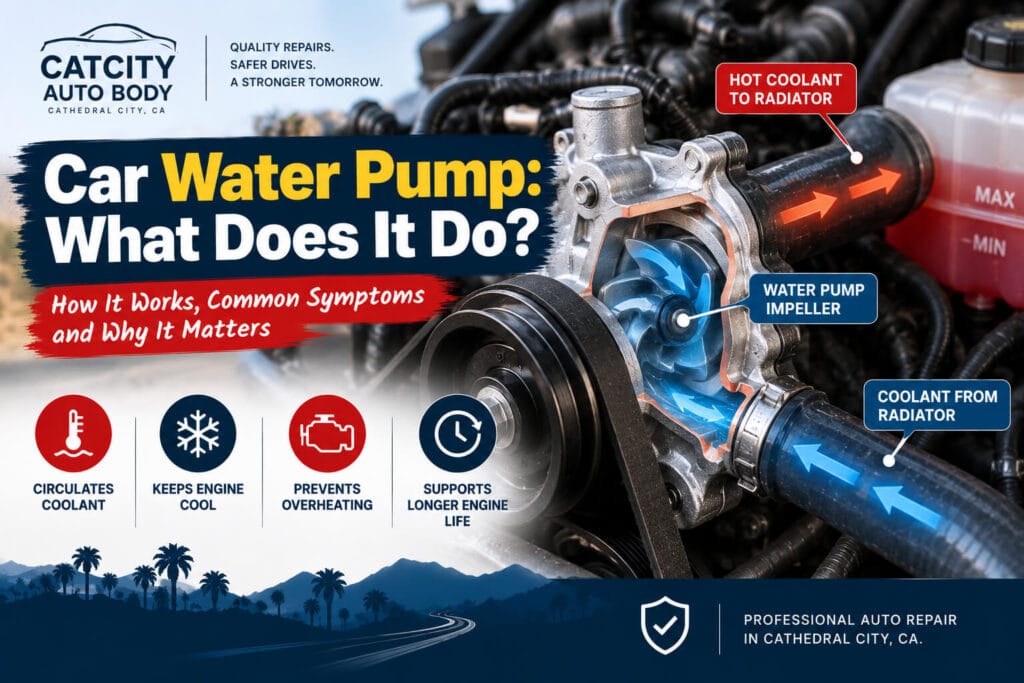
The water pump circulates coolant through the engine’s cooling system to help control engine temperature. Despite the name, modern automotive water pumps generally circulate a mixture of coolant and water rather than plain water.
The pump moves coolant through passages in the engine and cylinder head, where the coolant absorbs heat. The heated coolant then travels to the radiator, where heat is released before the coolant returns to the engine.
This continuous circulation helps prevent the engine from becoming excessively hot.
A properly functioning water pump is therefore an important part of the vehicle’s cooling system and engine temperature management.
For Cathedral City drivers, understanding what a car water pump does is particularly useful because an overheating engine can become a serious problem, especially during hot-weather driving.
How Does a Car Water Pump Work?
A typical engine cooling system follows a continuous circulation process:
Water pump → engine → radiator → water pump
Here’s what happens:
1. The pump circulates coolant
The water pump pushes coolant through the engine’s internal cooling passages.
2. Coolant absorbs engine heat
As coolant passes through the engine, it absorbs heat generated during combustion and normal engine operation.
3. Hot coolant travels to the radiator
The heated coolant moves toward the radiator.
4. The radiator releases heat
Air passing through the radiator removes heat from the coolant.
5. Cooled coolant returns to the engine
The coolant then circulates back through the system.
The process repeats while the engine is operating.
Why Is the Water Pump Important?
An internal combustion engine produces a large amount of heat.
Without an effective cooling system, engine temperatures can rise beyond the intended operating range.
The water pump helps maintain coolant circulation so that heat can continuously move away from the engine.
A functioning cooling system helps protect components such as:
- Engine block
- Cylinder head
- Head gasket
- Pistons
- Valves
- Other temperature-sensitive components
The water pump is only one part of this system, however.
Other important components include the:
- Radiator
- Thermostat
- Coolant
- Cooling fans
- Hoses
- Expansion tank or reservoir
- Temperature sensors
A cooling problem should therefore be diagnosed as a system rather than automatically blamed on the water pump.
Where Is the Water Pump Located?
The exact location varies by vehicle and engine design.
Many conventional engines have a water pump mounted on the engine and driven by:
- Serpentine belt
- Accessory belt
- Timing belt
- Timing chain on some designs
- An electric motor in certain modern vehicles
Some vehicles use mechanical water pumps, while others use electric water pumps.
Because of these differences, the location and replacement procedure can vary substantially between vehicles.
What Are the Signs of a Bad Water Pump?
A failing water pump can produce several warning signs.
Common symptoms include:
- Engine overheating
- Coolant leaking
- Low coolant level
- Unusual noises
- Temperature gauge fluctuations
- Steam or coolant smell
- Poor cooling-system performance
However, these symptoms can also be caused by other cooling-system problems.
Let’s look at them in more detail.
1. Engine Overheating
One of the most important warning signs is an engine that begins running hotter than normal.
You may notice:
- Temperature gauge rising
- Temperature warning light
- Engine overheating in traffic
- Temperature increasing during extended driving
A failed or poorly functioning water pump can reduce coolant circulation and contribute to overheating.
However, overheating can also result from:
- Low coolant
- Thermostat problems
- Radiator blockage
- Cooling fan failure
- Coolant leaks
- Hose problems
- Other cooling-system faults
The cause needs to be properly diagnosed.
2. Coolant Leaking From the Water Pump Area
A damaged water pump seal or gasket can allow coolant to escape.
You might notice:
- Coolant underneath the vehicle
- Wetness around the pump
- Dried coolant residue
- A recurring low coolant level
Some water pumps have a weep hole designed to indicate seal failure. Coolant coming from this area can be a sign that the pump requires attention.
The exact leak location should be confirmed because coolant can travel from another component and make it appear that the water pump is leaking.
3. Low Coolant Level
If coolant repeatedly becomes low, there may be a leak somewhere in the cooling system.
Possible sources include:
- Water pump
- Radiator
- Hoses
- Thermostat housing
- Expansion tank
- Heater system
- Other seals or connections
Simply adding coolant without finding the cause can allow the underlying problem to continue.
4. Unusual Water Pump Noise
A worn water pump bearing or other internal problem can produce unusual sounds.
Depending on the vehicle, you may hear:
- Grinding
- Whining
- Growling
- Humming
- Squealing
A noise from the front of the engine does not automatically prove that the water pump is failing.
Other belt-driven components can make similar noises.
A technician can inspect the pump and related components to identify the actual source.
5. Temperature Gauge Fluctuates
If the engine temperature gauge moves unusually high and low, the cooling system may not be operating correctly.
Possible causes include:
- Coolant circulation problems
- Thermostat problems
- Low coolant
- Air in the cooling system
- Cooling fan issues
- Temperature sensor problems
A water pump can be involved, but the symptom should be diagnosed rather than used as a direct diagnosis.
6. Coolant Smell
A sweet or unusual coolant odor around the vehicle can indicate a coolant leak.
You may notice the smell:
- After parking
- Around the engine compartment
- Through the vehicle’s ventilation system
- After the engine reaches operating temperature
If you smell coolant and the coolant level is dropping, have the cooling system inspected.
7. Steam or Visible Coolant
Steam coming from the engine compartment can indicate overheating or coolant escaping onto hot components.
Do not open the radiator cap or coolant reservoir when the cooling system is hot unless the vehicle manufacturer’s procedure specifically permits it.
Hot coolant and steam can cause serious burns.
If the engine is overheating, safely stop the vehicle and allow it to cool according to appropriate safety procedures.
Mechanical vs. Electric Water Pumps
Not every vehicle uses the same type of water pump.
Mechanical water pump
A mechanical water pump is driven by the engine through a belt or another mechanical drive system.
It circulates coolant based on engine operation.
Electric water pump
An electric water pump uses an electric motor to circulate coolant.
Depending on the vehicle design, an electric pump can operate independently of engine speed and may be controlled electronically.
This can allow manufacturers greater control over coolant circulation.
Because the two systems are different, the symptoms and diagnostic procedures can vary.
Does the Water Pump Run All the Time?
That depends on the type of pump.
A conventional mechanical water pump generally operates whenever its mechanical drive system is operating.
An electric water pump can be controlled electronically and may operate according to the vehicle’s cooling requirements.
Some electric pumps can continue operating after the engine is turned off under certain conditions.
Therefore, hearing a cooling-system pump after shutting off the engine does not automatically indicate a problem.
Water Pump vs. Thermostat: What’s the Difference?
The water pump and thermostat perform different jobs.
Water pump
Moves coolant through the cooling system.
Thermostat
Controls when and how much coolant flows through the radiator circuit based on engine temperature.
A thermostat that remains closed can restrict normal coolant circulation through the radiator.
A failed water pump can prevent adequate coolant circulation.
Both can contribute to overheating, but they require different repairs.
Water Pump vs. Radiator
These components also have different roles.
Water pump
Moves coolant through the system.
Radiator
Transfers heat from the coolant to the surrounding air.
The cooling system needs both effective coolant circulation and effective heat transfer.
A vehicle can therefore overheat because of a water pump problem, radiator problem, or another cooling-system issue.
Can a Bad Water Pump Cause an Overheated Engine?
Yes.
If the water pump is unable to circulate coolant properly, heat may not be transferred away from the engine efficiently.
This can contribute to overheating.
However, overheating does not automatically mean the water pump has failed.
Other causes include:
- Coolant leak
- Thermostat failure
- Radiator problem
- Cooling fan failure
- Blocked cooling passages
- Air trapped in the cooling system
- Hose failure
A complete diagnosis is important because continued operation while overheating can cause serious engine damage.
What Happens If You Keep Driving With a Bad Water Pump?
Continuing to drive with a failing water pump can allow the engine to overheat.
An overheated engine can potentially lead to expensive damage involving:
- Cylinder head
- Head gasket
- Engine block
- Internal engine components
The risk depends on how severe the pump failure is and how hot the engine becomes.
If the temperature gauge reaches the hot zone or a temperature warning appears, do not continue driving simply to reach your destination.
Safely stop and address the overheating problem.
Can You Drive With a Leaking Water Pump?
It depends on the severity of the leak, but a known coolant leak should not be ignored.
A small leak can become larger, potentially resulting in:
- Low coolant
- Reduced cooling performance
- Overheating
- Engine damage
There is no universal number of miles that is safe for every leaking water pump.
If coolant is leaking significantly or the engine is overheating, stop driving and arrange appropriate assistance.
Can a Water Pump Leak Without Making Noise?
Yes.
A water pump does not necessarily make an unusual noise before it begins leaking.
A damaged seal or gasket can produce coolant leakage without obvious bearing noise.
This is why other warning signs—such as unexplained coolant loss or visible leakage—should also be taken seriously.
Can a Water Pump Make a Car Overheat at Idle?
It can contribute to overheating, but overheating at idle does not automatically indicate water pump failure.
When a vehicle overheats primarily at low speed or while stopped, other possible causes include:
- Cooling fan problems
- Low coolant
- Radiator airflow issues
- Thermostat problems
- Water pump problems
A technician should determine whether coolant circulation, airflow, or another component is responsible.
Can a Water Pump Affect the Heater?
Yes.
The vehicle’s heater typically uses hot engine coolant to provide heat to the passenger compartment.
If coolant circulation is inadequate or the coolant level is too low, heater performance can change.
You may notice:
- Heater blowing cooler air than expected
- Heat fluctuating
- Heater performance changing with engine speed
However, heater problems can also result from heater-core, thermostat, coolant-level, or HVAC issues.
How Is a Bad Water Pump Diagnosed?
A proper diagnosis may involve several steps.
Visual inspection
A technician can inspect the pump area for:
- Coolant residue
- Leaks
- Corrosion
- Damaged components
Cooling-system inspection
The rest of the cooling system may be checked for:
- Leaks
- Hose problems
- Radiator condition
- Thermostat operation
- Coolant level
Pressure testing
A cooling-system pressure test may help identify leaks that are difficult to see during a normal inspection.
Checking pump operation
Depending on the vehicle, the technician may evaluate mechanical or electronic pump operation.
Checking temperature behavior
Engine temperature and coolant circulation can provide additional information about the source of the problem.
How Often Should a Water Pump Be Replaced?
There is no universal replacement interval for every vehicle.
Some water pumps are replaced as part of scheduled timing-belt service.
Others are replaced when symptoms or wear are detected.
The correct interval depends on:
- Vehicle manufacturer
- Engine design
- Pump type
- Mileage
- Maintenance history
- Timing-belt service requirements
Check your vehicle manufacturer’s maintenance information rather than relying on a generic mileage number.
Should the Water Pump Be Replaced With the Timing Belt?
On some engines, the water pump is driven by the timing belt.
When that is the case, replacing the pump during timing-belt service may be recommended or considered practical because accessing the pump can require much of the same labor.
However, this depends entirely on the vehicle’s engine design and manufacturer’s service recommendations.
Some engines use a serpentine/accessory belt or electric pump instead.
How Much Does Water Pump Replacement Cost?
The cost varies significantly between vehicles.
Factors include:
- Vehicle make and model
- Engine design
- Mechanical or electric pump
- Pump accessibility
- Labor time
- Additional parts required
- Coolant service
- Timing-belt-related work
A water pump that is easy to access can require substantially less labor than one located behind other major engine components.
If the pump has caused overheating, additional engine inspection may also be necessary.
Can a Car Accident Damage a Water Pump?
A collision can potentially damage cooling-system components, depending on where the vehicle is hit.
A front-end collision may affect:
- Radiator
- Cooling fans
- Coolant hoses
- Condenser
- Water pump or related components
- Engine-area mounting points
However, the water pump is not automatically damaged in every front-end accident.
If an overheating problem or coolant leak begins after a collision, the cooling system should be inspected as part of the overall damage assessment.
For more information about less-visible collision problems, read What Is Structural Damage on a Car?.
Water Pump Problems and Pre-Trip Vehicle Maintenance
A cooling-system inspection is especially useful before a long trip.
Before leaving Cathedral City, check for:
- Low coolant
- Visible coolant leaks
- Overheating
- Unusual engine noises
- Temperature gauge changes
- Coolant odor
- Warning lights
Our Pre-Trip Auto Maintenance Guide covers additional vehicle checks to perform before a long journey.
If your vehicle has already shown signs of overheating or coolant loss, address the problem before beginning an extended drive.
Water Pump vs. Other Cooling System Problems
Because multiple cooling-system components can cause similar symptoms, it helps to avoid diagnosing the water pump based on one sign.
| Symptom | Possible Causes |
| Engine overheating | Water pump, thermostat, radiator, fan, low coolant |
| Coolant leak | Water pump, hose, radiator, gasket, reservoir |
| Grinding noise | Water pump bearing, belt component, pulley |
| Low coolant | Leak anywhere in cooling system |
| Poor heater performance | Low coolant, thermostat, heater system, circulation problem |
| Temperature fluctuations | Thermostat, coolant level, air in system, circulation issue |
| Steam | Overheating or coolant contacting hot components |
Water Pump and Cooling-System Inspection in Cathedral City
If your vehicle is overheating, losing coolant, making unusual noises, or showing temperature changes, don’t automatically assume the water pump is the cause.
The cooling system should be inspected as a whole.
CatCity Auto Body in Cathedral City can inspect collision-related body and cooling-system concerns when cooling problems occur after an accident. For a mechanical water pump failure unrelated to collision damage, a qualified automotive repair facility may be the appropriate place for diagnosis and replacement.
If the problem started after a collision, tell the repair professional when the symptoms first appeared. This information can help determine whether the radiator, hoses, cooling fans, water pump, or nearby components need inspection.
Frequently Asked Questions
A water pump circulates coolant through the engine and cooling system, helping move heat away from the engine and toward the radiator.
A failing water pump can cause coolant circulation problems, leaks, unusual noises, or engine overheating, depending on the type of failure.
Common warning signs include coolant leakage, overheating, unusual pump-area noises, low coolant, and temperature changes. These symptoms can also have other causes.
Driving with a failing water pump can lead to engine overheating and potentially severe damage. If the engine is overheating, stop driving and arrange appropriate assistance.
Yes. A worn seal, gasket, or other pump-related failure can allow coolant to leak.
Yes. If coolant circulation is inadequate, engine temperature can rise. However, other cooling-system failures can also cause overheating.
There is no universal lifespan. Service life depends on the vehicle, engine design, pump type, maintenance, operating conditions, and whether the pump is replaced as part of scheduled timing-belt service.
Final Takeaway
The water pump’s main job is to circulate coolant through the engine and cooling system so heat can be transferred away from the engine.
A failing water pump can cause coolant leaks, unusual noises, poor coolant circulation, and overheating. But these symptoms can also be caused by other cooling-system components.
If your temperature gauge is rising, coolant is leaking, or the engine is overheating, don’t continue driving simply because the vehicle still starts and moves.
For Cathedral City drivers, especially before a long trip, addressing cooling-system warning signs early can help prevent a relatively manageable repair from turning into major engine damage.