
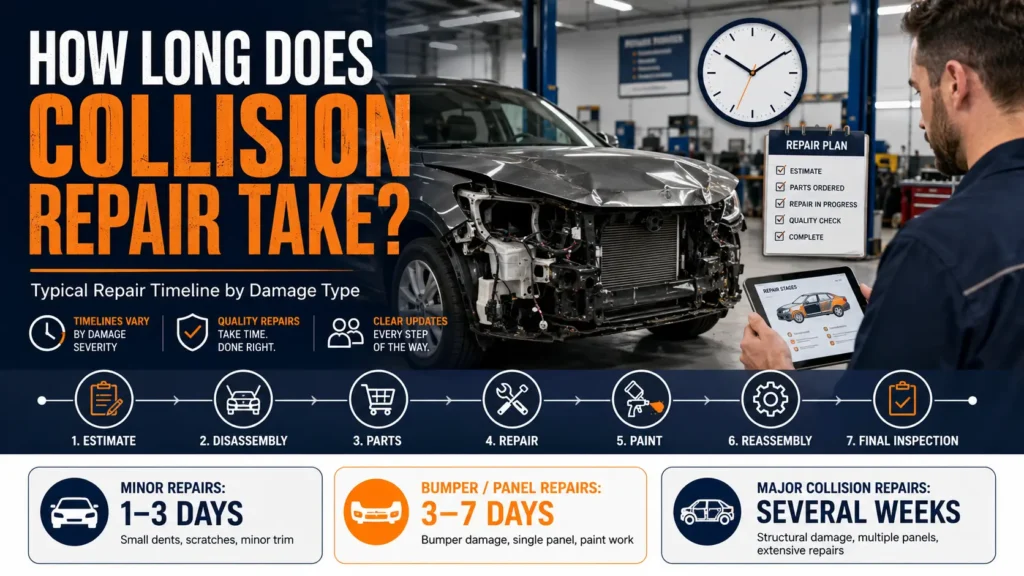
Collision repair can take anywhere from a few days to several weeks, depending on the severity of the damage, parts availability, insurance approval, vehicle technology and the amount of paint or structural work required.
A small bumper scrape or shallow dent may require only a short repair period. A collision involving multiple body panels, structural damage, airbags, suspension components or advanced driver-assistance systems will usually take longer.
The first repair estimate is also not always the final timeline. Hidden damage may become visible only after the damaged area is disassembled. When additional repairs are discovered, the body shop may need to update the estimate, obtain authorization and order more parts before work can continue.
For drivers in Cathedral City and the Coachella Valley, understanding the repair process can make it easier to plan transportation, communicate with the insurance company and recognize why a completion date may change.
How Long Does Auto Body Repair Take?
The following ranges can be used as general planning examples:
| Type of collision damage | General planning range |
| Minor scratch or small dent | 1–3 working days |
| Paintless dent repair | Same day to 2 working days |
| Minor bumper repair | 2–4 working days |
| Bumper replacement and painting | 3–7 working days |
| Single-panel body and paint repair | 3–7 working days |
| Multiple damaged body panels | 1–3 weeks |
| Frame or structural repair | 1–3 weeks or longer |
| Major collision repair | Several weeks |
These are not guaranteed completion times. The actual duration depends on the vehicle, damage, repair procedures, parts supply, insurance process and shop workload.
A body shop should inspect the vehicle and prepare a detailed repair plan before giving a reliable estimate of how long the work may take. The California Bureau of Automotive Repair explains that teardown and detailed estimating can help shops provide more realistic repair timeframes and reduce repeated estimate revisions.
What Determines the Collision Repair Timeline?
Two vehicles with similar-looking exterior damage may require very different repairs. The condition of the components behind the damaged panel often matters more than the size of the visible dent.
The main factors affecting repair time include:
- The number of damaged panels
- Whether a part can be repaired or must be replaced
- Hidden damage found during disassembly
- Structural or frame damage
- Mechanical and suspension repairs
- Replacement-part availability
- Insurance inspections and approvals
- Paint preparation, blending and curing
- Diagnostic scanning and sensor calibration
- Final quality-control inspections
An estimate written from photographs may provide a starting point, but it cannot always show damage hidden behind bumpers, fenders, trim or interior panels.
I-CAR identifies incomplete damage reports, hidden damage and supplements as factors that can interrupt the repair cycle. A more complete damage analysis early in the process generally improves scheduling accuracy.
How Long Does Minor Dent Repair Take?
A small, accessible dent may be repaired in one or two working days. In some cases, paintless dent repair can be completed on the same day.
Paintless dent repair, commonly called PDR, may be suitable when:
- The original paint is not cracked
- The metal is not severely stretched
- The dent is accessible from behind
- The damage is not located on a difficult body line
- The panel does not have extensive previous repair work
PDR can be faster because the technician does not need to apply body filler, primer, base coat and clear coat.
However, a dent that appears minor may require conventional body repair when it has a sharp crease, damaged paint or stretched metal. Conventional dent repair may involve reshaping the panel, preparing the surface and refinishing the affected area. That additional work can extend the repair to several days.
The exact location also matters. A dent in an easily accessible door may be simpler than damage near a reinforced edge, wheel opening or structural section.
How Long Does Bumper Repair Take?
A minor bumper repair commonly takes approximately two to four working days. Replacement and refinishing may take three to seven working days, assuming the correct parts are available.
The timeline depends on whether the bumper has:
- Surface scratches
- Paint transfer
- Dents
- Cracks
- Broken mounting tabs
- Damaged reinforcement
- Parking sensors
- Cameras or radar components
A bumper cover is only the visible part of the bumper system. Behind it may be an impact absorber, reinforcement bar, brackets, wiring and electronic components.
When technicians remove the cover, they may discover damage that was not visible during the initial inspection. The body shop may then need to prepare a collision repair supplement and wait for additional approval.
Modern vehicles can also have safety and driver-assistance technology positioned in or near bumper areas. Depending on the vehicle and repair, diagnostic scanning or calibration may be required. I-CAR notes that scan requirements vary according to the vehicle’s age, equipment, damage and component locations.
How Long Does Fender Repair Take?
A minor fender repair may take approximately three to five working days. Replacing and refinishing a fender can take around four to seven working days when parts are available and no hidden damage is found.
A fender repair may include:
- Removing trim, lamps or the wheel-liner area.
- Repairing or replacing the damaged fender.
- Checking adjacent mounting areas.
- Preparing the panel for refinishing.
- Matching and applying the paint.
- Blending nearby panels when necessary.
- Reassembling and inspecting the vehicle.
The job can take longer when the accident also damaged the bumper, headlight, hood, door, suspension or inner structure.
Paint color is another factor. Metallic and pearl finishes can require additional blending into adjacent panels to create a consistent appearance.
How Long Does Auto Painting Take?
Painting one repaired body panel may require approximately three to seven working days as part of the full repair process. A larger refinishing project involving multiple panels or the entire vehicle will take longer.
Professional automotive painting includes more than spraying color onto the surface. The process may involve:
- Removing moldings, handles or trim
- Repairing the underlying panel
- Sanding and preparing the surface
- Applying corrosion protection
- Applying primer
- Matching the existing paint
- Applying base coat and clear coat
- Blending adjacent panels
- Allowing materials to cure
- Polishing and inspecting the finish
Paint preparation has a major effect on the final quality. Rushing surface preparation or curing can create visible defects, adhesion problems or an inconsistent finish.
Weather outside the shop is generally less important when painting occurs in a properly controlled booth, but material requirements and repair complexity still affect the schedule.
How Long Does Frame Straightening Take?
Frame or structural repair may take one to three weeks or longer, depending on the location and severity of the damage.
Structural repairs often require additional steps, including:
- Vehicle disassembly
- Three-dimensional measurement
- Manufacturer repair research
- Structural pulling or straightening
- Welded component replacement
- Suspension inspection
- Wheel alignment
- Corrosion-protection restoration
- Reassembly
- Final measurements and quality checks
Three-dimensional measuring systems allow collision technicians to compare vehicle dimensions and document conditions before and after structural repairs.
A vehicle with minor structural movement may require less work than one with damaged frame rails, pillars, floor sections or suspension mounting points.
Structural repair should not be rushed simply to meet an early estimated completion date. The repair plan should be based on accurate measurements and procedures for the specific vehicle.
How Long Does Major Collision Repair Take?
A major accident repair can require several weeks.
This category may involve:
- Multiple damaged exterior panels
- Frame or unibody damage
- Airbag deployment
- Mechanical repairs
- Suspension damage
- Cooling-system components
- Electrical problems
- Interior repairs
- Diagnostic scanning
- ADAS calibration
- Extensive paintwork
The shop may also need to coordinate with outside specialists for services such as wheel alignment, glass installation or calibration. These outsourced operations are often called sublet repairs.
Major collision work usually follows several distinct stages. A delay at one stage can affect the entire delivery date.
For example, the vehicle may be fully disassembled before the shop discovers that a structural component or electronic module must be ordered. Work in that area may pause until the component arrives.
What Are the Main Stages of Collision Repair?
Understanding the repair process helps explain why a vehicle may not be completed immediately after arriving at the body shop.
1. Initial inspection and estimate
The estimator records visible damage, takes photographs and reviews the accident information.
The initial estimate may identify:
- Damaged body panels
- Broken lamps
- Visible bumper damage
- Paint and refinishing needs
- Obvious structural concerns
- Preliminary parts and labor
The first inspection creates a starting point, but it may not reveal every damaged component.
2. Insurance review and customer authorization
When an insurance claim is involved, the insurer may inspect the vehicle or review photographs and the estimate.
The repair facility must also obtain the vehicle owner’s authorization. In California, body shops must provide an itemized estimate and document authorization for repairs and supplemental changes.
Repairs can be delayed when the shop, insurer and customer have not yet agreed on the work or payment responsibility.
3. Disassembly and damage analysis
The damaged area is carefully taken apart so technicians can inspect hidden components.
This may reveal:
- Broken brackets
- Bent reinforcement
- Structural damage
- Damaged wiring
- Mechanical problems
- Additional parts requirements
A detailed repair plan created after disassembly is often more reliable than an exterior-only estimate.
4. Supplemental estimate approval
When additional accident damage is discovered, the shop prepares a supplement.
The insurance company may review photographs, parts prices, measurements and required repair procedures. The approval process may be quick, or it may take longer when an adjuster must reinspect the vehicle.
5. Parts ordering
The shop orders the parts needed to complete the approved repair.
A repair may be delayed when a part is:
- Backordered
- Incorrect
- Damaged during shipping
- Unavailable locally
- Superseded by a different part number
- Dependent on the vehicle identification number
- Requiring additional clips or hardware
Parts availability is one of the hardest timeline factors for a repair shop to control.
6. Body and structural repair
Technicians repair or replace damaged panels and structural components.
This stage may involve metal straightening, welding, measuring, panel fitting and restoration of factory-style corrosion protection.
7. Paint preparation and refinishing
The repaired areas are prepared, primed, painted and clear-coated. Adjacent panels may be blended when needed for a consistent color transition.
8. Reassembly and calibration
The vehicle is reassembled with trim, lamps, sensors, wiring and other components.
Depending on the vehicle, the repair process may also require diagnostic scanning or calibration of cameras, radar and other driver-assistance features.
9. Quality control and final inspection
Before delivery, the body shop should check:
- Panel alignment
- Paint appearance
- Warning lights
- Vehicle functions
- Cleanliness
- Repair documentation
- Road-test results when appropriate
California’s Bureau of Automotive Repair offers no-cost inspections for qualifying collision repairs and notes that much of the completed repair may be hidden beneath vehicle panels.
Why Do Collision Repairs Sometimes Take Longer Than Expected?
A repair completion date is usually an estimate rather than an absolute promise.
Common causes of delay include hidden damage, supplement review, parts shortages and added manufacturer procedures.
Hidden accident damage
The repair timeline can change when disassembly reveals damage behind the visible panels.
For example, a damaged front bumper may also conceal a bent reinforcement bar, broken air guide, damaged radiator support or sensor problem.
Insurance supplement approval
When new damage is found, the body shop may need insurer approval before continuing the affected work. The adjuster may ask for more documentation or an in-person inspection.
Incorrect or delayed parts
Even when a part arrives on time, it may be the wrong version for the vehicle. Trim level, production date, sensor openings and vehicle options can affect the correct part selection.
Advanced vehicle technology
Newer vehicles may require scanning, calibration or specialized procedures. These operations can add scheduling time, particularly when completed by an outside specialist.
Additional mechanical problems
An accident may damage suspension, steering or cooling-system components. These issues may become clearer during measurement, alignment or road testing.
Total-loss review
If hidden damage raises the repair cost substantially, the insurer may reconsider whether the vehicle should be declared a total loss. Repairs may pause until that decision is made.
Can You Make Collision Repair Faster?
The vehicle owner cannot control every delay, but several actions can help keep the process moving.
Provide the body shop with:
- Insurance company and claim information
- Adjuster contact details
- Accurate vehicle information
- Prompt repair authorization
- Current contact information
- Quick responses to approval questions
Remove personal belongings before leaving the vehicle and tell the shop about any warning lights or driving symptoms that appeared after the accident.
It is also helpful to choose a shop that performs detailed damage analysis, communicates clearly and orders parts as early as reasonably possible.
Do not pressure technicians to skip inspections, paint-curing requirements, measurements or calibration procedures merely to reduce the timeline.
How to Plan for Transportation During Repairs
When an insurer is involved, ask whether your policy includes rental reimbursement coverage. Confirm:
- The daily rental limit
- The maximum total benefit
- When coverage begins
- When rental coverage ends
- Whether you must use a specific provider
- What happens when repairs are delayed by parts
A repair facility can explain the estimated timeline, but only the insurer can confirm the rental benefits available under your policy.
Customers paying for their own rental vehicle should avoid making nonrefundable plans based solely on an early visual estimate.
Collision Repair Timeline in Cathedral City, CA
CatCity Auto Body serves drivers in Cathedral City and surrounding Coachella Valley communities after fender benders, parking-lot accidents and more serious collisions. The business describes its process as including an inspection for visible and hidden damage, followed by a detailed estimate addressing repair cost and timing.
The most accurate repair timeline can usually be provided after the vehicle has been inspected, the damaged area has been disassembled when necessary, the repair plan has been documented and required parts have been identified.
For a collision repair assessment in Cathedral City, contact CatCity Auto Body at 760-324-7117.
Frequently Asked Questions
Minor auto body repairs may take a few working days, while repairs involving multiple panels, structural damage or electronic systems can require several weeks. The body shop must inspect the specific vehicle before providing a reliable timeline.
Some very minor bumper damage may be repaired quickly, but most repairs require time for disassembly, surface preparation, painting, curing and reassembly. Hidden damage or sensor-related procedures can extend the timeline.
The shop may be waiting for insurance approval, replacement parts, a supplement decision or a specialized repair procedure. Ask the estimator which stage the vehicle is in and what must happen before work can continue.
It can. When the insurer must inspect the vehicle or review a supplemental estimate, the affected work may pause until payment and authorization questions are resolved.
A supplement can extend the repair timeline because the body shop may need to document additional damage, obtain approval and order more parts. A thorough early teardown can reduce repeated supplements but cannot prevent every change.
Painting one repaired area may be part of a three-to-seven-working-day process. The total time includes panel repair, preparation, primer, color matching, base coat, clear coat, curing, polishing and reassembly.