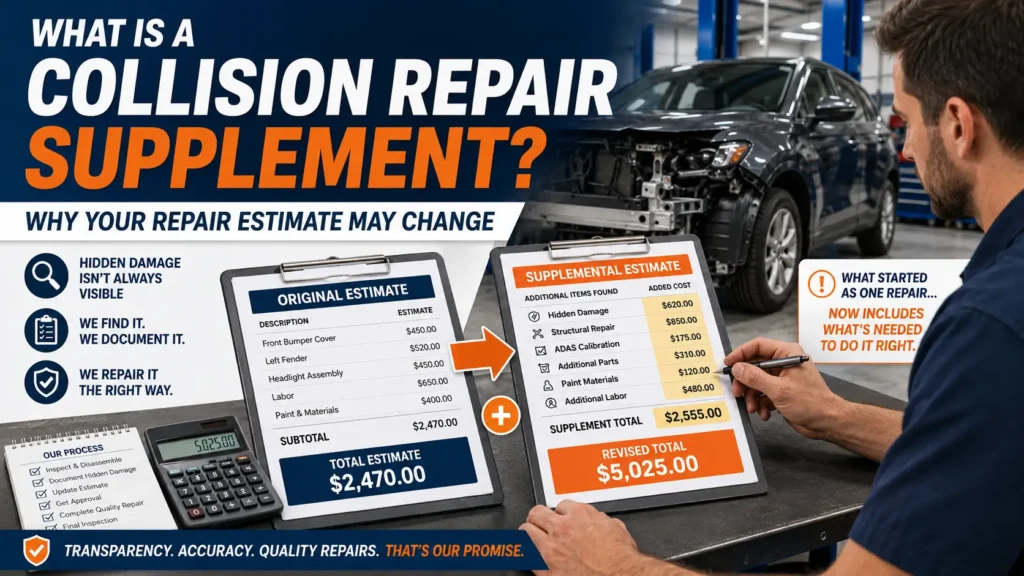
A collision repair supplement is a revised estimate that documents additional accident-related damage, parts, labor or repair procedures that were not included in the original estimate.
Supplements are common because an initial insurance or body shop estimate is often based primarily on visible damage. Once technicians remove the bumper, fender, interior trim or other affected components, they may discover hidden structural, mechanical or electronic damage.
The auto body shop then documents the newly identified work and submits a supplemental estimate to the insurance company for review. The insurer may approve the additional cost, request more documentation, inspect the vehicle again or dispute specific line items.
A supplement does not necessarily mean the repair shop made a mistake. In many cases, the additional damage could not have been confirmed until the vehicle was carefully disassembled.
Quick Answer: What Is a Supplemental Estimate for Auto Repair?
A supplemental estimate, sometimes called a repair supplement, is an addition or revision to the original collision repair estimate.
It may include:
- Hidden damage found after vehicle disassembly
- Additional replacement parts
- Revised parts prices
- Added body, frame, paint or mechanical labor
- Diagnostic scanning
- Wheel alignment
- Structural measurements
- Advanced driver-assistance system calibration
- Corrosion-protection materials
- Manufacturer-required repair operations
The supplement helps the body shop, vehicle owner and insurance company agree on the updated scope and cost of the collision repair.
I-CAR explains that an initial inspection may not identify every accident-related problem, particularly after a heavier impact. Damage concealed behind exterior panels may be added to the damage report after it becomes accessible.
Why Wasn’t All the Damage Included in the Original Estimate?
An initial damage appraisal is based on the information available at the time of inspection. Even a trained estimator cannot always see what is behind a damaged bumper, fender, door, quarter panel or interior component.
A vehicle that appears to have minor exterior damage may also have broken mounting points, bent reinforcement components, damaged wiring or misaligned structural areas.
For example, a rear bumper may show only scratches and a small dent. After the bumper cover is removed, technicians might find:
- A cracked energy absorber
- Bent bumper reinforcement
- Broken mounting brackets
- Damaged parking sensors
- Pinched wiring
- Distorted rear body panels
- Damage near the trunk floor
These components cannot always be inspected accurately while the bumper remains assembled.
The California Bureau of Automotive Repair recognizes that collision damage may be hidden from an initial visual inspection. A proper teardown can help identify the full repair scope, reduce repeated supplement revisions and provide a more realistic repair timeline.
What Is a Collision Repair Teardown?
A collision repair teardown, also called vehicle disassembly, is the controlled removal of damaged or adjacent components so the shop can inspect the underlying areas.
Depending on the accident, technicians may remove:
- Bumper covers
- Headlights and taillights
- Grilles
- Fender liners
- Exterior trim
- Interior trim panels
- Damaged doors or fenders
- Reinforcement components
- Cooling-system parts
- Underbody shields
The goal is not simply to take the vehicle apart. The shop uses the teardown to create a more complete repair plan, identify parts that must be ordered and determine which manufacturer procedures apply.
California repair facilities must properly document teardown work and obtain the customer’s authorization. Updated California requirements also address what collision repair teardown estimates must disclose, including the affected area and related charges.
A thorough initial teardown can reduce the likelihood of multiple supplements later in the repair, although newly discovered issues may still arise.
What Types of Damage Commonly Create a Supplement?
Hidden bumper damage
Modern bumpers are multi-part systems. The painted bumper cover is only the visible outer component.
Behind it may be:
- Impact absorbers
- Reinforcement bars
- Mounting brackets
- Air guides
- Wiring
- Cameras
- Radar units
- Parking sensors
A bumper that looks repairable from the outside may require additional parts after disassembly. Some vehicles also place driver-assistance components behind or near the bumper cover. I-CAR notes that systems such as blind-spot monitoring and adaptive cruise control can involve sensors positioned behind bumper areas, requiring special repair considerations.
Structural or frame damage
Impact forces can travel beyond the visibly damaged panel.
A front or rear collision may affect:
- Frame rails
- Aprons
- Radiator supports
- Crush zones
- Floor sections
- Pillars
- Subframes
- Suspension mounting points
Technicians may need three-dimensional measuring equipment to compare vehicle dimensions with manufacturer specifications. This measurement can help document structural conditions before and after straightening.
Structural damage can substantially increase an estimate because it may require additional disassembly, measuring, pulling, welding, part replacement and corrosion-protection procedures.
Damaged clips, brackets and fasteners
Small parts can create meaningful estimate changes when many are required.
During teardown, the shop may find damaged or one-time-use:
- Clips
- Retainers
- Bolts
- Brackets
- Adhesive tapes
- Emblems
- Moldings
- Seals
- Rivets
These components may not appear on a photo estimate but can be necessary to reassemble the vehicle correctly.
Paint blending and refinishing operations
The initial estimate may include repainting the visibly damaged panel but omit related refinishing procedures.
Additional operations can include:
- Removing trim before painting
- Preparing repaired surfaces
- Applying primer
- Matching the vehicle’s paint color
- Blending adjacent panels
- Applying clear coat
- Restoring texture or undercoating
- Polishing repaired areas
Metallic, pearl and other complex paint finishes may require blending into nearby panels to create a consistent visual transition.
Mechanical and suspension damage
A collision can damage mechanical components even when the exterior damage appears limited.
Possible supplement items include:
- Control arms
- Tie rods
- Wheel bearings
- Steering components
- Radiators
- Air-conditioning condensers
- Cooling fans
- Exhaust components
- Wheel alignment
These problems may become apparent only after the vehicle is raised, measured or road-tested.
Electronic and ADAS-related damage
Newer vehicles contain interconnected electronic safety and convenience systems.
Depending on the vehicle, a collision may affect:
- Forward collision warning
- Automatic emergency braking
- Adaptive cruise control
- Blind-spot monitoring
- Parking assistance
- Lane-departure systems
- Surround-view cameras
- Airbag and restraint systems
Some electronic problems do not immediately activate a visible warning light. I-CAR states that diagnostic checks may be needed to identify hidden damage involving vehicle electronics and driver-assistance systems.
A supplement may therefore include pre-repair scanning, post-repair scanning, diagnostic labor or sensor calibration when required for the specific vehicle and repair.
Does a Repair Supplement Mean the Body Shop Made a Mistake?
Not necessarily.
A supplement may result from:
- Damage that was physically concealed
- An initial photo-based estimate
- Parts that could not be inspected before removal
- Updated parts pricing
- Parts availability changes
- Manufacturer procedures identified during repair planning
- Additional damage discovered during measurement or diagnostics
A well-prepared body shop estimate should be as complete as reasonably possible. However, no estimator should claim to know the condition of components that cannot be inspected.
A supplement may indicate poor initial planning when obvious and accessible damage was overlooked. But the existence of a supplement alone is not evidence of carelessness or dishonesty.
The better question is whether the added repairs are clearly documented and related to the covered accident.
How Does the Collision Supplement Process Work?
Although the exact process varies by insurer and repair facility, it usually follows several stages.
1. The shop identifies additional damage
After receiving authorization, the shop disassembles the affected area and completes a detailed damage analysis.
Technicians and estimators document newly found problems using:
- Photographs
- Videos
- Measurements
- Diagnostic reports
- Parts information
- Manufacturer repair procedures
- Written repair-plan notes
2. The original estimate is revised
The estimator adds the newly required parts, labor, materials and repair operations to the damage report.
The revised document should show the difference between the original estimate and the supplemental amount.
For example:
| Estimate stage | Amount |
| Original estimate | $4,200 |
| Hidden structural repair | $650 |
| Additional parts | $430 |
| Diagnostic and calibration work | $320 |
| Revised estimated total | $5,600 |
These figures are only an example. Actual supplements vary widely depending on vehicle design, accident severity, insurance coverage and parts prices.
3. Documentation is sent to the insurer
The body shop submits the supplemental estimate and supporting evidence to the insurance adjuster.
The insurer may:
- Review the request remotely
- Ask for additional photographs
- Request invoices or parts documentation
- Send an appraiser to reinspect the vehicle
- Approve the supplement
- Approve only certain items
- Dispute or negotiate specific charges
4. The customer is informed
The vehicle owner should be notified when the repair scope or expected price changes.
California repair rules require customer authorization before repairs begin. Additional repairs or revised estimate amounts must also be properly authorized and documented.
Insurance approval is not a replacement for customer authorization. The vehicle owner remains the repair shop’s customer, even when an insurer is paying most of the bill.
5. Repairs continue after approval and authorization
Once the added work has been reviewed and authorized, the repair facility can continue with the affected operations.
The shop may also update:
- Parts orders
- Repair completion estimates
- Rental-car expectations
- Customer-payment estimates
- Quality-control procedures
How Long Does Insurance Approval for a Supplement Take?
There is no single approval time that applies to every collision claim.
Some supplements are reviewed quickly through photographs and electronic estimating systems. Others require an in-person inspection, additional documentation or discussions about parts and repair procedures.
Approval may take longer when:
- The adjuster must inspect the vehicle again
- The supplement contains structural damage
- Expensive parts are involved
- The vehicle may be a total loss
- The insurer requests manufacturer documentation
- Parts prices or labor operations are disputed
- Multiple supplements are submitted
- The claim involves several damaged areas
The repair facility should explain whether work can continue safely or whether the affected repair stage must pause until authorization is received.
A complete teardown and detailed repair plan prepared near the beginning of the process can reduce repeated interruptions and produce a more realistic schedule. California’s Bureau of Automotive Repair specifically identifies fewer supplemental revisions and more realistic timelines as benefits of thorough collision teardown procedures.
Will the Insurance Company Pay the Supplement?
The insurance company will review whether the additional work:
- Relates to the covered accident
- Falls within the policy’s coverage
- Is properly documented
- Uses reasonable parts and labor charges
- Meets accepted repair standards
- Is necessary to complete the repair
The insurer may approve the entire supplement, approve part of it or deny certain items.
A denial does not automatically mean the repair is unnecessary. It may mean the insurer wants additional evidence, disagrees with the proposed procedure or believes another repair method or part should be used.
The California Department of Insurance states that consumers may choose their own body shop and that insurers cannot require repairs at a specific facility. California also provides consumer guidance concerning estimates, parts identification and collision-repair rights.
Coverage decisions ultimately depend on the policy, accident circumstances and claim investigation.
Will You Have to Pay More Because of a Supplement?
A supplement does not automatically increase the amount the vehicle owner must pay.
In many covered claims, the insurer pays approved supplemental costs while the customer remains responsible for the original deductible.
However, additional customer charges may arise from:
- Pre-existing damage
- Damage unrelated to the accident
- Policy exclusions
- Coverage limits
- Customer-requested upgrades
- Betterment charges when applicable
- Non-covered repair choices
- Work authorized before payment responsibility was clarified
Before approving additional work, ask the body shop:
- Has the insurer approved the supplement?
- Which items are still being reviewed?
- Does the supplement change my deductible?
- Are any costs expected to be my responsibility?
- Why are the added operations necessary?
- Will the supplement change the completion date?
Request answers in writing when the financial responsibility is unclear.
Can a Supplement Cause the Vehicle to Be Declared a Total Loss?
Yes.
A vehicle may initially appear repairable based on visible damage. After disassembly, additional structural, mechanical or electronic damage may increase the estimated repair cost significantly.
The insurance company may then reevaluate whether repairing the vehicle remains economically appropriate under applicable total-loss standards.
This is one reason a complete damage analysis is important before extensive repairs are performed. California’s updated teardown guidance notes that a detailed early assessment can help prevent a situation in which a vehicle is declared a total loss only after substantial repairs have already begun.
If the insurer begins evaluating the vehicle as a possible total loss, ask the shop to pause unnecessary work until the claim status is clear.
Can You Reduce the Chance of Multiple Supplements?
A supplement cannot always be avoided, but a careful repair-planning process may reduce repeated revisions.
Look for a collision repair facility that:
- Performs a detailed initial inspection
- Obtains authorization for teardown
- Disassembles the relevant damaged areas
- Uses manufacturer repair information
- Identifies all required parts
- Documents structural measurements
- Considers scanning and calibration requirements
- Communicates with the insurer early
- Provides regular customer updates
In the collision industry, this comprehensive planning process is often called blueprinting.
I-CAR describes blueprinting as a structured process intended to discover damage before repairs begin, identify required parts and determine the correct repair information.
Even a strong blueprint may require later revisions, but it usually provides a more complete starting point than a visual-only estimate.
What Should You Ask When a Supplement Is Submitted?
Vehicle owners do not need to understand every estimating code, but they should receive a clear explanation of major changes.
Ask the estimator:
- What additional damage was discovered?
- Was the damage hidden before disassembly?
- Can I see photographs of the added damage?
- Which new parts or procedures are required?
- Has the insurer reviewed the supplement?
- Are any items currently disputed?
- Could I owe more than my deductible?
- Does the supplement affect the repair timeline?
- Is there a possibility the vehicle will be declared a total loss?
- Will I receive a detailed final invoice?
California consumers are entitled to an estimate showing expected parts and labor costs, authorization before repair work and a final invoice describing the completed services.
Collision Repair Supplements in Cathedral City, CA
Accident damage is not always limited to what can be seen from outside the vehicle. A scratched bumper, bent fender or damaged headlight may conceal problems involving reinforcement components, mounting areas, electronics or vehicle structure.
A qualified collision repair facility should inspect the vehicle carefully, explain newly discovered damage and document any required supplement before proceeding with additional work.
CatCity Auto Body helps drivers in Cathedral City and the surrounding Coachella Valley understand collision damage estimates, supplemental repairs and insurance-related repair procedures.
When reviewing a supplement, the goal is not simply to increase the estimate. The goal is to create a complete, documented repair plan that accounts for all accident-related damage.
To discuss a collision repair estimate or arrange a vehicle inspection, contact CatCity Auto Body at 760-324-7117.
Frequently Asked Questions
A supplement is a revision to the original repair estimate. It adds accident-related parts, labor or procedures discovered after the first inspection, often during vehicle disassembly, measurement or diagnostic testing.
Yes. Supplements are common because bumpers, fenders, doors and other exterior panels can conceal damage. Modern vehicle electronics and driver-assistance components can also require diagnostic procedures that are not obvious during an exterior inspection.
Not always. The insurance estimate may have been a preliminary assessment based on visible damage or photographs. A supplement provides updated information after the repair facility gains access to hidden areas.
The collision repair facility usually prepares the supplement. The estimator documents additional damage, updates the repair plan and sends the information to the insurance company for review.
The vehicle owner must authorize additional repairs. Whether work proceeds before insurer approval depends on the situation and the customer’s willingness to accept possible financial responsibility. Customers should clarify payment before authorizing disputed or unapproved work.
Normally, a supplement does not create a second deductible for the same covered claim. It revises the cost of the existing repair. Policy terms and claim circumstances can vary, so confirm your responsibility with the insurer.
The bumper cover can hide reinforcement bars, absorbers, sensors, wiring, brackets and structural mounting areas. These components may be impossible to inspect completely until the cover is removed.
Yes. Repairs may pause while the insurer reviews the additional documentation, reinspects the vehicle or resolves disputed line items. A detailed initial teardown can help reduce repeated delays.