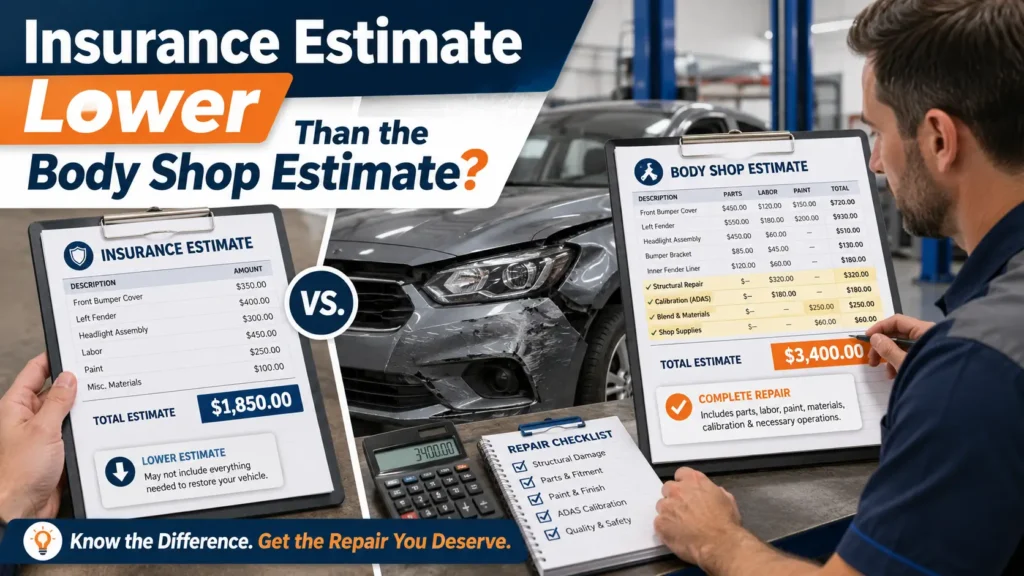
Receiving two different collision repair estimates after an accident can be confusing. Your insurance company may estimate the damage at $3,500, while the auto body shop determines that the vehicle needs $5,200 in repairs.
Does that mean you must immediately pay the $1,700 difference?
Usually, no.
An insurance estimate is often an initial assessment based on visible damage, available photographs and the insurer’s estimating process. Once the vehicle reaches a collision repair facility and damaged components are removed, technicians may identify hidden damage, additional labor, required replacement parts or manufacturer-recommended repair procedures that were not included in the first estimate.
The body shop can document these differences and submit a collision repair supplement to the insurance company for review. Your final financial responsibility depends on your insurance coverage, deductible, approved repairs, policy exclusions and any repair choices you make.
What Happens When the Insurance Estimate Is Too Low?
When an insurance estimate is lower than the body shop estimate, the typical process is:
- The body shop compares both estimates line by line.
- The vehicle may be disassembled to identify hidden collision damage.
- The repair facility documents missing parts, labor and procedures.
- A supplemental estimate is submitted to the insurance adjuster.
- The insurer reviews the additional repair costs.
- You authorize any changes before additional repairs proceed.
- The final amount is divided among the insurer, your deductible and any non-covered costs.
A lower initial estimate does not automatically mean the insurance company has denied the additional repair work. It often means the insurer has not yet received enough documentation to evaluate the complete repair.
Why Is the Insurance Estimate Lower Than the Body Shop Estimate?
An insurance company and an auto body shop may inspect the same vehicle for different purposes.
The insurance appraiser is evaluating the covered loss and preparing an initial claim estimate. The collision repair facility is developing a repair plan intended to restore the damaged vehicle using appropriate parts, labor operations, materials and repair procedures.
Several factors can create an estimate discrepancy.
1. The Insurance Estimate May Cover Only Visible Damage
Photographs and exterior inspections cannot always show the complete extent of accident damage.
A cracked bumper cover may hide damage to:
- Bumper reinforcement bars
- Energy absorbers
- Mounting brackets
- Wiring harnesses
- Parking sensors
- Lamps
- Cooling components
- Structural mounting points
Similarly, a damaged fender can conceal problems involving the apron, suspension mounting areas, inner panels or adjacent components.
I-CAR explains that an initial inspection may not identify all collision-related damage because some problems are hidden behind panels and become visible only after adjacent parts are removed. These newly discovered items may be added to the damage report through a supplement.
2. The Body Shop May Perform a More Detailed Teardown
A teardown, also called disassembly, involves removing damaged components so technicians can inspect the areas behind them.
For example, inspecting front-end collision damage may require removing the:
- Bumper cover
- Grille
- Headlamps
- Fender liners
- Damaged trim
- Impact absorber
- Reinforcement components
California’s Bureau of Automotive Repair notes that collision damage frequently includes problems that cannot be identified through a visual inspection alone. A teardown allows the repair facility to evaluate the full damage and prepare a more accurate repair estimate.
The shop must explain and obtain authorization for the teardown before disassembly begins. California regulations also require applicable teardown estimates to describe the area being disassembled and disclose related costs.
3. Necessary Repair Operations May Be Missing
Collision estimates contain individual repair operations. A short estimate may include the major damaged part but leave out related work needed to complete the repair properly.
Potentially missing operations may include:
- Removing and installing adjacent components
- Refinishing and paint preparation
- Blending paint into nearby panels
- Corrosion-protection restoration
- Seam-sealer replacement
- Vehicle scanning
- Wheel alignment
- Structural measurements
- Sensor calibration
- Road testing
- Post-repair inspections
- Replacement of clips, fasteners and one-time-use parts
Not every operation applies to every vehicle. The correct procedures depend on the vehicle, damage location, construction materials, installed technology and manufacturer repair information.
4. Labor Rates or Labor Times May Differ
The insurance repair estimate and body shop quote may use different assumptions about:
- Body labor rates
- Refinishing rates
- Frame or structural labor rates
- Mechanical labor
- Paint and material charges
- The number of labor hours required
- Included and non-included estimating operations
A difference in total labor cost does not necessarily mean either party made a simple mathematical error. The estimates may contain different procedures, labor categories or repair decisions.
The best approach is to compare the documents line by line instead of focusing only on the final totals.
5. The Estimates May Specify Different Parts
One estimate may specify an original equipment manufacturer part, while another lists an aftermarket, recycled, reconditioned or alternative replacement component.
These choices can produce substantial price differences for items such as:
- Bumper covers
- Fenders
- Hoods
- Lamps
- Doors
- Grilles
- Mirrors
- Radiators and condensers
California collision repair estimates must identify replacement crash parts appropriately. New replacement parts are treated as new OEM parts unless the estimate specifically identifies them as non-OEM aftermarket or used parts.
California’s Auto Body Repair Consumer Bill of Rights also states that estimates and invoices must identify parts as new, used, aftermarket, reconditioned or rebuilt.
The appropriate part may depend on availability, policy terms, vehicle-manufacturer requirements and whether the proposed component provides the necessary fit, quality, safety and performance.
6. Modern Vehicle Technology May Increase the Repair Scope
A minor-looking accident can affect electronic systems that are not visibly damaged.
Depending on the vehicle, the damaged area may contain or affect:
- Blind-spot monitoring sensors
- Parking-assistance sensors
- Forward radar
- Surround-view cameras
- Adaptive headlights
- Airbag-system components
- Occupant-detection systems
- Driver-assistance technology
Some electronic faults may not immediately produce a dashboard warning. Diagnostic scanning, inspection or calibration requirements may therefore be added after the first insurance estimate. I-CAR notes that diagnostic checks can be necessary to identify hidden problems in advanced vehicle electronics and driver-assistance systems.
What Is a Collision Repair Supplement?
A collision repair supplement is a documented request to add accident-related repairs or costs that were not included in the original estimate.
A supplement may be needed when the body shop finds:
- Hidden damage after disassembly
- Additional damaged components
- Different parts prices
- Missing labor operations
- Necessary structural measurements
- Required diagnostic procedures
- Additional paint and material costs
- Manufacturer-required repair steps
- Sublet work such as alignment or calibration
The repair facility normally provides photographs, measurements, invoices, diagnostic information and revised estimate line items to support the request.
A supplement does not automatically mean the original estimator or body shop made a mistake. Many supplements result from damage that could not reasonably be confirmed before the vehicle was disassembled.
I-CAR describes supplements as new damage-report items that become necessary when previously hidden collision damage is discovered.
Will the Insurance Company Pay the Body Shop’s Full Estimate?
The insurer may approve the entire supplement, approve part of it or request more information.
Payment can depend on:
- The terms of the insurance policy
- Whether the damage resulted from the covered accident
- The customer’s deductible
- Policy limits and exclusions
- The documentation supporting the repair
- Whether the cost is considered reasonable
- The type and availability of replacement parts
- Accepted repair standards
- Any betterment or customer-requested upgrades
California guidance states that when a consumer chooses a repair shop, the insurer must pay reasonable repair costs for work performed according to accepted trade standards. However, each claim still depends on its facts and applicable policy terms.
Do not assume that every difference will be paid automatically. Ask the repair facility and insurance adjuster to explain which items have been approved, denied or remain under review.
Could You Be Required to Pay Part of the Difference?
You may be responsible for certain amounts, including:
- Your insurance deductible
- Damage unrelated to the covered accident
- Pre-existing damage
- Policy exclusions or coverage limits
- Customer-requested upgrades
- Betterment charges when applicable
- Work you authorize before confirming insurance payment
- Differences involving a repair option that the policy does not cover
The body shop should explain the estimated customer responsibility before proceeding. If the approved insurance amount is unknown, California repair documentation may inform the customer that they are responsible for contacting the third-party payer to confirm payment for authorized repairs.
This does not mean you should negotiate complex repair details alone. A qualified collision repair estimator can help identify the disputed line items and provide supporting documentation.
What Should You Do When the Two Estimates Do Not Match?
Step 1: Obtain Complete Copies of Both Estimates
Request the complete:
- Insurance damage estimate
- Body shop repair estimate
- Parts list
- Labor breakdown
- Paint and material charges
- Photographs or damage documentation
- Supplement information, when available
Do not compare only the final prices. Two estimates with different totals may also describe very different repair plans.
Step 2: Ask for a Line-by-Line Explanation
Ask the body shop to identify:
- Which procedures are missing
- Which parts differ
- Why the labor hours are different
- Whether hidden damage was discovered
- Which items relate directly to safety or manufacturer procedures
- Which charges may become your responsibility
A clear explanation should identify specific repair operations rather than simply state that the insurer’s estimate is “too low.”
Step 3: Allow the Shop to Submit a Supplement
The body shop can send the insurance company a revised estimate supported by:
- Damage photographs
- Teardown photographs
- Parts invoices
- Diagnostic reports
- Structural measurements
- Manufacturer repair information
- Calibration requirements
- Written explanations
The insurer may send an adjuster for another inspection or review the supplement remotely.
Step 4: Confirm Authorization Before Additional Work
California consumers must authorize repairs before the work begins. Authorization may be written, oral or electronic, but it must be documented. The shop must also inform the customer and receive authorization when additional problems change the repair.
Before approving changes, ask:
- Has the insurance company approved this item?
- How much is the insurer expected to pay?
- Does my deductible change?
- Could I owe anything beyond the deductible?
- Will this supplement affect the completion date?
Step 5: Request a Written Explanation for Unresolved Items
When an insurance company does not approve a repair procedure, ask for a clear explanation.
Compare that explanation with:
- Your policy
- The body shop’s documentation
- Applicable repair procedures
- The type of damage
- The proposed replacement parts
- Accepted collision repair standards
Maintain copies of emails, estimates, photographs, authorizations and claim correspondence.
Step 6: Escalate the Concern When Necessary
Start by speaking with the adjuster and body shop estimator. Many estimate differences can be resolved through additional documentation.
When a dispute remains unresolved, you may:
- Ask for an insurance claim supervisor
- Review the coverage with your agent
- Request clarification in writing
- Contact the California Department of Insurance about claim-handling concerns
- Contact the Bureau of Automotive Repair about concerns involving repair-shop conduct
California separates complaints about insurance claim handling from complaints concerning vehicle repairs.
Can You Choose Your Own Body Shop in California?
Yes. California’s Auto Body Repair Consumer Bill of Rights states that a consumer may select the auto body shop that repairs insurance-covered vehicle damage. It also states that consumers may obtain an independent estimate from a registered repair facility while pursuing an insurance claim.
An insurance company may recommend a repair facility, but it cannot require you to use one specific shop.
When selecting a collision repair center, look for:
- A detailed, itemized estimate
- Clear repair authorizations
- Documented supplement procedures
- Qualified technicians
- Appropriate repair equipment
- Transparent parts identification
- Written warranty information
- Help communicating with the insurance adjuster
- Thorough final quality-control inspections
Why the Lowest Estimate Is Not Always the Best Repair Plan
The purpose of a collision repair estimate is not simply to produce the lowest possible number. It should identify what is necessary to repair the accident damage properly.
An incomplete estimate may leave out:
- Hidden structural damage
- Damaged mounting components
- Required safety inspections
- Paint blending
- Electronic diagnostics
- Sensor calibration
- Corrosion protection
- One-time-use fasteners
- Post-repair verification
Conversely, a higher estimate should not be accepted without explanation. Every recommended operation should relate to the damage, repair procedures or documented vehicle requirements.
The strongest estimate is one that is detailed, supported and easy for the vehicle owner to understand.
Get Help Reviewing Your Collision Repair Estimate in Cathedral City
When your insurer’s estimate does not match the body shop estimate, do not panic and do not approve unclear charges.
Ask the repair facility to:
- Compare the estimates
- Inspect for hidden damage
- Explain the repair plan
- Document missing procedures
- Submit necessary supplements
- Clarify your expected financial responsibility
CatCity Auto Body assists Cathedral City and Riverside County drivers with collision damage assessment, auto body repair and insurance-related repair estimates. The shop states that it has more than 20 years of collision-industry experience and I-CAR- and ASE-certified technicians.
Call +1 760-324-7117 to request an estimate or discuss the next steps after an accident.
Frequently Asked Questions
Why is my body shop estimate higher than my insurance estimate?
The body shop may have identified hidden damage, additional labor operations, different replacement parts, diagnostic requirements or manufacturer-recommended procedures that were not included in the insurer’s preliminary assessment. The shop can submit these items as a supplement for review.
Do I have to pay the difference between the insurance estimate and repair estimate?
Not necessarily. The repair facility will usually submit documentation requesting approval for additional accident-related repairs. You may still be responsible for your deductible, excluded damage, pre-existing problems, customer-requested upgrades or work that the insurer does not cover.
What is a supplemental estimate for auto body repair?
A supplemental estimate is a revised damage report containing repairs or costs discovered after the original estimate. Supplements commonly include hidden damage found during disassembly, additional parts, labor procedures, scans, structural measurements or calibration work.
Can a body shop begin additional repairs without my permission?
California repair facilities must obtain customer authorization before beginning repairs and must receive authorization for additional work when newly discovered problems change the repair. Authorization can be written, oral or electronic, but it must be documented.
Can I take my vehicle to a body shop that is not on the insurance company’s list?
Yes. California consumers have the right to choose the auto body repair facility that repairs their vehicle. An insurer may recommend a shop, but it cannot require you to use one specific facility.
Does a collision repair supplement delay the repair?
It can. The body shop may need to pause affected work while the insurance company reviews photographs, parts prices or additional repair procedures. A thorough teardown and damage analysis early in the process can reduce repeated supplements and produce a more realistic repair timeline.
Is an insurance estimate the final repair price?
Not always. An insurance estimate may be based on visible damage and the information available during the first inspection. The final repair cost can change after disassembly reveals hidden accident damage or additional procedures needed to complete the repair.