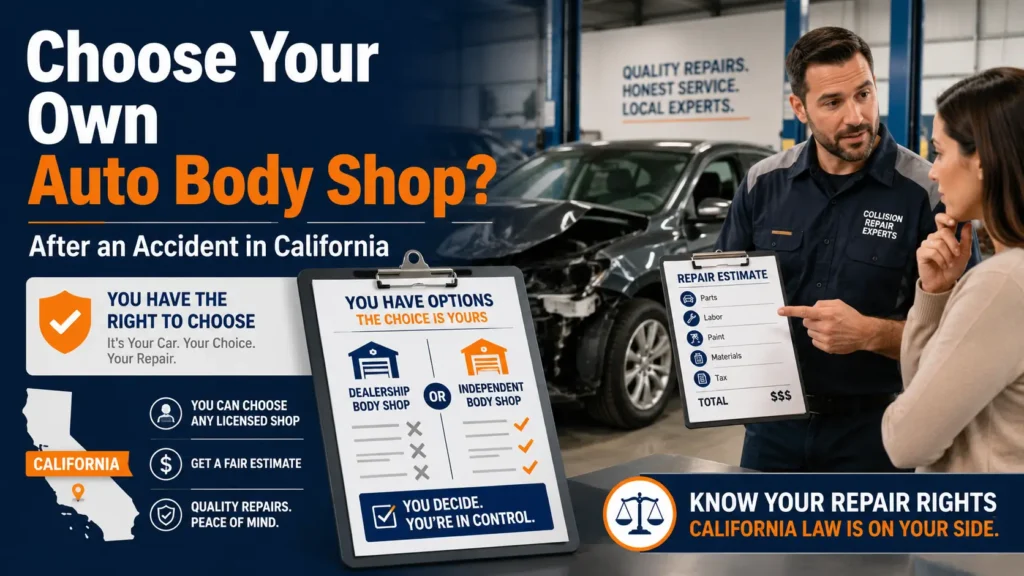
Yes. In California, you generally have the right to choose the auto body shop that repairs your vehicle after an accident.
Your insurance company may recommend a collision repair facility or provide a list of preferred shops, but it cannot require you to use one particular business. California Insurance Code Section 758.5 protects a consumer’s ability to select a repair shop for covered auto body damage.
That choice matters because the repair facility—not the insurance company—will inspect the vehicle, prepare the repair plan, order parts, perform or coordinate repairs and stand behind the completed work.
Drivers should still review their insurance coverage, deductible and payment responsibilities before authorizing repairs. Choosing your own body shop does not automatically mean the insurer will approve every proposed charge. However, it allows you to select a facility based on experience, communication, repair quality, certifications and confidence rather than relying only on an insurer’s recommendation.
Your Right to Select a Collision Repair Facility
California’s Auto Body Repair Consumer Bill of Rights states that a consumer is entitled to select the auto body repair shop that will repair damage covered by an insurance company.
The California Department of Insurance also explains that an insurer cannot require a vehicle to be repaired at a specific shop. An insurer may recommend a shop under conditions established by law, but the final decision remains with the vehicle owner.
In practical terms, this means you may choose:
- A shop recommended by your insurer
- A dealership collision center
- An independent auto body shop
- A manufacturer-certified repair facility
- A local collision center you already trust
You do not lose your claim simply because you choose a shop outside the insurer’s preferred repair network.
However, the insurance company may still review the estimate, inspect the damage, evaluate parts and labor costs and determine what it considers payable under the policy. The body shop may then communicate with the adjuster about differences or additional damage.
What Is a Preferred or Direct Repair Program Shop?
Many insurance companies maintain networks of repair facilities. These arrangements are commonly called preferred repair programs or direct repair programs.
A direct repair program shop may have an established process for:
- Sending estimates electronically
- Receiving insurance assignments
- Uploading damage photographs
- Communicating with adjusters
- Processing supplements
- Following insurer-specific administrative procedures
- Providing repair-status information
Using one of these shops may make certain parts of the claim process more convenient. For example, the insurer and repair facility may already use compatible estimating and communication systems.
That does not automatically mean a network shop is better or worse than an independent shop. The quality of the repair depends on the facility, technicians, equipment, procedures, parts decisions and quality-control process.
An independent shop may also work regularly with insurance companies even when it is not part of a particular insurer’s direct repair program.
The important point is that an insurer’s preferred list is a recommendation—not a requirement. California guidance clearly states that consumers may choose their own repair facility.
Can the Insurance Company Refuse to Work With Your Chosen Shop?
An insurance company generally cannot refuse a covered claim merely because you selected your own body shop.
It can, however, review whether the requested repair costs and procedures are covered, documented and reasonable under the policy.
The insurer may question:
- Labor rates
- Repair versus replacement decisions
- Original equipment manufacturer parts
- Aftermarket or recycled parts
- Paint and material charges
- Additional repair operations
- Diagnostic scanning
- Sensor calibration
- Structural procedures
- Storage charges
- Damage unrelated to the accident
These discussions can happen at any collision repair facility, including one recommended by the insurer.
When the body shop’s estimate is higher than the insurance estimate, the shop can compare the documents and submit supporting information. If hidden accident damage is found after disassembly, the repair facility may prepare a supplemental estimate.
The vehicle owner should ask which items have been approved, which are still under review and whether any amount may become the customer’s responsibility.
Will Insurance Pay More If You Choose Your Own Body Shop?
Choosing your own shop does not guarantee that the insurance company will pay every amount listed on the shop’s estimate.
The insurer will evaluate the claim according to:
- The policy terms
- The cause of the damage
- Applicable limits and exclusions
- The repair scope
- Parts and labor costs
- The evidence supporting the estimate
- Accepted collision repair practices
The California Department of Insurance states that an insurer must pay reasonable costs to repair a vehicle according to accepted trade standards when the consumer chooses the repair facility, subject to the applicable coverage and claim circumstances.
Disagreements may still occur. For example, the repair shop may recommend an OEM component while the insurance estimate lists an alternative part.
California rules require estimates and invoices to properly identify replacement crash parts. A new replacement crash part is treated as a new OEM part unless it is specifically identified as non-OEM aftermarket or used.
California insurance guidance also states that an insurer cannot require a non-OEM crash part unless it is at least equal to the OEM part in kind, quality, safety, fit and performance.
Vehicle owners should ask the shop and adjuster to explain parts differences rather than assuming that all estimates describe the same repair.
Do You Need More Than One Body Shop Estimate?
You may obtain an independent estimate, but you are not necessarily required to collect several estimates before choosing a shop.
The insurance company will often prepare its own damage estimate. Your selected repair facility can then inspect the vehicle and prepare a separate repair plan.
Having two estimates can be useful because it allows you to compare:
- Damaged components
- Proposed repair procedures
- Labor hours
- Replacement parts
- Paint operations
- Structural work
- Scanning and calibration
- The estimated customer responsibility
The lowest total is not always the most complete estimate. A preliminary insurance estimate may be based primarily on visible damage, while a body shop estimate prepared after disassembly may include hidden damage and additional required procedures.
California consumers are entitled to an itemized repair estimate. Auto body and collision estimates must identify expected parts and labor and meet state documentation requirements.
Who Authorizes the Collision Repair?
You—the vehicle owner—authorize the repair.
Even when an insurance company is paying most of the cost, the repair facility must obtain authorization from the customer before beginning work. California allows authorization to be given in written, oral or electronic form, provided it is properly documented.
The insurer’s approval of an estimate is not the same as the owner’s authorization.
California’s Bureau of Automotive Repair emphasizes that the vehicle owner remains the customer and must be kept informed throughout the repair process.
Before authorizing repairs, confirm:
- What damage is included
- What parts will be used
- The estimated total
- Your deductible
- Whether additional costs may arise
- Whether teardown is required
- How supplements will be handled
- The approximate repair timeline
- The warranty provided by the shop
If additional damage is discovered later, the shop must explain the changed repair scope and obtain further authorization.
Can You Change Body Shops After the Claim Has Started?
In many cases, you can change repair facilities, but moving the vehicle may create additional costs or delays.
Before transferring the vehicle, determine whether the first facility has already performed:
- Towing
- Storage
- Teardown
- Estimating
- Diagnostic work
- Parts ordering
- Repair work
You may be responsible for authorized charges that have already been incurred.
There may also be towing or storage costs associated with moving the vehicle. California has specific requirements for repair dealers that charge storage fees and for documenting towing authorization.
Before changing shops:
- Request a written summary of completed work and current charges.
- Confirm whether parts have been ordered.
- Ask whether special-order parts can be returned.
- Review storage and towing fees.
- Notify the insurance adjuster.
- Confirm that the new shop will accept the vehicle.
- Obtain copies of estimates, photographs and claim documents.
Changing shops may be appropriate when communication has broken down, required repairs are not being addressed or you no longer trust the facility. However, it is easier to research the shop carefully before authorizing a teardown or repair.
How to Choose the Right Auto Body Shop?
A collision repair decision should be based on more than convenience or the lowest estimate.
Check the business registration and reputation
California automotive repair dealers are regulated by the Bureau of Automotive Repair. Consumers can use BAR resources to learn about repair businesses and submit complaints involving automotive or collision repairs.
Also review:
- Google Business Profile reviews
- Recent customer feedback
- Better Business Bureau history
- Local business reputation
- Before-and-after repair photographs
- Responses to negative reviews
Look for patterns rather than judging the shop from one comment.
Ask about technician training
Modern collision repair may involve high-strength steel, aluminum, electronics, structural adhesives and advanced driver-assistance systems.
Ask whether the shop’s technicians receive current training and whether the facility follows repair information for the specific vehicle.
Relevant qualifications may include:
- I-CAR training
- ASE certifications
- Manufacturer certifications
- Welding certifications
- Structural repair training
- Refinishing training
- ADAS-related education
A logo alone does not guarantee repair quality, but current training is an important signal.
Review the estimating process
A thorough facility should explain whether the estimate is based on:
- A visual exterior inspection
- Damage photographs
- Partial disassembly
- A complete teardown or blueprint
- Structural measurement
- Diagnostic scanning
A visual estimate may be appropriate as an initial assessment, but the shop should explain that hidden damage can change the repair plan.
California’s teardown regulations were updated effective July 1, 2025, to make teardown estimates and approvals clearer and more consistent.
Ask about parts
Find out whether the estimate includes:
- New OEM parts
- Non-OEM aftermarket parts
- Recycled parts
- Reconditioned components
- Repaired original panels
The shop should explain why a particular part or repair method is being recommended.
Review the warranty
Ask for the warranty terms in writing.
Determine:
- What work is covered
- Whether paintwork is included
- How long coverage lasts
- Whether parts have separate warranties
- Which shop is responsible for warranty service
- Whether the warranty applies if you move
Do not rely only on phrases such as “lifetime warranty” without reading the conditions.
Evaluate communication
A good repair facility should explain:
- The estimate
- Insurance differences
- Supplements
- Parts delays
- Timeline changes
- Customer costs
- Repair-status updates
- Final quality checks
The shop should be willing to answer questions without dismissing your concerns.
Questions to Ask Before Selecting a Body Shop
Use these questions when comparing collision repair facilities:
- Do you regularly work with my insurance company?
- Will you communicate directly with the adjuster?
- Is the first estimate based only on visible damage?
- Will the vehicle require disassembly?
- How will hidden damage be documented?
- What types of replacement parts are listed?
- Do you follow manufacturer repair procedures?
- Will diagnostic scanning be performed when required?
- Could the vehicle need ADAS calibration?
- Who performs structural measurements?
- What warranty do you provide?
- How often will I receive updates?
- Could I owe more than my deductible?
- Will you obtain my authorization before added work?
These questions reveal more than simply asking how quickly the vehicle can be repaired.
What Is Insurance Steering?
Insurance steering generally refers to conduct intended to improperly pressure a customer toward or away from a particular repair facility.
An insurer is permitted to recommend a shop under California law, but it cannot require the consumer to use one specific facility.
A recommendation may include information about:
- A direct repair network
- Warranty arrangements
- Estimate procedures
- Rental coordination
- Claim administration
That information can help you make a decision, but it should not be presented as though you have no choice.
Be cautious when you are told:
- The insurer will not pay if you use another shop
- Your warranty will automatically be invalid
- Your claim cannot proceed outside the network
- You must move the vehicle immediately
- You cannot obtain an independent estimate
Ask for statements about coverage or payment in writing. When necessary, contact the California Department of Insurance for clarification or assistance. The department accepts consumer complaints involving insurance companies and claim handling.
What If the Shop and Insurance Company Disagree?
Estimate disagreements are common and do not always mean the claim has reached an impasse.
The body shop may provide:
- Additional photographs
- Teardown documentation
- Parts invoices
- Structural measurements
- Diagnostic reports
- Manufacturer repair procedures
- A supplemental estimate
The insurer may then approve the item, request more evidence or continue disputing it.
As the customer, ask both sides to clearly identify:
- The disputed operation
- The amount involved
- The reason for the disagreement
- Whether the issue affects safety
- Whether work can continue
- Whether you may owe the difference
For unresolved insurance claim concerns, California consumers can contact the Department of Insurance. Certain automobile physical-damage disputes may also qualify for the state’s automobile claims mediation program.
Concerns about the conduct of the automotive repair facility can be directed to the Bureau of Automotive Repair.
Choosing a Body Shop in Cathedral City, CA
Drivers in Cathedral City do not have to select a collision facility solely because it appears on an insurance company’s list.
A local shop may be a strong choice when it offers:
- Convenient communication
- Familiarity with local customers
- Help reviewing the insurance estimate
- Detailed damage documentation
- Qualified collision technicians
- Clear repair authorizations
- Written warranty information
- Accessible post-repair support
CatCity Auto Body provides collision repair and related auto body services for Cathedral City and surrounding Coachella Valley drivers. Customers can bring an insurance estimate to the shop, request an independent damage assessment and discuss the repair process before authorizing work.
To schedule an inspection or ask questions about an accident claim, call 760-324-7117.
Frequently Asked Questions
Yes. California consumers are entitled to select the auto body repair facility that repairs covered collision damage. An insurer may recommend a shop, but it cannot require you to use one specific facility.
The insurer should still process the covered claim, but it may review the shop’s proposed parts, labor rates and repair procedures. Payment depends on the policy, covered damage and supported repair costs.
No. A preferred or direct repair shop is an option, not a requirement. You may select an independent body shop or another qualified facility.
An insurer may describe warranty arrangements associated with its network. Your chosen independent shop may provide its own written warranty. Review who is responsible for warranty service before authorizing repairs.
You can authorize repairs, but you may assume financial risk when insurance payment has not been confirmed. Ask which costs are approved and whether you could owe more than your deductible.