
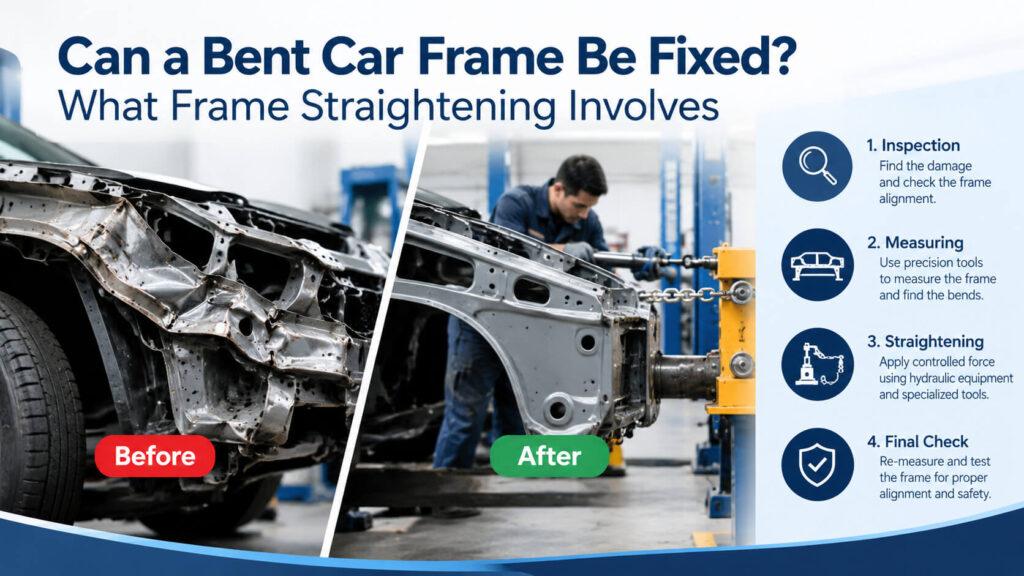
A bent car frame is one of the most serious damages a vehicle can sustain, often resulting from collisions, rollovers, or severe road hazards. The frame (or unibody structure) provides the backbone that supports the engine, suspension, drivetrain, and passenger cabin. If it’s compromised, the car’s handling, safety, and longevity are at risk.
Can a bent car frame be fixed? The short answer is yes, but the success of the repair depends on the severity of the bend, the type of frame material (steel vs. aluminum), and the expertise of the technician. Modern frame straightening techniques combine mechanical force, precision measurement, and computer‑aided diagnostics to restore the original geometry safely and effectively.
Car Frame Types
| Frame Type | Material | Typical Bend Repair | Key Considerations |
| Body‑on‑Frame (Body‑on‑Chassis) | High‑strength steel or mixed steel/aluminum | Mechanical pulling, hydraulic presses, or laser‑guided straightening | Easier to access individual rails; often uses dedicated frame racks. |
| Unibody (Monocoque) | Aluminum or steel sheet metal integrated with body panels | Laser‑guided pulling, spot‑weld reinforcement, or section replacement | Requires precise measurement of multiple points; may involve welding and panel replacement. |
| Hybrid/Modular | Mix of steel and aluminum sections | Combination of mechanical straightening and selective part replacement | Complexity increases with mixed materials; may need OEM‑specific tools. |
Signs Your Car Frame Is Bent
- Uneven tire wear or pulling to one side while driving.
- Misaligned doors, hood, or trunk that no longer close flush.
- Visible dents, creases, or twists in the frame rails or underbody.
- Excessive chassis flex when the vehicle is jacked up.
- Warning lights related to suspension or steering sensors (e.g., ABS, ESP).
If you notice any of these symptoms after an accident, it’s advisable to have a professional inspect the frame promptly.
The Frame Straightening Process
Step 1: Initial Assessment & Documentation
- Visual inspection for obvious damage.
- Computerized measurement system (e.g., laser or ultrasonic) maps the frame’s geometry against manufacturer specifications.
- Documentation of all measured deviations (mm or inches) to create a repair plan.
Step 2: Preparation
- Secure the vehicle on a frame rack or lift.
- Remove components that could interfere (e.g., suspension, exhaust, drivetrain) to expose the frame fully.
- Protect surrounding panels with covers to avoid scratches during pulling.
Step 3: Mechanical Straightening
- Hydraulic rams or pullers apply controlled force to the bent section.
- Multi‑point pulling ensures the frame returns to its original angles without overstressing any single area.
- Real‑time feedback from the measurement system monitors progress, adjusting force as needed.
Step 4: Stress Relief & Verification
- After the frame reaches the target geometry, the technician re‑measures all critical points.
- Stress‑relief cycles (controlled heating and cooling) may be used to eliminate residual stress in steel frames.
- Final alignment check confirms that wheel alignment, suspension geometry, and drivetrain clearances are within spec.
Step 5: Repair & Reinforcement (If Needed)
- Welding or bonding may be required to restore structural integrity, especially on aluminum frames.
- Replacement of damaged sections (e.g., cracked rails) using OEM‑approved parts.
- Re‑installation of removed components, ensuring all bolts are torqued to manufacturer specifications.
Step 6: Post‑Repair Testing
- Road test to evaluate handling, steering response, and overall stability.
- Diagnostic scan to clear any stored fault codes related to frame sensors.
- Final inspection by a certified technician to sign off on the repair.
| Tool | Purpose | Typical Use |
| Frame Rack / Pulling Rig | Holds the vehicle steady while applying force | Hydraulic or pneumatic rams |
| Laser/Ultrasonic Measuring System | Provides precise 3‑D mapping of frame geometry | Real‑time monitoring during straightening |
| Computer‑Aided Design (CAD) Software | Simulates the straightening process before physical work | Planning force vectors and predicting stress |
| Hydraulic Presses | Apply uniform pressure to large sections | Straightening major bends or twists |
| Spot‑Welding Machines | Reinforce or replace damaged metal | Restoring structural strength after pulling |
Tools & Technology Used in Modern Frame Straightening
Cost Factors
| Factor | Impact on Cost |
| Extent of Damage | Minor bends (≤5 mm) cost 500‑1,200; severe structural damage can exceed $5,000. |
| Frame Material | Steel frames are generally cheaper to straighten than aluminum, which may require specialized tools and welding. |
| Vehicle Make & Model | Luxury or high‑performance cars often need OEM‑specific parts and labor rates. |
| Labor Rates | Independent shops may charge 80‑120 per hour; dealerships can be 150‑200+. |
| Additional Repairs | Replacing suspension components, realigning wheels, or repairing body panels adds to the total. |
Tip: Always request a detailed estimate that breaks down labor, parts, and any diagnostic fees. Compare at least three quotes before proceeding.
Safety Considerations
- Structural Integrity: A improperly repaired frame can compromise crash safety. Use only certified technicians and OEM‑approved methods.
- Stress Risks: Over‑pulling can cause new cracks, especially in high‑strength steel. Modern measurement systems help avoid this.
- Corrosion Protection: After straightening, apply rust‑inhibiting coatings, particularly on steel frames exposed to harsh climates.
Frequently Asked Questions (FAQs)
In most cases, yes. Modern pulling rigs and measurement technology can realign even severe twists. However, if the metal is cracked or the structural integrity is compromised, replacement of the affected section may be necessary.
Simple bends may be completed in 4‑6 hours. Complex, multi‑point straightening can take 1‑3 days, including measurement, pulling, and post‑repair verification.
Generally, yes. Repairing a bent frame is often 30‑60% less expensive than a full frame replacement, especially when the damage is localized.
Most comprehensive auto policies cover structural repairs resulting from covered accidents. Verify with your insurer and provide the repair estimate for claim approval.
Absolutely. Realigning the wheels ensures proper handling, tire wear, and prevents future steering issues.
Choosing the Right Repair Shop
- Certification: Look for shops employing technicians certified by ASE, I-CAR, or the vehicle manufacturer.
- Equipment: Verify they use a calibrated frame rack and laser/ultrasonic measuring system.
- Warranty: A reputable shop offers a warranty (typically 12‑24 months) on both labor and parts.
- Reviews: Check online ratings and ask for references from recent customers.
Conclusion
A bent car frame is a serious concern, but modern frame straightening techniques make repair not only possible but often more cost‑effective than a full replacement. By understanding the type of frame, recognizing the signs of damage, and selecting a qualified technician equipped with the right tools, you can restore your vehicle’s structural integrity, safety, and performance.
Key Takeaways:
- Assessment first – precise measurement is the foundation of a successful repair.
- Professional tools matter – hydraulic rams, laser measuring systems, and CAD software ensure accuracy.
- Cost and time vary – expect 500‑5,000 depending on damage severity and vehicle type.
- Safety is paramount – always use certified professionals and verify post‑repair alignment.
If you suspect frame damage, schedule an inspection promptly. Early detection and expert straightening can keep your car safe on the road for years to come.