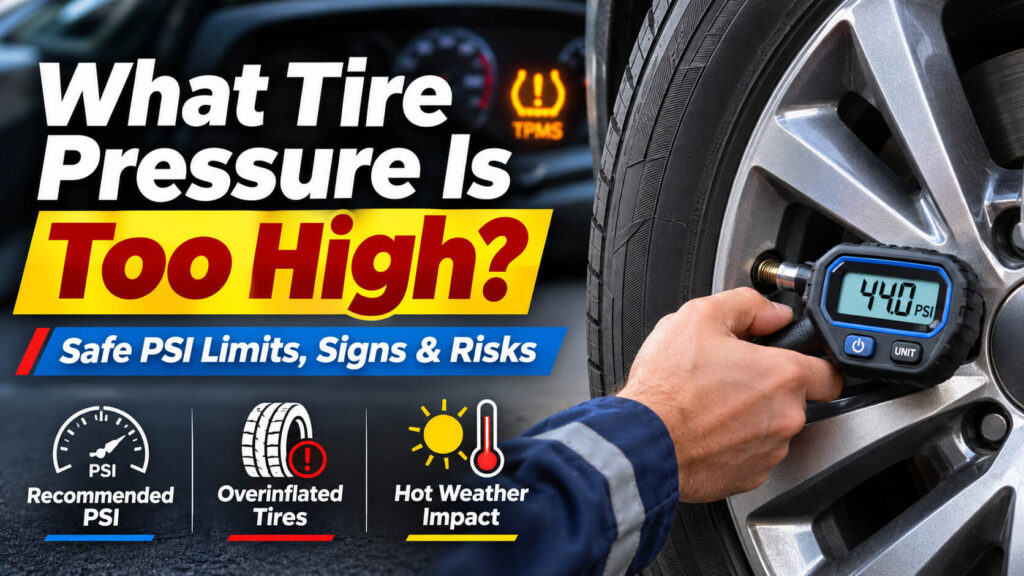
Tire pressure is too high when it exceeds the vehicle manufacturer’s recommended PSI (pounds per square inch) for the specific tire and driving conditions. There is no single PSI number that is considered too high for every vehicle. For example, if your vehicle recommends 35 PSI when the tires are cold, a reading of 42 PSI is generally higher than recommended and should be corrected.
However, the correct tire pressure depends on your vehicle, tire specifications, load requirements, and manufacturer recommendations.
Driving with overinflated tires can reduce the tire’s contact with the road, affect handling, create a harsher ride, and contribute to uneven tread wear. Excessive pressure can also increase the risk of tire damage under certain driving conditions.
The good news is that checking and correcting tire pressure is relatively simple. In this guide, you’ll learn what tire pressure is too high, how much PSI is safe, what happens when tires are overinflated, and how to maintain the correct pressure throughout the year.
What Tire Pressure Is Considered Too High?
Tire pressure is considered too high when it exceeds the recommended cold inflation pressure specified by your vehicle manufacturer.
Most passenger vehicles have recommended tire pressures somewhere around 30–35 PSI, although some vehicles require higher or lower pressures.
For example:
| Recommended tire pressure | Actual tire pressure | Assessment |
| 30 PSI | 32 PSI | Slightly above recommendation |
| 32 PSI | 38 PSI | Overinflated |
| 35 PSI | 40 PSI | Overinflated |
| 36 PSI | 45 PSI | Significantly overinflated |
| 40 PSI | 42 PSI | Slightly above recommendation |
These examples are illustrative, not universal safety thresholds. The correct pressure for your vehicle may differ.
Important: The maximum PSI printed on a tire’s sidewall is not the recommended everyday inflation pressure for your vehicle. It generally indicates a maximum pressure associated with the tire’s rated load capacity under specified conditions.
Always use the recommended cold tire pressure shown on the driver’s door-jamb placard or in your owner’s manual.
How Do You Know If Your Tires Are Overinflated?
Overinflated tires do not always produce an obvious warning. In many cases, drivers discover the problem through a pressure gauge, tire inspection, or changes in vehicle handling.
Here are common signs to watch for.
1. A Harsher or Bumpier Ride
One of the most noticeable effects of overinflated tires is a less comfortable ride.
When tire pressure is higher than recommended, the tire becomes stiffer and may absorb road imperfections less effectively.
You may notice:
- More vibration over rough roads.
- Increased impact from potholes.
- A firmer ride over speed bumps.
- More road noise in certain conditions.
2. Uneven Tire Tread Wear
Overinflation can change how the tire’s tread contacts the road.
In some circumstances, excessive inflation can contribute to increased wear around the center portion of the tread.
However, center wear is not definitive proof of overinflation. Tire design, alignment, driving habits, and other mechanical issues can also contribute to uneven wear.
3. Reduced Road Grip
Tires are engineered to provide a particular contact patch with the road.
When pressure is significantly above the recommended level, the contact characteristics can change, potentially reducing grip in certain conditions.
This can affect braking, cornering, and overall vehicle control.
4. Unusual Handling
Overinflated tires may make your vehicle feel less predictable, particularly when driving over uneven surfaces.
You might notice:
- A firmer steering response.
- More vibration.
- Reduced comfort during cornering.
- A tendency to feel unsettled on rough pavement.
If the vehicle suddenly handles differently, check tire pressure and inspect the tires for damage.
5. Increased Risk of Tire Damage
An overinflated tire may be more vulnerable to damage from severe road impacts, particularly when combined with excessive vehicle loading or other tire problems.
For example, striking a pothole can place significant stress on a tire and wheel assembly.
If you notice a bulge, crack, exposed cord, or other visible damage, have the tire inspected by a qualified tire professional.
What Are the Effects of Overinflated Tires?
Driving with overinflated tires can affect your vehicle’s comfort, handling, traction, and tire lifespan.
Although a small pressure difference does not automatically mean your tires are unsafe, consistently driving above the recommended PSI can create problems.
Here are the main effects of overinflated tires.
1. Reduced Tire Contact With the Road
When a tire is overinflated, its center tread can carry a greater share of the vehicle’s load.
This can change the tire’s contact patch and affect how evenly it distributes pressure across the road surface.
As a result, you may experience reduced grip under certain driving conditions, particularly when cornering or driving on wet pavement.
2. Faster Center Tread Wear
One common sign of chronic tire overinflation is excessive wear in the middle of the tread.
Because the center portion can carry more of the load, it may wear faster than the outer tread areas.
Over time, this uneven wear can shorten tire life and force you to replace your tires sooner.
3. Reduced Driving Comfort
Overinflated tires tend to be stiffer, making it harder for them to absorb bumps and road imperfections.
You may notice a rougher ride when driving over:
- Potholes.
- Expansion joints.
- Gravel roads.
- Speed bumps.
- Uneven pavement.
4. Changes in Handling and Braking
Proper tire inflation helps maintain the tire’s intended performance characteristics.
When pressure is too high, changes in the contact patch and tire stiffness can affect handling and braking performance.
This is particularly important during emergency maneuvers or when driving on wet or uneven roads.
5. Increased Vulnerability to Road Impact Damage
An excessively inflated tire may have less flexibility to absorb certain road impacts.
If you hit a deep pothole or strike a curb, the impact can damage the tire or wheel.
The actual risk depends on tire construction, pressure, vehicle load, and impact severity.
A qualified tire technician should inspect any tire with a visible bulge, cut, or suspected internal damage.
Technical reference: Michelin’s tire maintenance guidance explains the relationship between overinflation and center tread wear.
What Is the Difference Between Overinflated and Underinflated Tires?
Both overinflated and underinflated tires can affect vehicle safety, but they create different problems.
| Comparison | Overinflated tires | Underinflated tires |
| Air pressure | Above recommended PSI | Below recommended PSI |
| Tread wear | Often concentrated in the center | Often concentrated along both edges |
| Ride comfort | Typically harsher | May feel less responsive or unstable |
| Heat buildup | Depends on operating conditions | Can generate excessive heat |
| Road handling | Can affect grip and contact characteristics | Can reduce handling stability |
| Tire lifespan | May cause uneven wear | Can cause excessive shoulder wear |
| Main concern | Excess pressure and altered contact patch | Excess flexing and heat generation |
The important thing to remember is that neither condition is ideal.
Your tires are designed to operate at a specific inflation pressure for your vehicle and its intended load.
You should not deliberately overinflate your tires to compensate for underinflation, improve fuel economy, or increase handling performance.
What Is the Correct Tire Pressure for Your Car?
The correct tire pressure depends on your vehicle’s manufacturer recommendations, not a universal PSI figure.
Many passenger cars use cold tire pressures around 30–35 PSI, while some SUVs, trucks, and other vehicles require different pressures.
Here is an illustrative reference:
| Vehicle category | Example cold PSI range |
| Compact cars | 30–35 PSI |
| Midsize sedans | 32–36 PSI |
| SUVs | 32–40 PSI |
| Pickup trucks | 35–45 PSI |
| Minivans | 32–38 PSI |
These are broad examples for educational purposes, not recommended inflation specifications. Always follow the vehicle’s tire placard or owner’s manual.
Where Can You Find the Recommended Tire Pressure?
In most American vehicles, you can find the recommended cold tire pressure in one of these places:
- Driver’s-side door jamb.
- Driver’s-side door edge.
- Vehicle owner’s manual.
- Tire and Loading Information Label.
The label typically lists the recommended front and rear tire pressures, which may be different.
For example, your vehicle may specify:
- Front tires: 35 PSI.
- Rear tires: 33 PSI.
In this situation, inflating all four tires to 35 PSI would not follow the manufacturer’s recommendation.
The NHTSA specifically advises drivers to follow the vehicle’s tire information placard rather than the maximum pressure printed on the tire sidewall.
Is the Maximum PSI on the Tire Sidewall the Recommended Pressure?
No. This is one of the most common tire maintenance misunderstandings.
The number printed on the tire sidewall identifies the tire’s maximum permissible inflation pressure under specified conditions. It is not necessarily the correct pressure for your particular vehicle.
For example, a tire may display a maximum pressure of 44 PSI, while your vehicle manufacturer recommends 35 PSI.
You should generally use the vehicle manufacturer’s recommended cold pressure, provided the replacement tire is correctly sized and approved for the vehicle.
If you have installed a different tire size or load rating, consult a qualified tire professional to confirm the correct inflation requirements.
Can Hot Weather Cause Tire Pressure to Get Too High?
Yes. Hot weather can increase tire pressure because the air inside the tire expands as its temperature rises.
This means your tire pressure may be higher after driving or during periods of high outdoor temperatures.
According to automotive tire guidance, pressure changes by approximately 1 PSI for every 10–12°F change in temperature, although actual changes vary with conditions.
For example:
| Temperature change | Approximate pressure change |
| 10°F increase | +1 PSI |
| 20°F increase | +2 PSI |
| 30°F increase | +3 PSI |
| 10°F decrease | -1 PSI |
| 20°F decrease | -2 PSI |
These are approximate changes, not a formula for manually adjusting tire pressure.
Should You Release Air From Hot Tires?
Generally, no.
If you check your tires after driving and notice that the pressure is higher than the recommended cold PSI, do not immediately release air.
Tire pressure naturally increases during operation because the tires heat up.
If you release air while the tires are hot, you could end up with underinflated tires once they cool down.
Instead:
- Park the vehicle safely.
- Allow the tires to cool for at least three hours.
- Check the pressure using an accurate tire gauge.
- Adjust the pressure to the recommended cold PSI.
NHTSA recommends checking tire pressure when tires are cold, meaning the vehicle has not been driven for at least three hours.
What Should You Do If Your Tire Pressure Is Too High?
If your tires are overinflated, correcting the pressure is usually straightforward.
You do not necessarily need to visit a repair shop if the tires are otherwise in good condition and you have access to a reliable tire pressure gauge.
Follow these steps.
Step 1: Check the Recommended PSI
Locate the Tire and Loading Information Label on the driver’s-side door jamb.
Write down the recommended cold pressure for the front and rear tires.
Step 2: Allow Your Tires to Cool
For an accurate reading, check your tires before driving or after the vehicle has been parked for at least three hours.
This helps prevent you from mistaking normal operating temperature increases for overinflation.
Step 3: Measure the Tire Pressure
Remove the valve stem cap and firmly attach a tire pressure gauge to the valve.
Record the reading.
Repeat the process for all four tires.
Step 4: Slowly Release Excess Air
If a tire is above its recommended cold pressure, gently press the valve stem to release small amounts of air.
Avoid releasing too much at once.
Step 5: Check the Pressure Again
Use your gauge to measure the pressure after each adjustment.
Continue until the reading matches the manufacturer’s recommended cold PSI.
Step 6: Replace the Valve Stem Caps
Once you have adjusted the tires, reinstall the valve stem caps to help keep dirt and moisture out of the valve.
Step 7: Check the TPMS Warning Light
If your vehicle has a Tire Pressure Monitoring System (TPMS), check whether the warning light turns off after correcting the pressure.
Some vehicles require driving under specific conditions before the warning disappears.
If the warning remains illuminated, consult your owner’s manual or have the system inspected.
Can Overinflated Tires Cause a Blowout?
Yes, excessive tire pressure can contribute to tire damage, but overinflation alone does not mean a tire will automatically blow out.
Tire failure can result from several factors, including:
- Excessive vehicle loading.
- Severe pothole impacts.
- Damaged tire sidewalls.
- Incorrect tire installation.
- Excessive heat.
- Improper inflation.
- Existing structural tire damage.
Underinflation is also a major tire safety concern because it causes excessive flexing and heat buildup.
The safest approach is to maintain the manufacturer’s recommended cold pressure and inspect your tires regularly.
If you experience a sudden loss of pressure, visible tire damage, or unusual vibration, stop driving when it is safe and arrange a professional inspection.
How Often Should You Check Tire Pressure?
You should check your tire pressure at least once a month and before long road trips.
Regular checks are particularly important during seasonal temperature changes because tire pressure can fluctuate as outdoor temperatures rise and fall.
Here is a practical maintenance schedule:
| Inspection frequency | What to check |
| Monthly | Cold tire pressure on all tires |
| Before road trips | Pressure and visible tire condition |
| During seasonal changes | Pressure changes due to temperature |
| After hitting a pothole | Tire and wheel damage |
| When TPMS warning appears | Actual pressure and sensor condition |
Do not rely entirely on visual inspection.
A tire can be underinflated or overinflated without looking noticeably different.
Keep a quality digital or manual tire pressure gauge in your vehicle so you can check the pressure whenever necessary.
NHTSA also recommends monthly cold-pressure checks, including the spare tire where applicable.
Does Overinflated Tire Pressure Affect Your TPMS?
Yes, but there is an important distinction between the tire pressure itself and the TPMS warning system.
A Tire Pressure Monitoring System is designed primarily to alert drivers when tire pressure becomes significantly low.
It is not necessarily designed to warn you whenever tire pressure exceeds the recommended value.
This means your dashboard may not display a warning even if your tires are overinflated.
If your vehicle has a TPMS display showing individual tire pressure readings, use those readings as an additional reference, but verify them with a reliable pressure gauge.
If the TPMS warning light flashes or remains illuminated after correcting the tire pressure, the issue could involve a faulty sensor or another system problem.
You can learn more about the issue in our guide to TPMS sensor replacement costs, including sensor diagnosis, replacement, and programming considerations.
Can Incorrect Tire Pressure Cause Vehicle Damage After an Accident?
Incorrect tire pressure is a maintenance issue, but tire and wheel damage can also occur during a collision or road impact.
For example, hitting a curb or pothole can damage:
- Tire sidewalls.
- Wheel rims.
- Suspension components.
- Steering components.
- Wheel alignment.
In some situations, damage may not be immediately visible.
If your vehicle has recently been involved in an accident, a professional inspection can help identify damage that may affect its safety and performance.
Cat City Auto Body provides information about collision repair services for vehicles with accident-related damage.
You can also explore:
- Bumper and fender repair for visible exterior damage.
- Frame straightening for qualifying structural damage.
- Dent repair for damaged body panels.
- Insurance claim assistance for covered collision repairs.
For tire, wheel, and suspension concerns, consult a qualified tire or mechanical repair professional.
Frequently Asked Questions About High Tire Pressure
There is no universal PSI threshold that makes every tire dangerously overinflated. Tire pressure becomes excessive when it exceeds the vehicle manufacturer’s recommended cold inflation pressure. A significant increase above the recommended PSI should be corrected, particularly if accompanied by handling problems or visible tire damage.
It depends on your vehicle. If your vehicle recommends 35 PSI, then 40 PSI is above the recommended cold pressure. However, some vehicles are designed to operate at 40 PSI or higher. Always check your driver’s-side door-jamb label.
For many passenger cars, 45 PSI is higher than the recommended cold pressure. However, some trucks, SUVs, and vehicles with specific tire configurations may require higher pressures. Check the vehicle manufacturer’s specifications before making adjustments.
For many standard passenger vehicles, 50 PSI would be significantly above the recommended pressure. However, the correct limit depends on the vehicle and tire specifications. Never assume that a tire’s maximum sidewall PSI is the correct everyday inflation pressure.
You may be able to drive a short distance if the pressure is only slightly above the recommended level and the tires are otherwise in good condition. However, significantly overinflated tires can affect handling, ride comfort, and tire wear. Correct the pressure before normal driving.
There is no universal allowance of extra PSI that is safe for every vehicle. Even a few PSI above the recommended cold pressure should be evaluated in the context of the vehicle’s specifications and tire temperature.
No. Cold weather generally causes tire pressure to decrease rather than increase. As temperatures rise, pressure generally increases. This is why checking tire pressure during seasonal changes is important.
Some vehicles can display individual tire pressure readings, but many TPMS systems primarily warn drivers about significantly underinflated tires. You should use a tire pressure gauge to identify overinflation rather than relying exclusively on the dashboard warning light.
Final Thoughts: What Tire Pressure Is Too High?
Tire pressure is too high when it exceeds the vehicle manufacturer’s recommended cold inflation pressure.
Although a small difference does not automatically make your tires unsafe, consistently driving with excessive pressure can contribute to uneven tread wear, reduced ride comfort, and changes in handling.
To protect your tires:
- Check tire pressure at least once a month.
- Use the recommended PSI on your driver’s-side door-jamb label.
- Measure pressure when tires are cold.
- Avoid using the tire sidewall’s maximum PSI as your everyday target.
- Inspect tires after hitting potholes or curbs.
- Address unusual wear, vibrations, and visible tire damage promptly.
Proper tire inflation is a simple but important part of vehicle maintenance. A few minutes spent checking your tires can help preserve tire life and support safer driving.
If your vehicle has sustained collision damage, contact Cat City Auto Body to learn about available auto body and collision repair services in Cathedral City, California.