
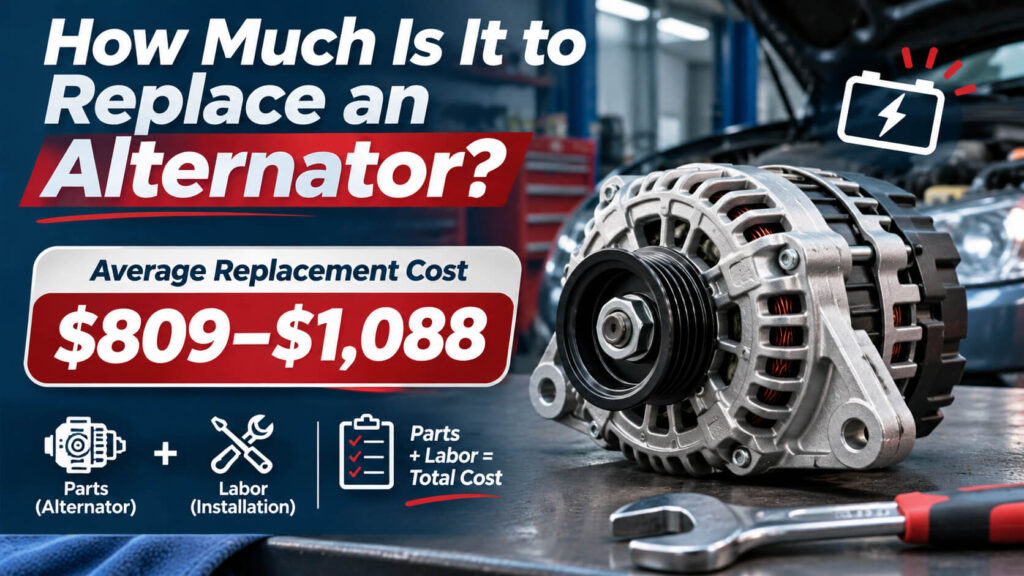
If your headlights are flickering, your battery keeps dying, or a battery warning light appears on your dashboard, your alternator may be failing. Understanding alternator replacement costs can help you prepare for the repair and avoid unnecessary expenses.
The average cost to replace an alternator is $809 to $1,088 in 2026, including parts and labor. Replacement parts typically cost $613 to $800, while labor ranges from $196 to $288, according to RepairPal. Your final price depends on your vehicle’s make and model, alternator type, repair complexity, and local labor rates.
Getting your charging system tested before replacing the alternator can help determine whether the problem is caused by the alternator itself, a weak battery, damaged wiring, or another electrical component.
How Much Does Alternator Replacement Cost in 2026?
Alternator replacement generally costs several hundred dollars to more than $1,000. The exact amount varies considerably between vehicles.
Two nationally recognized automotive pricing resources provide the following estimates:
| Cost Source | Average Replacement Cost |
| Kelley Blue Book | 747–842 |
| RepairPal | 809–1,088 |
These are national estimates rather than guaranteed repair quotes. Luxury vehicles, high-output alternators, and engines with difficult-to-access components may cost more.
Alternator replacement cost breakdown
Average U.S. replacement cost
809–1,088
Parts
613–800
Labor
196–288
The alternator itself usually accounts for the largest portion of the repair bill. However, additional work involving the drive belt, belt tensioner, battery, or electrical connections can increase the total cost.
What Is an Alternator and What Does It Do?
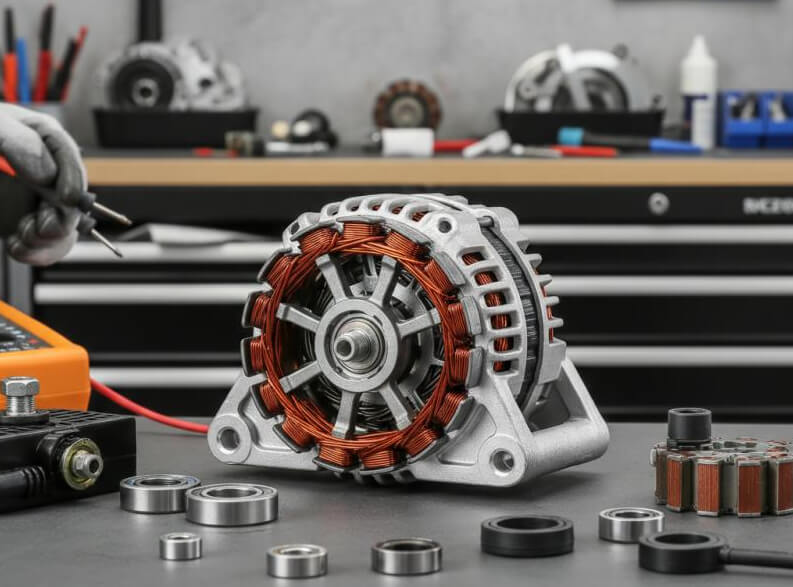
An alternator is an electrical generator that converts mechanical energy from the engine into electricity. It supplies power to the vehicle’s electrical systems and helps recharge the battery while the engine runs.
In a conventional gasoline-powered vehicle, the alternator supports several essential components:
- Headlights and interior lighting.
- Battery charging.
- Engine control modules.
- Dashboard instruments.
- Air conditioning controls.
- Infotainment and electrical accessories.
The alternator and battery work together, but they perform different functions. The battery provides energy to start the engine, while the alternator supplies electricity during normal engine operation.
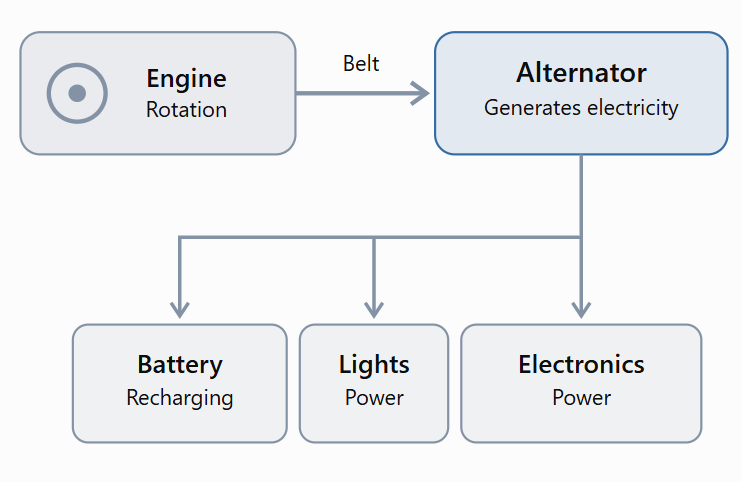
How a conventional vehicle’s alternator supplies electrical power.
When the alternator stops functioning properly, the vehicle relies increasingly on the battery’s remaining charge. Once that energy is depleted, the engine may stall and the vehicle may fail to restart.
Alternator Replacement Cost by Vehicle Make and Model
The cost of replacing an alternator varies significantly depending on the vehicle. Even two vehicles from the same manufacturer can have different repair costs due to engine configuration, alternator capacity, and accessibility.
| Vehicle Make and Model | Estimated Replacement Cost |
| Toyota Corolla | 527–814 |
| Toyota Camry | 566–876 |
| Chevrolet Silverado 1500 | 600–877 |
| Nissan Altima | 694–893 |
| Honda Accord | 720–1,071 |
| Honda Civic | 770–1,220 |
| Ford F-150 | 831–1,025 |
| Honda CR-V | 1,093–1,439 |
These estimates demonstrate why providing your vehicle identification number (VIN), model year, and engine size is important when requesting a repair quote.
What Factors Affect the Cost of Replacing an Alternator?
The total cost of alternator replacement depends on five primary factors: vehicle type, replacement part quality, labor rates, alternator accessibility, and additional repair requirements.
1. Vehicle Make and Model
Vehicles requiring specialized or high-output alternators may have higher replacement costs. Engine compartment design also affects how much work is required to remove and install the component.
2. New vs. Remanufactured Alternators
The type of replacement alternator you choose can significantly affect your repair budget.
| Alternator Type | Relative Cost | Key Consideration |
| New OEM alternator | Higher | Original manufacturer specifications |
| New aftermarket alternator | Moderate to high | Quality and compatibility vary |
| Remanufactured alternator | Often lower | Reconditioned and tested components |
| Used alternator | Often lowest | Uncertain remaining service life |
A remanufactured alternator from a reputable supplier can be a cost-effective option, particularly for an older vehicle. However, compatibility, reliability, and warranty coverage should be considered alongside price.
3. Labor Rates and Installation Complexity
Some alternators are easily accessible from the top of the engine compartment. Others require technicians to remove surrounding components before reaching the alternator.
The more complicated the installation, the higher the potential labor cost.
4. Alternator Amperage and Electrical Capacity
Vehicles equipped with numerous electrical accessories may require higher-output alternators.
Installing an alternator with an incorrect output rating can lead to charging problems. The replacement should meet the vehicle manufacturer’s electrical requirements.
5. Additional Components and Repairs
During alternator replacement, a technician may discover other components that require attention, including:
- Worn serpentine belts.
- Damaged belt tensioners.
- Corroded battery terminals.
- Deteriorated electrical wiring.
- Weak or damaged batteries.
These components should only be replaced when inspection or testing establishes that replacement is necessary.
What Are the Symptoms of a Bad Alternator?
A failing alternator can cause electrical problems, unexpected breakdowns, and repeated battery discharge.
Recognizing the warning signs early may help prevent a roadside emergency.
| Warning Sign | Possible Explanation |
| Battery warning light | Charging system malfunction |
| Dim or flickering headlights | Inconsistent electrical supply |
| Frequently discharged battery | Insufficient battery charging |
| Grinding or whining noise | Worn bearings or pulley problems |
| Slow electrical accessories | Inadequate electrical output |
| Engine stalling | Insufficient power for essential systems |
| Burning rubber smell | Potential drive belt problem |
AAA identifies dashboard battery warnings, lighting problems, and repeated battery discharge as potential symptoms of alternator failure. However, these symptoms can also indicate other electrical faults.
If you are preparing for a long drive through the Coachella Valley, use our pre-trip auto maintenance guide to identify potential battery, lighting, and vehicle safety issues before traveling.
How Can You Tell If the Alternator or Battery Is Bad?
A defective battery and a failing alternator can produce similar symptoms, but they affect different stages of vehicle operation.
A weak battery primarily affects the vehicle’s ability to start. A defective alternator affects its ability to maintain electrical power while running.
| Symptom | Bad Battery | Bad Alternator |
| Slow engine cranking | Common | Possible |
| Car will not start | Common | Possible |
| Headlights flicker while driving | Less typical | Possible |
| Battery warning light while driving | Possible | Common |
| Engine stalls after starting | Less typical | Possible |
| Repeated battery discharge | Possible | Common |
These symptoms are general indicators, not definitive diagnoses.
A professional charging system inspection should evaluate the battery, alternator output, drive belt, electrical connections, and voltage regulation system before recommending replacement.
Never disconnect the battery while the engine is running to test the alternator. This outdated testing method can damage sensitive vehicle electronics.
How Long Does It Take to Replace an Alternator?
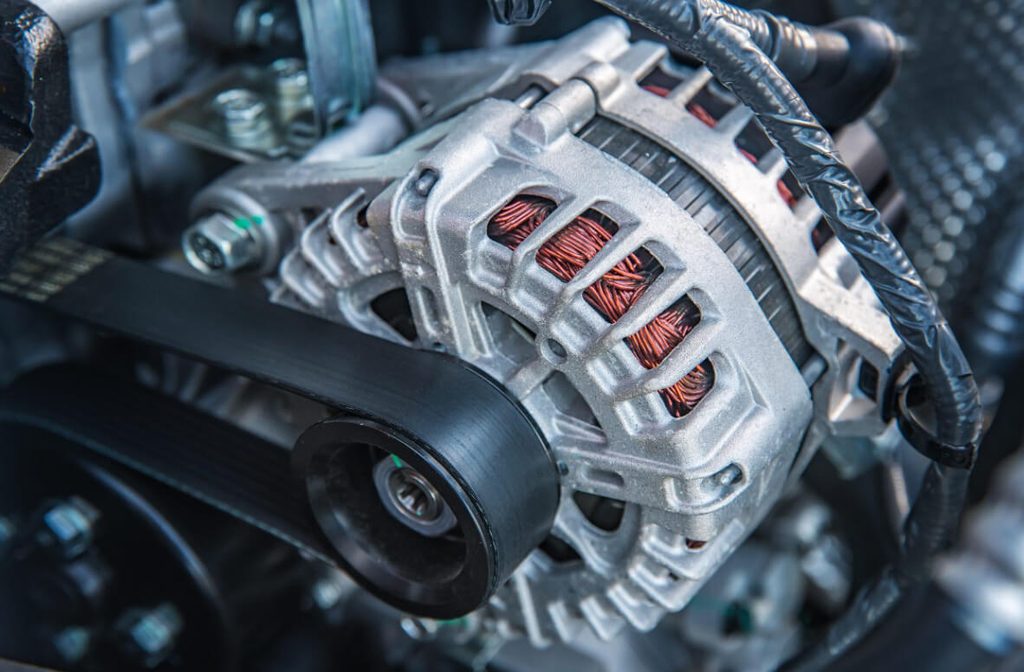
Replacing an alternator typically takes one to two hours of labor on many vehicles. However, vehicles with difficult engine compartment access may require additional time.
Kelley Blue Book
A typical professional replacement involves:
- Testing the charging system.
- Disconnecting the battery safely.
- Removing the necessary belts and electrical connections.
- Removing the defective alternator.
- Installing the compatible replacement.
- Testing the charging system after installation.
Although the installation itself may take only a few hours, the total turnaround time depends on diagnostic requirements, parts availability, and the repair facility’s schedule.
Can You Drive a Car With a Bad Alternator?
No, continuing to drive with a confirmed faulty alternator is not recommended.
When the alternator fails, the battery may temporarily supply electrical power. However, that stored energy will eventually run out, potentially causing the engine to stall.
There is no reliable distance that every vehicle can travel with a failed alternator. Remaining battery capacity, electrical demand, and vehicle design influence how quickly power is lost.
If the charging system warning light appears while driving:
- Pull over in a safe location as soon as practical.
- Avoid unnecessary electrical accessory use while reaching safety.
- Arrange roadside assistance or towing.
- Have the charging system inspected before continuing your journey.
A jump-start may temporarily restore starting power, but it does not repair a defective alternator.
Is It Better to Repair or Replace an Alternator?
Replacing an alternator is often more practical when several internal components are worn or damaged. However, rebuilding or repairing the existing unit may be economical when the problem is limited to a replaceable internal component.
| Consideration | Alternator Repair | Alternator Replacement |
| Upfront cost | May be lower | Generally higher |
| Availability | Requires specialized expertise | More widely available |
| Reliability | Depends on repair quality | Depends on replacement quality |
| Warranty | Varies by rebuilder | Varies by supplier |
| Best suited for | Repairable internal faults | Extensive component failure |
Before making a decision, compare the complete installed price, warranty terms, and condition of the existing alternator.
Can a Car Accident Damage the Alternator?
Yes. A vehicle collision, particularly a front-end impact, can potentially damage the alternator or surrounding charging system components.
Although the alternator is located inside the engine compartment, collision forces may affect nearby mechanical and electrical systems.
Potential accident-related damage includes broken alternator mounting brackets, damaged pulleys, displaced drive belts, damaged wiring, and impact damage to the alternator housing.
Not all collision damage is immediately visible. If electrical warning lights or charging problems develop after an accident, read our guide on how to tell if your car has hidden damage after an accident.
Vehicles with significant front-end impacts may require a broader inspection to determine whether the damage extends beyond exterior body panels.
Learn more about front-end damage repair and its importance in restoring accident-damaged vehicles.
Does Car Insurance Cover Alternator Replacement?
Standard auto insurance generally does not cover alternator failure caused by normal wear, aging, or mechanical breakdown.
However, if the alternator is damaged as a direct result of a covered accident, replacement may qualify under the applicable insurance policy.
| Cause of Alternator Failure | Potential Coverage |
| Normal wear and tear | Generally not covered |
| Age-related component failure | Generally not covered |
| Covered vehicle collision | May be covered by collision insurance |
| Covered flooding event | May be covered by comprehensive insurance |
| Qualifying manufacturing defect | May be covered by a manufacturer warranty |
| Covered mechanical breakdown | May be covered by a vehicle service contract |
Drivers considering mechanical breakdown protection can read our guide on how much CarShield costs per year to better understand service contract expenses and coverage limitations.
If the charging system damage resulted from a crash, our auto insurance claim assistance services can help you navigate the collision repair claims process.
How Much Does Alternator Replacement Cost in Cathedral City, CA?
Drivers in Cathedral City can use the national average of 809–1,088 as an initial budgeting reference. However, actual alternator replacement prices in Cathedral City, Palm Springs, Rancho Mirage, and the surrounding Coachella Valley depend on vehicle-specific requirements and local repair shop labor rates.
Desert driving conditions also make charging system reliability particularly important. High temperatures can contribute to battery deterioration, while heavy electrical demand from cooling systems and accessories increases the importance of a properly functioning charging system.
Before approving an alternator replacement in California, request an itemized estimate that explains the required parts and labor.
The California Bureau of Automotive Repair requires automotive repair businesses to provide customers with an estimate and obtain authorization before performing repairs.
Bureau of Automotive Repair
How Can You Reduce Alternator Replacement Costs?
You can reduce unnecessary repair expenses without compromising vehicle reliability by making informed decisions.
- Confirm the diagnosis: Test the complete charging system before purchasing a replacement.
- Compare written estimates: Review parts, labor, warranty coverage, and additional charges.
- Consider remanufactured parts: Choose a reputable supplier offering compatible components.
- Maintain your battery: Identify weak batteries and poor electrical connections early.
- Check existing warranty coverage: Determine whether the failure qualifies for manufacturer or service contract protection.
- Address warning signs promptly: Avoid repeated breakdowns and unnecessary towing expenses.
The cheapest replacement is not always the most economical choice. A compatible, reliable alternator with appropriate warranty protection may provide better long-term value.
Frequently Asked Questions
Not necessarily. A $1,000 replacement falls within RepairPal’s national average range of 809–1,088. Whether the quote is reasonable depends on the vehicle, replacement part, labor requirements, and additional repairs.
RepairPal estimates average replacement parts costs between $613 and $800. Aftermarket and remanufactured alternators may cost less, depending on vehicle compatibility and supplier pricing.
Average alternator replacement labor costs range from $196 to $288. Vehicles with restricted engine compartment access may require more expensive installation.
Yes. A failing alternator may prevent a new battery from receiving sufficient charge. Certain internal alternator faults can also cause battery discharge while the vehicle is parked.
Not always. If the battery remains healthy and can hold a sufficient charge, replacement may be unnecessary. A battery condition test should determine whether both components require replacement.
Sometimes. A jump-start may provide enough power to start the engine temporarily. However, it will not restore normal charging system operation or prevent another breakdown.
Yes, if you have the necessary mechanical knowledge, tools, diagnostic equipment, and manufacturer-specific repair instructions. Professional installation is advisable when the alternator is difficult to access or the electrical system is complex.
Final Thoughts
The average cost of replacing an alternator ranges from $809 to $1,088, including replacement parts and professional labor. Your actual repair bill depends on the vehicle’s design, alternator specifications, local labor rates, and additional repair requirements.
Before spending money on a replacement, have the complete charging system inspected to confirm the cause of the problem.
If your vehicle develops electrical problems following an accident, the issue may involve hidden collision damage rather than ordinary mechanical wear.
At Cat City Auto Body, we specialize in professional collision repair for drivers throughout Cathedral City and the surrounding Coachella Valley. If your vehicle has sustained accident-related damage, contact Cat City Auto Body to discuss your repair needs.