
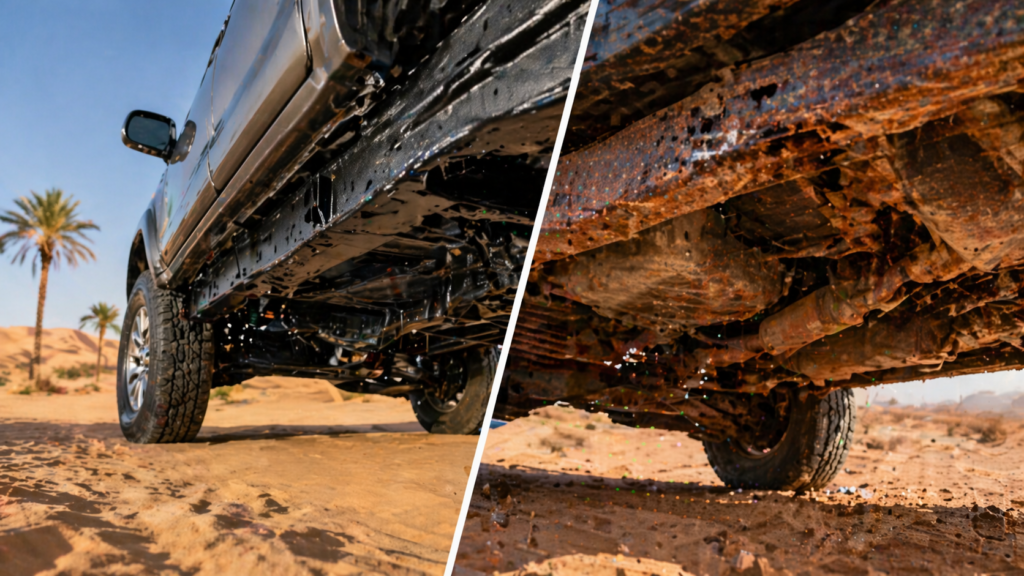
When people think about rust and vehicle corrosion, they typically picture cold, wet climates — coastal cities with salt air, northern states where roads are blanketed in de-icing chemicals every winter, humid regions where moisture is a constant presence. Desert environments like Cathedral City and the Coachella Valley don’t usually make the list.
That’s a dangerous assumption — and one that costs desert drivers significantly every year.
Rustproofing is just as essential for vehicles in desert climates as it is anywhere else in the country. In some ways, the unique conditions of a desert environment make vehicle rust prevention even more critical, because the factors that drive corrosion here are less obvious, less expected, and therefore far less likely to be addressed before serious damage has already begun.
If you drive in Cathedral City, Palm Springs, or anywhere in the Coachella Valley, understanding why rustproofing matters in your specific environment — and what you can do about it — is one of the most valuable things you can do for your vehicle’s long-term health and value.
The Desert Rust Myth: Why So Many Drivers Are Caught Off Guard
The misconception that desert climates are rust-free environments is understandable. Rust requires moisture, and deserts are defined by their lack of it — right?
The reality is more nuanced. Desert environments present several specific conditions that actively promote corrosion, and the very fact that drivers don’t expect rust in the desert means they’re far less likely to take preventative measures or catch early-stage corrosion before it progresses.
Understanding what actually drives rust in desert car care contexts starts with understanding the real environmental factors at play.
Extreme Heat and UV Exposure
Cathedral City regularly experiences summer temperatures exceeding 110°F. This extreme heat doesn’t directly cause rust, but it does accelerate the degradation of protective coatings — factory paint, undercoating, and sealants — that serve as your vehicle’s primary defense against moisture and oxygen reaching bare metal.
When paint chips, scratches, or abrasions occur on a vehicle in a hot climate, the heat accelerates oxidation once moisture does make contact with the exposed metal. The window between initial paint damage and visible rust formation is significantly shorter in a hot climate than it would be in a milder one. UV radiation compounds this problem by breaking down clear coat and paint layers over time, gradually thinning the protective barrier across the entire vehicle surface.
Desert Humidity and Monsoon Conditions
While the Coachella Valley is arid for much of the year, it experiences seasonal humidity events — particularly during late summer monsoon periods when moisture levels rise significantly. These humidity spikes, combined with the extreme heat, create conditions where moisture intrusion into unprotected metal surfaces can lead to rapid corrosion development.
Dew and condensation also play a role. Desert nights can be dramatically cooler than desert days — temperature swings of 40°F or more between day and night are not uncommon. This cycling causes condensation to form on and within vehicle surfaces, repeatedly introducing moisture to any area where protective coatings have been compromised. Vehicle rust prevention in the desert must account for this cyclical moisture exposure, not just rain or standing water.
Sandy and Abrasive Road Conditions
Desert roads carry fine sand and grit that acts as an abrasive against your vehicle’s paint and undercoating every time you drive. This is particularly aggressive on the lower panels, rocker panels, wheel wells, and undercarriage — exactly the areas most vulnerable to rust development.
Over time, this constant abrasive exposure wears through protective coatings in areas that are difficult to inspect and easy to ignore. By the time corrosion in these areas becomes visible from the outside, it has often already progressed significantly beneath the surface.
Vehicles With Prior Exposure to Other Climates
A significant portion of vehicles on Coachella Valley roads weren’t always desert vehicles. Many were purchased after spending years in coastal or northern climates where rust-promoting conditions are more severe. These vehicles may carry existing corrosion — sometimes hidden beneath undercoating or in interior body cavities — that the desert climate then continues to develop.
If your vehicle was previously registered in a coastal state, a northern state with heavy winter road salt use, or a high-humidity region, rustproofing becomes even more urgent, as you may be dealing with the compounding effects of prior climate exposure on top of current desert conditions.
Where Desert Vehicles Are Most Vulnerable to Rust
Effective vehicle rust prevention starts with knowing where to look. Rust doesn’t develop uniformly across a vehicle — it concentrates in specific areas where moisture accumulates, protective coatings are thin or compromised, and ventilation is poor.
Undercarriage and Frame
The underside of a vehicle is the most rust-vulnerable surface and the least inspected. Road debris, sand abrasion, and moisture splash from driving all impact the undercarriage constantly. Factory undercoating provides some protection, but it degrades over time and can crack or chip, leaving bare metal exposed in areas that never see direct sunlight or air circulation.
Rustproofing the undercarriage with professional-grade coating is one of the highest-impact preventative measures a desert driver can take. It creates a durable barrier between the metal and the elements across the vehicle’s most exposed surface.
Wheel Wells
Wheel wells are constantly bombarded with debris thrown up by the tires — sand, gravel, and moisture. The plastic liners that protect wheel wells in modern vehicles help, but they can trap moisture against the metal behind them when they crack or become loose. Inspecting wheel well liners periodically and ensuring the metal surfaces behind them are properly protected is an important part of comprehensive desert car care.
Door Bottoms and Rocker Panels
The lower edges of doors and the rocker panels running beneath them are prime rust zones in any climate, but particularly in desert environments where sand abrasion is constant. These areas are hit repeatedly by road debris and tend to trap moisture in their seams and drain channels. Rust that develops here can spread upward into door panels and downward into the vehicle’s structural sill — areas where repair becomes both complex and expensive.
Windshield and Window Seals
Degraded seals around windows and windshields allow water intrusion into the interior of door panels and the A-pillar — areas that are almost entirely enclosed and receive no airflow to dry them out. Moisture trapped in these cavities promotes rust that develops completely out of sight, often progressing significantly before any external sign appears.
Hidden Body Cavities
Modern vehicles have numerous enclosed body cavities — inside doors, behind bumpers, within pillars — that are sealed from the outside but can accumulate moisture through condensation and minor intrusion. Factory rustproofing treatments applied during manufacturing provide some protection in these areas, but they have a finite lifespan. Supplemental cavity wax or rust inhibitor injection into these areas is one of the most effective preventative treatments available for older vehicles.
Rustproofing Methods: What’s Available and What Works
Not all rustproofing approaches are equal. Understanding the options helps you make informed decisions about what level of protection is appropriate for your vehicle.
Electronic Rust Inhibitors
Electronic rust inhibitor modules claim to prevent corrosion by sending a low-level electrical current through the vehicle’s metal to counteract the electrochemical process that causes rust. The scientific consensus on their effectiveness is mixed at best, and they should not be relied upon as a primary vehicle rust prevention strategy.
Dripless Oil Spray Rustproofing
Dripless oil spray is a thick, waxy substance applied to the vehicle’s undercarriage, wheel wells, and rocker panels that forms a protective barrier against moisture. It’s effective, relatively long-lasting, and a solid choice for protecting large surface areas. It does require periodic reapplication as it degrades over time.
Drip Oil Spray Rustproofing
Drip oil spray is a thinner, penetrating oil that is injected into body cavities and enclosed spaces where moisture can accumulate. Its lower viscosity allows it to reach areas that thicker coatings cannot penetrate, making it particularly effective for internal cavity protection. It does drip for a period after application, which is a minor inconvenience for a significant protective benefit.
Rubberized Undercoating
Rubberized undercoating is a spray-applied coating that forms a thick, flexible, rubber-like barrier over the undercarriage. It provides excellent protection against moisture, road debris, and abrasion — particularly relevant in desert environments where sand and gravel impact is constant. It also provides some sound dampening as a secondary benefit.
Paint Protection and Sealants
For the vehicle’s painted surfaces, desert car care includes regular application of quality wax, paint sealant, or ceramic coating — products that create a protective barrier over the paint, reducing UV degradation and sealing minor surface imperfections that could allow moisture to reach bare metal. Paint protection film applied to high-impact areas provides a physical barrier against the chip-causing road debris that initiates so many rust problems.
How Often Should Desert Vehicles Be Rustproofed?
The frequency of rustproofing treatment depends on the vehicle’s age, its prior exposure history, and the specific products used. As a general framework for desert vehicles:
New vehicles benefit from supplemental undercoating and cavity protection applied early in their life, before any deterioration of factory coatings occurs. Waiting until problems develop means working reactively rather than preventatively.
Vehicles between three and eight years old should have their undercarriage and cavity protection inspected annually and reapplied as needed — particularly if they have been driven on desert roads where abrasive wear is accelerating coating degradation.
Older vehicles, or those with known prior exposure to corrosive climates, should be assessed professionally for existing rust development and treated accordingly. In some cases, existing surface rust must be treated and arrested before new protective coatings are applied — coating over active rust without addressing it first is ineffective and can actually trap moisture against the corroding metal.
The Long-Term Value of Rustproofing
Beyond avoiding repair bills, consistent vehicle rust prevention has a direct and measurable impact on your vehicle’s resale value. A vehicle with a clean, rust-free undercarriage and well-maintained body surfaces commands significantly more on the used car market than one showing corrosion damage — even if the mechanical condition is identical.
In a region like the Coachella Valley, where vehicles often have high mileage accumulated over years of desert driving, a well-preserved exterior and undercarriage can be a meaningful differentiator when it comes time to sell or trade in. The cumulative cost of consistent rustproofing maintenance over the life of a vehicle is a fraction of the value it protects.
There’s also the safety dimension. Structural rust — rust that has progressed into frame components, floor pans, or unibody structural members — doesn’t just look bad. It compromises the vehicle’s crash performance by weakening the very components engineered to protect occupants in a collision. Desert car care that keeps rust from reaching structural elements is, ultimately, a safety investment as much as a financial one.
CatCity Auto Body: Protecting Desert Vehicles From the Inside Out
At CatCity Auto Body, Inc., we understand the specific challenges that Cathedral City’s desert climate presents for vehicle preservation. Our team has spent over 20 years working on vehicles in the Coachella Valley — we know exactly where desert rust develops, how quickly it can progress, and what it takes to stop it before it becomes a serious problem.
Whether you need a professional undercarriage assessment, rustproofing treatment, paint protection, or rust remediation on a vehicle where corrosion has already begun, CatCity Auto Body, Inc. has the expertise and the tools to protect your investment. We approach vehicle rust prevention with the same precision and commitment to quality that we bring to every collision repair we perform — because keeping your vehicle in peak condition is just as important as restoring it after an accident.
Don’t wait until rust becomes visible to take action — by that point, it has almost certainly already progressed further than what you can see. Call CatCity Auto Body, Inc. at 760-324-7117 to schedule an inspection and find out what desert car care protection your vehicle needs. Serving Cathedral City and the entire Coachella Valley, we’re here to keep your vehicle protected, preserved, and performing at its best for years to come.
CatCity Auto Body, Inc. — Cathedral City’s trusted collision repair experts for over 20 years.