
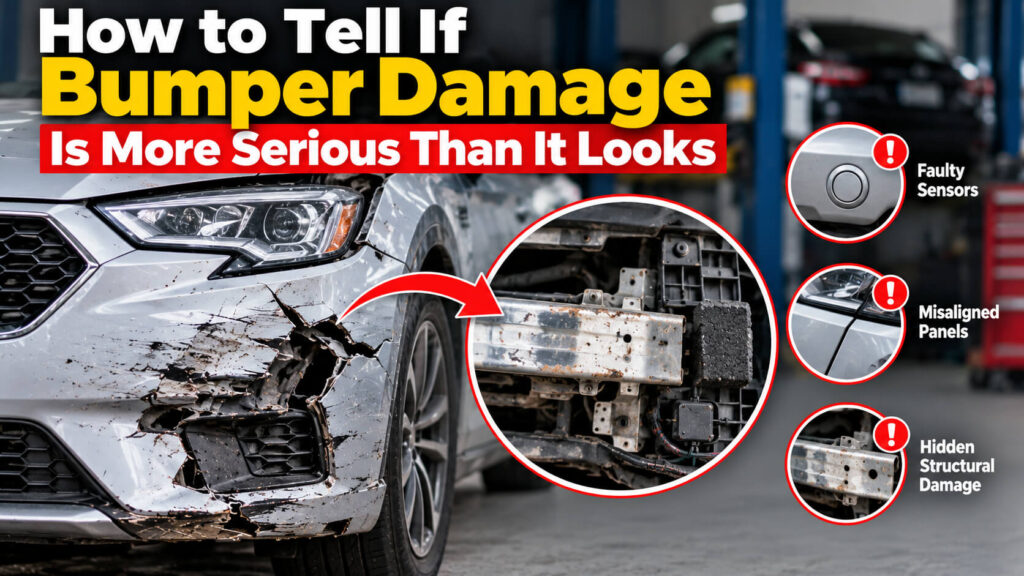
A small dent, scratch, or crack in your car’s bumper might seem like a minor cosmetic problem. However, bumper damage isn’t always as simple as it appears. Even a low-speed collision can cause hidden damage behind the bumper cover, affecting important components responsible for protecting your vehicle and its occupants.
Modern vehicles have bumper systems that include energy-absorbing materials, reinforcement bars, mounting brackets, sensors, and other safety-related components. While the exterior bumper cover may look relatively undamaged, the structure underneath could have absorbed significant impact.
So, how can you tell if bumper damage is more serious than it looks? Warning signs include uneven panel gaps, loose bumper sections, unusual noises, malfunctioning parking sensors, and changes in vehicle handling.
Understanding these signs can help you determine when professional collision repair is necessary and why ignoring seemingly minor bumper damage may lead to larger problems.
In this guide, we’ll explain how to identify hidden bumper damage, what components may be affected, and when you should have your vehicle inspected by a professional.
Why Bumper Damage Can Be More Serious Than It Appears
A vehicle’s bumper is designed to help manage impact forces during certain types of collisions. However, the visible bumper cover is only one part of the entire bumper system.
Most modern passenger vehicles have several components behind the bumper cover, including:
- Bumper cover: The visible exterior panel, typically made from flexible plastic.
- Energy absorber: Foam, plastic, or another engineered material designed to absorb some collision energy.
- Bumper reinforcement bar: A structural component that helps manage and distribute impact forces.
- Mounting brackets: Components that secure the bumper system to the vehicle.
- Crash sensors and related components: Depending on the vehicle, sensors or wiring may be located near the bumper area.
- Parking and driver-assistance sensors: Equipment used for parking assistance, blind-spot monitoring, or other advanced safety features.
During a collision, some of these components may deform, crack, or become displaced without causing obvious exterior damage.
For example, a flexible plastic bumper cover may temporarily bend during an impact and return close to its original shape. Meanwhile, the energy absorber or reinforcement bar behind it may remain damaged.
This is why visual inspection alone cannot always determine the severity of bumper damage.
10 Signs Your Bumper Damage May Be More Serious Than It Looks
Recognizing the warning signs of hidden damage can help you avoid overlooking important repairs.
1. The Bumper Has Uneven Gaps or Looks Misaligned
One of the most noticeable signs of potentially serious bumper damage is improper alignment between the bumper and surrounding body panels.
You may notice:
- Larger gaps between the bumper and fenders.
- One side of the bumper sitting lower than the other.
- The bumper protruding or appearing pushed inward.
- Uneven spacing around headlights or the trunk.
These issues may indicate broken mounting clips, damaged brackets, or displacement of supporting components.
Although bumper misalignment doesn’t always mean structural damage, it should be inspected after a collision.
2. The Bumper Feels Loose or Moves When Touched
A properly installed bumper cover should remain securely attached to the vehicle.
If it moves excessively, rattles, or separates from the surrounding panels, its mounting components may be damaged.
Broken clips and brackets are common after minor collisions. However, looseness can also indicate damage to the bumper’s supporting structure.
A loose bumper may detach further while driving, especially at highway speeds or over uneven roads.
3. There Are Cracks, Splits, or Deep Dents
Small surface scratches are often cosmetic, but cracks and deep dents deserve closer attention.
A cracked bumper cover may indicate that the impact force exceeded the material’s ability to flex without damage.
Look for:
- Cracks extending across the bumper surface.
- Split plastic around mounting points.
- Deep dents that do not return to their original shape.
- Missing or broken bumper sections.
- Damage near parking sensors or lights.
Cracks do not automatically mean the underlying reinforcement is damaged. However, they can justify a more detailed inspection to determine whether other components were affected.
4. Parking Sensors or Safety Features Stop Working
Many modern vehicles have sensors integrated into or mounted behind their bumpers.
These may support features such as parking assistance, rear cross-traffic alerts, blind-spot monitoring, or automatic emergency braking.
After a collision, you might notice:
- Parking sensors giving false warnings.
- A backup camera displaying an unusual angle.
- Blind-spot monitoring warnings.
- Driver-assistance features becoming unavailable.
- Dashboard messages indicating sensor faults.
These symptoms may result from damaged sensors, displaced mounting brackets, disconnected wiring, or other collision-related problems.
Some repairs require sensor calibration or verification according to the vehicle manufacturer’s procedures.
Important: Even if a sensor appears to work, that does not necessarily confirm that its mounting position or calibration is correct.
5. You Hear New Rattling or Scraping Noises
Unusual sounds after a bumper impact may indicate loose or displaced components.
For example, you might hear rattling when driving over bumps or scraping noises while turning.
Possible causes include damaged bumper brackets, loose splash shields, broken underbody panels, or components contacting the tires or road.
If you notice new noises after a collision, have the affected area inspected rather than assuming the damage is cosmetic.
6. The Trunk or Hood No Longer Closes Properly
A collision involving the front or rear bumper can sometimes affect nearby body structures.
After a rear-end impact, you may notice that the trunk lid no longer closes smoothly or sits unevenly.
Following a front-end collision, the hood may appear misaligned or become difficult to latch.
These symptoms can indicate damage to hinges, latches, body panels, or underlying support structures.
Because hood and trunk latches are safety-related components, closure problems should be addressed promptly.
7. Your Vehicle Pulls to One Side After the Accident
Bumper damage alone does not normally cause wheel alignment problems.
However, the same collision that damaged the bumper may also have affected steering, suspension, wheels, or structural mounting points.
If your vehicle begins pulling to one side after an accident, possible causes include:
- Bent suspension components.
- Damaged steering parts.
- Incorrect wheel alignment.
- Tire or wheel damage.
- Displaced suspension mounting points.
A professional inspection can help identify whether the issue is related to the collision.
If steering feels unstable or unpredictable, avoid driving until the vehicle has been evaluated.
8. You Notice Fluid Leaks Near the Damaged Area
Fluid leaks after a collision can indicate damage beyond the bumper cover.
Front-end impacts may affect nearby cooling components, hoses, or fluid reservoirs, depending on the vehicle’s design.
Potential warning signs include puddles underneath the vehicle, a rising engine temperature gauge, or visible fluid dripping from the damaged area.
If you suspect a coolant, fuel, brake-fluid, or other important fluid leak, do not continue driving until the problem has been assessed.
9. Headlights or Taillights Are Misaligned
Bumper impacts can affect nearby lighting assemblies, mounting brackets, and body panels.
You may notice headlights that appear crooked, taillights that no longer fit correctly, or moisture entering damaged light assemblies.
Misaligned headlights can reduce nighttime visibility or create glare for other drivers.
Damaged lighting components should be inspected and repaired to maintain safe vehicle operation.
10. The Bumper Looks Fine but the Impact Was Significant
Sometimes the most important warning sign is the collision itself.
Flexible bumper covers can return close to their original shape after an impact, hiding damage underneath.
If your vehicle experienced a substantial impact, particularly one involving another vehicle, a fixed object, or a significant speed difference, a professional collision inspection is advisable even when the bumper looks relatively normal.
The appearance of the bumper alone cannot reliably indicate how much collision energy reached the components behind it.
What Hidden Damage Can Occur Behind a Bumper?
Several important vehicle components can be affected during a collision without obvious exterior damage.
| Component | Possible Hidden Damage | Potential Consequence |
| Bumper reinforcement bar | Bending, cracking, deformation | Reduced ability to perform as designed in a future impact |
| Energy absorber | Compression, cracking, permanent deformation | Compromised impact-energy management |
| Mounting brackets | Broken clips, bent brackets, displaced attachments | Loose or misaligned bumper |
| Body structure | Damage to mounting areas or structural sections | More complex collision repairs |
| Parking sensors | Displacement, electrical damage | Incorrect warnings or feature malfunction |
| Wiring harnesses | Broken connectors, damaged insulation | Electrical faults or unavailable features |
| Cooling components | Damaged radiator, condenser, or hoses | Leaks, overheating, or air-conditioning problems |
| Lighting assemblies | Broken mounts, cracks, misalignment | Reduced visibility or lighting faults |
Not every bumper impact damages these components. The actual damage depends on the collision’s direction, severity, and vehicle construction.
Minor Bumper Damage vs. Serious Bumper Damage
Understanding the difference between cosmetic and potentially serious damage can help drivers decide what to do next.
| Feature | Usually Minor Damage | Potentially Serious Damage |
| Surface appearance | Light scratches or paint scuffs | Deep cracks, major deformation |
| Bumper fitment | Properly aligned | Loose, uneven, or displaced |
| Mounting components | Secure and intact | Broken or bent |
| Safety sensors | No apparent issues | Faults, warnings, or displacement |
| Nearby panels | Normal gaps and operation | Misaligned hood, trunk, or lights |
| Vehicle handling | Unchanged | Pulling, vibration, or steering problems |
| Repair approach | Cosmetic repair may be sufficient | Detailed inspection and possible component replacement |
These are general indicators, not a definitive diagnosis. Even apparently minor bumper damage can conceal issues that are only discovered after the bumper cover is removed.
Can a Minor Bumper Collision Cause Structural Damage?
Yes, although structural damage is not inevitable in a minor collision.
The severity depends on factors such as impact speed, angle, contact height, vehicle design, and the object involved.
For example, a collision with a narrow, rigid object may concentrate force in a small area. A vehicle-to-vehicle impact can distribute force differently depending on bumper heights and the areas of contact.
Modern vehicles are engineered with specific structures designed to manage collision energy.
If an impact exceeds the capacity of certain components, damage can extend beyond the bumper system into nearby body structures.
A qualified collision repair technician can inspect the vehicle and determine whether structural measurement is necessary.
Can You Drive With a Damaged Bumper?
Whether it is safe to drive with a damaged bumper depends on the extent and location of the damage.
A minor surface scratch generally does not affect vehicle operation.
However, driving may be unsafe when the bumper is loose, has sharp or protruding sections, interferes with the wheels, or is accompanied by other collision-related problems.
You should avoid driving and consider towing if:
- The bumper or underbody components are dragging.
- Steering or braking feels abnormal.
- Important fluids are leaking.
- The hood cannot latch securely.
- A tire is rubbing against damaged bodywork.
- The vehicle shows signs of overheating.
- The collision may have compromised critical safety components.
If the damage appears cosmetic and the vehicle operates normally, a professional inspection can still help determine whether hidden repairs are needed.
How Do Professionals Inspect Hidden Bumper Damage?
Professional collision repair technicians use a systematic process to evaluate bumper damage.
Step 1: Exterior Damage Assessment
The technician checks the bumper cover, surrounding panels, lights, and visible mounting areas.
They look for cracks, deformation, uneven gaps, and signs of impact.
Step 2: Bumper Removal When Necessary
If hidden damage is suspected, the bumper cover may need to be removed to inspect components underneath.
This can reveal damaged reinforcement bars, energy absorbers, brackets, or wiring.
Step 3: Structural Inspection
Technicians examine the bumper mounting areas and nearby body structure.
If there are signs of structural displacement, additional measurements may be needed.
Step 4: Electronic System Diagnostics
Vehicles with parking sensors and advanced driver assistance systems may require diagnostic scanning.
Technicians check for relevant fault codes and assess sensor mounting positions.
Step 5: Repair Planning
Based on the inspection, the repair facility determines which components can be repaired and which must be replaced.
Repairs should follow the vehicle manufacturer’s procedures, including any required calibration or post-repair checks.
Should You Repair or Replace a Damaged Bumper?
The decision depends on the type of damage, bumper material, component condition, and manufacturer repair guidelines.
When Bumper Repair May Be Appropriate
Repair may be possible when damage is limited to superficial scratches, small paint defects, or certain repairable plastic bumper-cover areas.
A qualified technician must determine whether the specific material and damage location permit repair.
When Bumper Replacement May Be Necessary
Replacement may be required when the bumper cover has extensive cracking, damaged attachment points, severe deformation, or damage in an area where the manufacturer prohibits repairs.
Components behind the bumper, including energy absorbers and reinforcement bars, must also be assessed separately.
A repaired exterior cover does not automatically mean the complete bumper system has been restored.
How Much Does It Cost to Repair Hidden Bumper Damage?
Bumper repair costs can vary considerably.
A cosmetic scratch repair is generally less expensive than replacing a bumper cover or repairing structural components.
Costs may increase when a collision affects multiple parts or requires electronic diagnostics and calibration.
Factors influencing the final price include the vehicle’s make and model, paint requirements, replacement parts, labor rates, structural damage, and the number of sensors involved.
For an accurate estimate, request a professional inspection that accounts for both visible and potentially hidden damage.
An initial estimate may change if additional damage is discovered during disassembly.
What Should You Do After a Bumper Collision?
Taking the right steps after a collision can help protect your safety and make the repair process easier.
- Check for injuries and immediate hazards. Move to a safe location if possible and follow local accident-reporting requirements.
- Document visible damage. Take photographs of the bumper, surrounding panels, and accident scene when it is safe to do so.
- Check for obvious mechanical problems. Look for fluid leaks, loose components, warning lights, or abnormal wheel positioning without placing yourself in danger.
- Avoid driving if safety is uncertain. Arrange towing if the vehicle has significant damage or unusual handling.
- Schedule a professional collision inspection. Ask the repair facility to assess hidden bumper components when appropriate.
- Review the repair estimate. Confirm whether necessary diagnostics, structural inspections, and sensor calibrations are included.
A thorough inspection can help ensure that important collision-related damage is not overlooked.
How to Prevent Minor Bumper Damage From Becoming a Bigger Problem
Although you cannot prevent every collision, addressing bumper damage promptly can reduce the likelihood of related issues going unnoticed.
Keep the bumper securely attached, repair damaged lighting, and have malfunctioning sensors evaluated.
Avoid attempting to force a displaced bumper back into position without understanding why it moved.
Most importantly, do not rely solely on the bumper’s appearance when deciding whether a collision caused significant damage.
Professional inspection is particularly important after impacts involving safety sensors, suspension components, or structural mounting areas.
Frequently Asked Questions
Yes. Plastic bumper covers can flex during a collision and return close to their original shape, while reinforcement bars, energy absorbers, or mounting brackets remain damaged.
Possible signs include displaced body panels, uneven gaps, damaged mounting areas, and persistent problems after a collision. However, structural damage generally requires professional inspection and sometimes specialized measurement equipment to confirm.
A cracked bumper cover is not always an immediate safety hazard, but it may indicate underlying damage or create loose, sharp sections. A professional inspection can determine whether repair or replacement is necessary.
Yes. Low-speed impacts can damage energy absorbers, brackets, sensors, and other components even when exterior damage is limited. The extent depends on the vehicle and collision circumstances.
Some vehicles require calibration, aiming, initialization, or functional checks after bumper or sensor-related repairs. Requirements vary by manufacturer, model, and sensor system.
Coverage depends on your insurance policy, the circumstances of the accident, and applicable laws. Collision-related hidden damage may be covered under certain policies, but the insurer must assess the claim.
Bumper-cover damage itself typically does not affect wheel alignment. However, the collision that damaged the bumper may also have affected steering, suspension, or structural mounting points, potentially causing alignment problems.
Final Thoughts
Bumper damage can be more serious than it looks, especially when an impact affects components hidden behind the exterior cover.
Uneven panel gaps, loose mounting points, unusual noises, malfunctioning sensors, and changes in vehicle handling are all warning signs worth investigating.
While minor scratches and paint damage may require only cosmetic repairs, a collision can sometimes damage reinforcement bars, energy absorbers, or nearby structural components.
The safest approach is to have suspected collision damage professionally inspected rather than judging its severity by appearance alone.