Your vehicle communicates with you constantly. The way it handles, the sounds it makes, the way certain doors feel when you close them — all of these are signals. Most drivers have learned to listen for mechanical signals: the low rumble that means a tire is going flat, the squeal that means brake pads are wearing thin. But far fewer drivers know how to read the early signs of auto body damage — the subtle visual and physical cues that indicate something is wrong with the exterior structure of their vehicle before it becomes an expensive, complicated problem.
This matters enormously. Auto body damage, like most forms of vehicle deterioration, follows a predictable pattern: small issues that are inexpensive and straightforward to address become large issues that are costly and complex if left unattended. A paint chip becomes a rust spot. A rust spot becomes a corroded panel. A minor misalignment becomes a structural problem. The difference between catching damage at stage one versus stage three is often thousands of dollars — and in some cases, it’s a safety issue, not just a financial one.
Knowing how to conduct a proper vehicle inspection for early body damage, what to look for, and when to take action is a skill every car owner should have. This guide walks you through it systematically — from paint surface to structural signals — so you can stay ahead of damage rather than reacting to it.
Why Early Detection Makes Such a Difference
Before getting into the specifics of what to look for, it’s worth understanding why early detection is so disproportionately valuable compared to catching damage at a later stage.
The Compounding Nature of Auto Body Damage
Auto body damage rarely stays contained. It spreads, deepens, and involves adjacent systems over time. A small scratch that penetrates through the clear coat and paint layers to bare metal creates an entry point for moisture. Moisture initiates oxidation. Oxidation spreads beneath the surrounding intact paint — invisibly, from the inside out — until it surfaces as bubbling and peeling across a much larger area than the original scratch occupied. What was a touch-up job has become a panel refinishing project.
The same compounding dynamic applies to structural misalignment, seal degradation, and glass damage. Every category of early signs of auto body damage has a trajectory — and the earlier that trajectory is interrupted, the less expensive and disruptive the intervention.
The Safety Dimension of Early Detection
Not all auto body damage is purely cosmetic. Damage to structural panels, pillars, and frame components affects how your vehicle performs in a collision. Compromised seals and glass affect water intrusion, electrical systems, and in the case of the windshield, the structural integrity of the roof. Minor damage repair performed promptly keeps these issues in the cosmetic category — ignoring them can allow them to cross into the safety category over time.
Conducting a Systematic Vehicle Inspection
The most effective approach to identifying early signs of auto body damage is a systematic vehicle inspection — one that covers the vehicle’s exterior in a logical sequence rather than a casual glance. Doing this monthly, or at minimum after any significant weather event, road debris impact, or minor collision, significantly improves your chances of catching developing issues early.
Choose the Right Conditions
Inspection conditions matter more than most people realize. Direct sunlight, while bright, creates harsh reflections that wash out surface imperfections. The ideal conditions for a thorough vehicle inspection are overcast daylight or a well-lit indoor environment — conditions that provide even, diffuse light that reveals surface irregularities without reflection interference.
A clean vehicle is also essential. Dirt and grime mask paint defects, surface rust, and panel misalignment. Always wash your vehicle before a detailed inspection so you’re looking at the actual surfaces rather than a layer of contamination.
Use the Right Technique
Stand back from the vehicle — five to ten feet — and look along each panel at a low angle. This technique, sometimes called raking, causes surface irregularities to cast small shadows that make them dramatically more visible than they would be when viewed straight on. Subtle dents, ripples in flat panel surfaces, and areas of paint texture variation all become apparent with this approach.
Then move closer for a detailed inspection of paint condition, glass integrity, seals, and panel gaps. A combination of the two perspectives — distant raking and close examination — gives you the most complete picture of your vehicle’s exterior condition.
What to Look for: A Panel-by-Panel Guide
Paint Surface Condition
The paint surface is the first and most visible indicator of developing auto body damage. Look specifically for the following:
Chips and Scratches
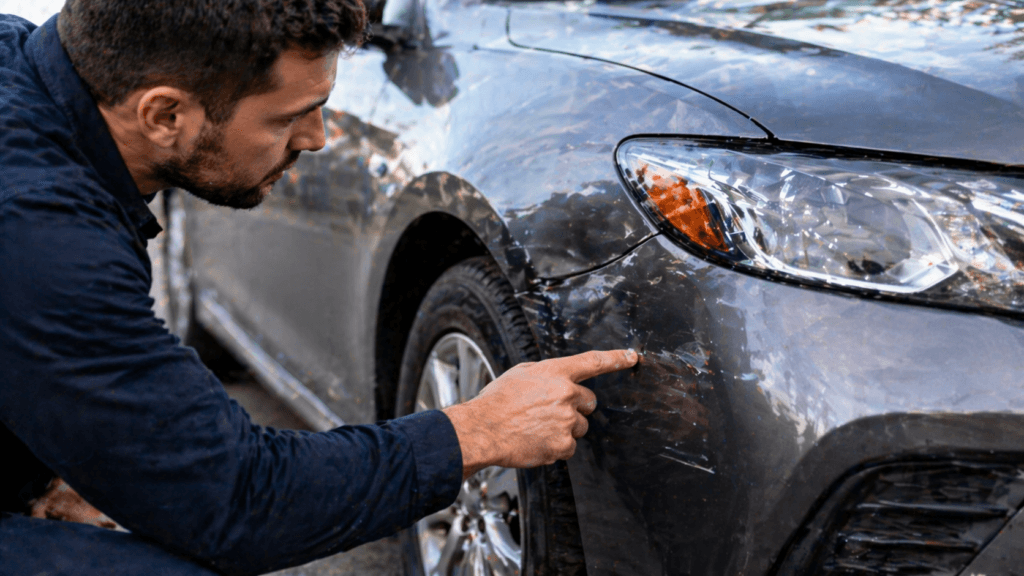
Paint chips — particularly along the hood, front bumper, and leading edge of the roof — are the most common entry points for corrosion. A chip that appears small on the surface may have disturbed all paint layers down to bare metal, even if it doesn’t look that deep. In the context of vehicle inspection, every chip should be evaluated for depth, not just size.
Scratches vary in severity. A scratch that only affects the clear coat — detectable because it’s visible in raking light but disappears when you run a wet finger over it — can often be addressed with paint correction. A scratch that goes through the color layer to primer or bare metal requires proper touch-up or refinishing to prevent corrosion development.
Paint Oxidation
In high-UV environments like Cathedral City and the Coachella Valley, paint oxidation is a common and often underestimated problem. Oxidation presents as a chalky, dull, or faded appearance — particularly on horizontal surfaces like the hood and roof that receive the most direct sun exposure. Beyond being a cosmetic issue, oxidation indicates that the clear coat is degrading, reducing its effectiveness as a moisture barrier over the paint and metal beneath.
Catching oxidation early — when it affects only the clear coat surface — allows for correction through professional paint correction and resealing. Left until the clear coat has failed entirely, the solution becomes full panel refinishing.
Bubbling or Blistering Paint
Bubbling paint is one of the most important early signs of auto body damage to know. When paint bubbles or blisters beneath the surface, it almost always indicates that rust has developed underneath and is pushing outward through the paint layers. By the time bubbling is visible on the surface, the corrosion beneath it has typically already spread beyond the visible bubble area.
Any bubbling, however small, warrants immediate professional assessment. This is a situation where minor damage repair performed promptly — before the corrosion spreads further — is dramatically less expensive than repair after the fact.
Mismatched Paint Color or Texture
Subtle differences in paint color, sheen, or texture between adjacent panels can indicate a prior repair. This isn’t necessarily a problem if the repair was done correctly, but paint inconsistency that you didn’t arrange yourself is worth investigating — it may indicate undisclosed prior damage that affects the vehicle’s structural or cosmetic condition.
Panel Alignment and Gaps
After paint surface inspection, step back and evaluate the alignment and gaps between adjacent body panels. Consistent, even gaps between the hood and fenders, between doors and door frames, and between the trunk lid and rear quarter panels are indicators of a correctly aligned body structure.
Uneven Panel Gaps
Gaps that are noticeably wider on one side than the other, or that vary in width along their length, indicate panel misalignment. This can result from a collision — even a minor one — that shifted a panel or its mounting point. It can also develop gradually through worn or damaged hinges, latches, or mounting hardware.
Uneven panel gaps are significant as early signs of auto body damage because they often indicate more than just a misaligned panel. The gap irregularity may be the visible symptom of underlying structural deformation that isn’t otherwise obvious. A professional evaluation can determine whether the cause is a simple hardware issue or something requiring structural attention.
Doors and Trunk Lids That Don’t Close Cleanly
A door or trunk lid that requires more force than usual to close, doesn’t latch on the first push, or produces a different sound when closing compared to the other doors on the same vehicle, is communicating that something has changed in its alignment or the condition of its seals and latches. This deserves prompt investigation — both for the practical inconvenience and for what it may indicate about the underlying structure.
Rust and Corrosion
Rust inspection should be a dedicated part of every vehicle inspection, with particular attention paid to the areas where corrosion is most likely to begin.
Lower Panels and Rocker Panels
The lower edges of doors and the rocker panels running beneath them are among the most rust-vulnerable surfaces on any vehicle. They receive constant debris impact and trap moisture in their seams. Inspect these areas closely for any paint bubbling, discoloration, or areas where the paint surface feels slightly raised or soft — all indicators of developing corrosion beneath.
Wheel Wells
Inspect wheel wells carefully for rust development on the inner metal surfaces. The plastic liners that protect modern wheel wells can trap moisture behind them when they crack or pull away from their mounting points. Look for rust staining around the edges of the liner and listen for any crackling or movement in the liner itself that might indicate it has separated.
Undercarriage and Frame
A thorough rust inspection of the undercarriage requires getting the vehicle off the ground — either on a lift at a professional shop or safely elevated on jack stands. The underside of the vehicle, including frame rails, crossmembers, and floor pan surfaces, should be inspected for rust development, coating damage, and any areas where bare metal is exposed. This is the single most important area for minor damage repair intervention, as undercarriage rust that is caught early can be treated and coated at modest cost, while advanced structural rust requires significantly more extensive work.
Glass and Seals
Windshield and Window Glass
Inspect all glass surfaces for chips, cracks, and crazing — the fine network of surface cracks that develops in glass that has been subjected to significant thermal stress. Pay particular attention to the windshield, where even a small chip in the driver’s direct line of sight is both a safety issue and a legal concern in most states.
A chip in the windshield that is smaller than a quarter and not in the driver’s primary sight line can often be repaired quickly and inexpensively through resin injection — a minor damage repair that takes less than an hour and restores the structural integrity of the glass. A chip that is ignored becomes a crack, and cracks spread — particularly in the Coachella Valley’s extreme temperature cycling environment, where thermal expansion and contraction place constant stress on already-compromised glass.
Window and Door Seals
Run your fingers along the rubber seals around every window and door. Seals that are cracked, compressed, torn, or pulling away from their channels are no longer providing an effective moisture barrier. Water intrusion through degraded seals leads to interior moisture damage, mold development, and — in the case of door seals — rust development inside the door cavity where it is completely invisible until it has progressed significantly.
Seal replacement is among the least expensive minor damage repair interventions available and among the most cost-effective, given the damage that degraded seals allow to develop over time.
Structural and Handling Signals
Some of the most important early signs of auto body damage aren’t visible at all — they’re felt through the vehicle’s behavior while driving.
Vehicle Pulling to One Side
A vehicle that consistently pulls to one side despite correct tire pressures and recent wheel alignment may be communicating a structural geometry issue. Frame deformation — whether from a collision, accumulated impact damage, or corrosion-related weakening — can alter the vehicle’s structural geometry in ways that no amount of alignment adjustment will fully correct, because the underlying structure is not where it should be.
Unusual Sounds Over Uneven Surfaces
Creaking, groaning, or rattling sounds from the body structure — particularly pronounced over speed bumps, potholes, or uneven pavement — can indicate cracked welds, loose structural components, or corrosion-related weakening in body panels or frame members. These sounds should prompt a professional structural inspection.
Wind Noise or Water Intrusion
Increased wind noise at highway speeds, or water appearing inside the vehicle after rain, indicates that body seals, panel gaps, or glass seals are no longer providing an effective barrier. Beyond the immediate inconvenience, these are symptoms of alignment or seal issues that allow ongoing moisture intrusion — a progressive problem if not addressed.
When to Take Action: The Right Threshold for Professional Evaluation
One of the most common mistakes car owners make is setting too high a threshold for seeking professional evaluation — waiting until damage is obvious and undeniable before doing anything about it. The appropriate threshold for a vehicle inspection by a professional auto body technician is much lower than most people apply.
Any paint damage that reaches bare metal, any rust bubbling regardless of size, any panel misalignment that wasn’t there before, any glass chip, any seal degradation, and any unusual structural sound or handling change all warrant professional evaluation. The cost of an assessment is minimal. The cost of the problems that develop from uninvestigated early signs of auto body damage is not.
Minor damage repair is only minor when it’s caught and addressed at the minor stage. The same damage becomes a major repair when it’s allowed to progress.
CatCity Auto Body: Catching Problems Before They Become Costly
At CatCity Auto Body, Inc., we believe that the best collision repair is the one you never need — because damage was caught early and addressed before it escalated. Our experienced technicians are available to perform professional vehicle inspections that go beyond the surface, identifying developing issues in paint condition, panel alignment, rust formation, glass integrity, and structural condition before they become expensive repairs.
Whether you’ve noticed something specific that concerns you, recently experienced a minor collision, or simply want the peace of mind that comes from knowing your vehicle’s condition has been professionally assessed, CatCity Auto Body, Inc. is here to help. We bring the same attention to detail and technical expertise to preventative inspections that we bring to full collision repairs — because minor damage repair done right, at the right time, is one of the most valuable services we offer.
Call CatCity Auto Body, Inc. at 760-324-7117 to schedule your professional vehicle inspection today. Serving Cathedral City and the entire Coachella Valley, we’re committed to keeping your vehicle in the best possible condition — starting with catching the small things before they become big ones.
CatCity Auto Body, Inc. — Cathedral City’s trusted collision repair experts for over 20 years.