
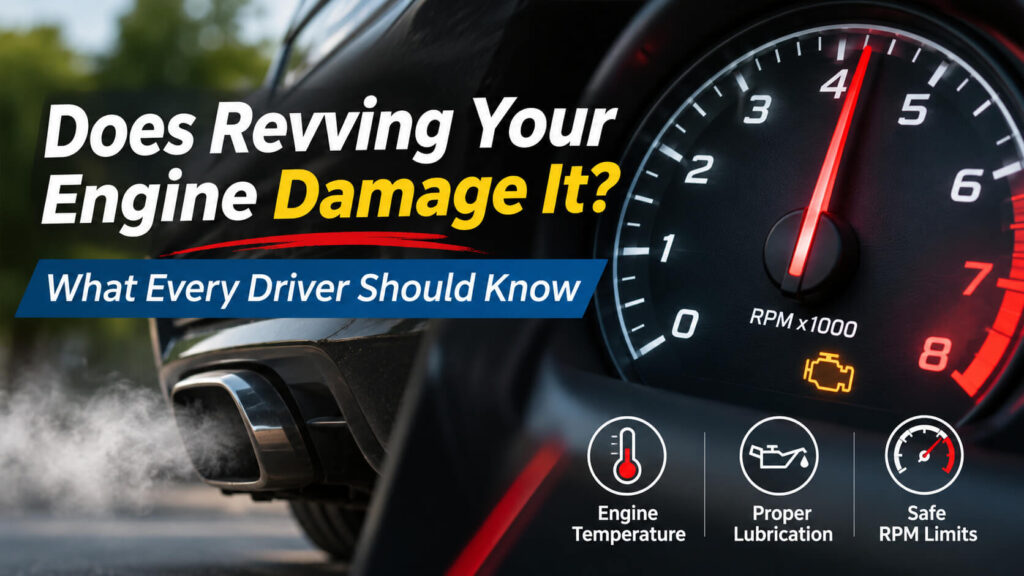
Revving your engine does not automatically cause damage, but excessive or improper revving can increase engine wear and potentially lead to mechanical problems. The risk depends on engine temperature, RPM (revolutions per minute), how long the engine stays at high RPM, and whether the vehicle is moving or stationary.
A brief increase in RPM while driving is generally normal for a properly maintained engine. However, repeatedly revving a cold engine, holding it near the redline, or accelerating aggressively while parked can place unnecessary stress on internal components.
Understanding when revving is harmless and when it becomes risky can help you protect your vehicle, avoid expensive repairs, and develop better driving habits.
What Does Revving an Engine Mean?
Revving an engine means increasing its rotational speed by pressing the accelerator pedal. Engine speed is measured in revolutions per minute (RPM), which indicates how many times the crankshaft rotates each minute.
When you press the accelerator, the engine management system increases power output by adjusting airflow, fuel delivery, and other operating parameters. As a result, engine RPM rises.
For example:
- Idle: Many passenger vehicles idle around 600–1,000 RPM when warm.
- Normal driving: Engine speed often falls between approximately 1,500 and 3,000 RPM, depending on the vehicle, transmission, and driving conditions.
- Hard acceleration: RPM may climb to 4,000–6,000 or higher, depending on engine design.
- Redline: The manufacturer-defined upper operating range, beyond which the risk of engine damage increases.
These are general examples, not universal safe limits. Diesel engines, performance engines, hybrids, and other powertrains may operate in substantially different RPM ranges.
Revving is not inherently harmful because engines are designed to operate across a range of speeds. Problems arise when engine speed, temperature, lubrication, or mechanical load exceeds what the engine can safely tolerate.
Does Revving Your Engine Damage It?
Revving your engine can cause damage if you do it excessively, especially when the engine is cold or operating near its RPM limit. Occasional revving within the manufacturer’s recommended operating range is unlikely to harm a healthy, properly maintained engine.
The difference comes down to how and when you rev the engine.
When Revving Your Engine Is Generally Safe
Revving is usually a normal part of vehicle operation in situations such as:
- Accelerating to merge onto a highway.
- Passing another vehicle when conditions allow.
- Driving uphill when additional engine power is needed.
- Downshifting appropriately in a manual transmission vehicle.
- Briefly increasing RPM during normal driving after the engine has reached operating temperature.
Modern engines are engineered to handle varying RPM levels. Many also include electronic rev limiters that help prevent excessive engine speed under certain conditions.
However, a rev limiter cannot prevent every type of engine damage, particularly mechanical over-revving caused by selecting an inappropriate gear.
When Revving Your Engine Can Be Harmful
Revving becomes more concerning when you:
- Repeatedly accelerate a cold engine to high RPM.
- Hold the engine near redline for extended periods.
- Continuously rev the engine while parked or in neutral.
- Ignore low engine oil levels or existing mechanical problems.
- Force the engine beyond its designed operating speed.
Excessive engine speed increases the frequency and intensity of forces acting on moving components. Under unfavorable conditions, this can accelerate wear or cause mechanical failure.
What Happens When You Rev Your Engine Too Much?
When an engine operates at high RPM, several mechanical and thermal changes occur. While a healthy engine can tolerate high RPM within its design limits, excessive revving increases the demands placed on its internal components.
1. Increased Engine Wear
At higher RPM, pistons, connecting rods, bearings, camshafts, and other moving components complete more operating cycles per second.
This increases mechanical activity and can accelerate wear, particularly when lubrication is inadequate or engine components are already worn.
A single brief rev does not necessarily cause measurable damage. Repeated high-RPM operation under poor conditions creates greater risk.
2. Higher Engine Temperatures
Higher engine speeds can increase heat generation, especially when the engine is producing significant power.
The cooling system is designed to regulate operating temperature, but prolonged high-load operation, insufficient coolant, or an existing cooling-system problem may contribute to overheating.
Overheating can damage components such as cylinder heads, head gaskets, and other heat-sensitive parts.
3. Greater Stress on Internal Components
High RPM increases inertial forces acting on pistons, connecting rods, and valvetrain components.
If engine speed exceeds the manufacturer’s limits, components may no longer operate as intended.
Potential consequences include:
- Valve float or loss of proper valve control.
- Connecting rod or bearing damage.
- Piston-to-valve contact in certain engine designs.
- Severe internal engine failure.
These outcomes are associated with extreme operating conditions or mechanical faults, not ordinary acceleration within the engine’s intended range.
4. Increased Fuel Consumption
Revving the engine unnecessarily consumes fuel without providing a useful driving benefit.
Fuel consumption depends on engine speed, engine load, and the vehicle’s control systems. However, repeated unnecessary acceleration generally wastes fuel and may increase emissions.
5. Additional Exhaust System Stress
High-RPM operation can increase exhaust flow and thermal demands, particularly under heavy engine load.
A properly functioning exhaust system is designed to tolerate normal operating conditions. However, existing exhaust leaks, damaged mounts, or other defects may become more noticeable during aggressive revving.
If your vehicle develops unusual exhaust noises, vibrations, or visible damage after an incident, professional inspection can help identify the source.
Is It Bad to Rev Your Engine in Park or Neutral?
Revving your engine in park or neutral is not automatically damaging, but repeatedly holding it at high RPM provides little benefit and can increase mechanical stress.
When the vehicle is stationary, the engine can increase speed without the same drivetrain load it experiences during normal acceleration.
Some vehicles limit RPM in park or neutral through their engine management systems. Others may allow higher engine speeds.
Even when the vehicle has a rev limiter, repeatedly pressing the accelerator to reach that limit is not a recommended maintenance practice.
Can Revving in Park Damage Your Transmission?
Simply increasing engine RPM while an automatic transmission is securely in Park does not place the same driving load on the transmission as accelerating on the road.
However, shifting into Drive or Reverse while the engine is revving can produce a sudden drivetrain shock and potentially damage transmission or drivetrain components.
Never shift gears at elevated engine speed to launch the vehicle.
For routine driving, allow the engine to settle to its normal idle speed before selecting a driving gear.
Is It Bad to Rev a Cold Engine?
Yes. Revving a cold engine aggressively is generally riskier than revving an engine that has reached normal operating temperature.
When an engine first starts, its oil and internal components may not yet be at their normal operating temperatures.
Cold engine oil can be more viscous, while engine components have not fully reached their intended thermal clearances.
Although modern lubrication systems begin circulating oil quickly, aggressive revving immediately after startup can create unnecessary mechanical stress.
How Should You Warm Up Your Engine?
For most modern gasoline-powered vehicles, the recommended approach is to start the engine, allow it to stabilize briefly, and begin driving gently.
Avoid hard acceleration and sustained high RPM until the engine approaches normal operating temperature.
Extended idling is generally unnecessary for warming up most modern passenger vehicles, although manufacturer guidance and extreme weather conditions may require different precautions.
Always follow the instructions in your vehicle’s owner’s manual.
Does Revving Your Engine in Neutral Damage It?
Revving in neutral can damage an engine under the same unfavorable conditions as revving in park, particularly when the engine is cold, poorly lubricated, or operated excessively close to its RPM limit.
Neutral revving is not inherently destructive, but it is generally unnecessary outside specific diagnostic or manufacturer-approved procedures.
There is also an important distinction between revving an engine in neutral and using controlled throttle inputs during a manual-transmission downshift.
Rev matching, when performed correctly, can help synchronize engine speed with the lower gear and reduce drivetrain shock.
However, an incorrect downshift can mechanically over-rev the engine, potentially causing serious damage even if the vehicle has an electronic rev limiter.
Can Revving Your Engine Cause a Blown Engine?
Yes, extreme over-revving can cause catastrophic engine failure, although it is not a typical result of briefly revving a healthy engine.
A blown engine is a general term commonly used to describe severe internal engine damage.
Potential causes associated with excessive RPM include connecting rod failure, bearing failure, valvetrain damage, or piston damage.
The risk increases when high engine speed is combined with inadequate lubrication, overheating, pre-existing wear, or a mechanical over-revving event.
If your engine suddenly produces loud knocking sounds, loses power, or displays a critical oil-pressure warning, stop driving as soon as it is safe and shut off the engine. Continuing to operate it may worsen the damage.
Does Revving Your Engine Help Charge the Battery?
Increasing engine RPM can sometimes increase alternator output, particularly when the engine is idling and the electrical system is under significant load.
However, unnecessary high-RPM revving is not an effective or recommended way to charge a weak battery.
Modern charging systems regulate alternator output based on vehicle design and electrical demand. Many can provide substantial charging output at idle.
If your battery frequently loses charge, the underlying issue may involve battery condition, alternator performance, wiring, or an electrical drain.
A battery and charging-system test is more useful than repeatedly revving the engine.
Does Revving Your Engine Clean It?
Revving an engine while parked does not reliably clean the engine or remove harmful carbon deposits.
Some engines and emissions systems benefit from operating at appropriate temperatures and loads during normal driving, but this depends on the vehicle’s design.
For example, certain diesel particulate filter regeneration processes require specific operating conditions. Simply revving the engine in neutral is not an equivalent substitute.
If your vehicle experiences rough idling, hesitation, reduced power, or suspected carbon buildup, proper diagnosis is preferable to aggressive revving.
How to Tell If Revving Has Damaged Your Engine
Engine damage may not always be immediately apparent. However, certain symptoms can indicate that a vehicle needs professional attention.
| Warning sign | Possible explanation |
| Knocking or tapping noises | Internal wear, lubrication issues, or mechanical damage |
| Rough idle | Ignition, fuel, airflow, or mechanical problems |
| Unusual exhaust smoke | Oil consumption, fueling problems, or coolant entering combustion chambers |
| Reduced engine power | Engine management faults or mechanical problems |
| Overheating | Cooling-system problems or excessive thermal stress |
| Oil-pressure warning light | Potentially inadequate oil pressure |
| Persistent check engine light | A fault detected by the vehicle’s diagnostic system |
These symptoms do not prove that revving caused the problem. Several unrelated mechanical or electrical issues can produce similar warning signs.
If an oil-pressure warning appears or the engine makes severe knocking noises, stop driving safely and arrange professional assistance rather than continuing to test the engine.
How to Rev Your Engine Without Causing Damage
Safe engine operation depends more on following manufacturer guidance than staying below a single universal RPM number.
Here are practical habits that can help reduce unnecessary wear.
Follow Your Vehicle’s RPM Limits
Pay attention to the tachometer and the manufacturer’s recommended operating range.
Avoid intentionally holding the engine near redline or repeatedly activating the rev limiter.
Let the Engine Warm Up Before Hard Acceleration
Drive gently during the initial warm-up period.
Remember that coolant temperature and engine oil temperature are not necessarily identical. On some vehicles, the oil takes longer to reach its normal operating temperature.
Maintain Proper Oil Levels
Engine oil helps lubricate, cool, and protect moving components.
Check the oil level as recommended and follow the manufacturer’s oil specification and service interval.
Avoid Unnecessary Revving While Stationary
Repeatedly revving in park or neutral offers little practical benefit for most drivers.
If you suspect an engine problem, avoid using high RPM as a diagnostic shortcut.
Address Warning Signs Early
Unusual vibrations, fluid leaks, abnormal noises, or warning lights should be investigated before they become more serious.
If your vehicle has also suffered accident-related damage, a qualified inspection can determine whether collision-related components need repair.
For visible exterior damage, learn more about collision repair services and how professional assessments help identify damage that may not be obvious at first glance.
Can an Accident Affect Your Engine or Drivetrain?
Although excessive revving and collision damage are different issues, a vehicle involved in an accident can experience problems that affect its ability to operate safely.
For example, a collision may damage cooling-system components, engine mounts, hoses, wiring, or nearby structural parts.
Even a seemingly minor impact can sometimes cause damage beyond the visible bumper or body panels.
At Cat City Auto Body, vehicle owners can explore professional bumper and fender repair and frame straightening services when collision damage affects the vehicle’s exterior or structure.
If engine or drivetrain symptoms appear after an accident, a qualified mechanical technician should also inspect the relevant systems.
When Should You Have Your Vehicle Inspected?
A professional inspection is advisable if you notice unusual noises, vibrations, warning lights, fluid leaks, or changes in vehicle performance after excessive revving or an accident.
For suspected internal engine damage, choose a qualified engine repair technician or mechanical repair facility.
For accident-related body and structural damage, Cat City Auto Body offers information about its auto body services, including dent repair and collision repair.
If your vehicle has been damaged in a covered accident, you can also learn about insurance claim assistance and the collision repair process.
Frequently Asked Questions About Revving Your Engine
Not usually. Briefly increasing RPM within the manufacturer’s operating limits is unlikely to damage a healthy engine. Immediate damage is more likely when the engine is severely over-revved, has inadequate lubrication, or already has a serious mechanical problem.
Not necessarily. Many gasoline engines are designed to operate at 4,000 RPM during normal acceleration. However, whether that speed is appropriate depends on the specific engine, its temperature, its condition, and the manufacturer’s operating limits.
A brief increase to 5,000 RPM may be normal for some gasoline engines but excessive for others, particularly certain diesel engines. Consult your vehicle’s tachometer and owner’s manual rather than relying on a universal RPM threshold.
Occasional, moderate revving in park is unlikely to harm a healthy, warm engine. Repeatedly revving to high RPM or holding the engine near its limit can create unnecessary wear and mechanical stress.
Revving alone in park or neutral generally does not apply the same load to the transmission as driving. However, shifting into gear while the engine is at high RPM can cause drivetrain shock and potentially damage components.
Yes, aggressive revving when the engine is cold can increase wear because engine oil and internal components have not reached normal operating temperatures. Gentle driving during warm-up is generally preferable.
Yes. Unnecessary revving consumes fuel, and repeated throttle increases can raise fuel consumption without providing useful vehicle movement.
High engine speed can contribute to heat generation, particularly under heavy load. A healthy cooling system should manage normal operating conditions, but excessive operation or existing cooling problems can increase overheating risk.
No. There is no general evidence that unnecessarily revving an engine while stationary extends its lifespan. Proper maintenance, appropriate driving habits, and following manufacturer recommendations are more important.
Final Thoughts: Is Revving Your Engine Bad?
Revving your engine is not inherently bad. Engines are designed to operate at different speeds, and higher RPM is sometimes necessary for acceleration, hill climbing, or normal gear changes.
The main risks arise from excessive RPM, cold-engine revving, poor lubrication, prolonged high-speed operation, and mechanical over-revving.
To protect your vehicle, follow the manufacturer’s operating limits, maintain the engine properly, and avoid unnecessary aggressive revving.
If your vehicle has sustained collision damage, contact Cat City Auto Body to discuss an exterior or structural damage assessment. For internal engine concerns, consult a qualified mechanical repair specialist.