
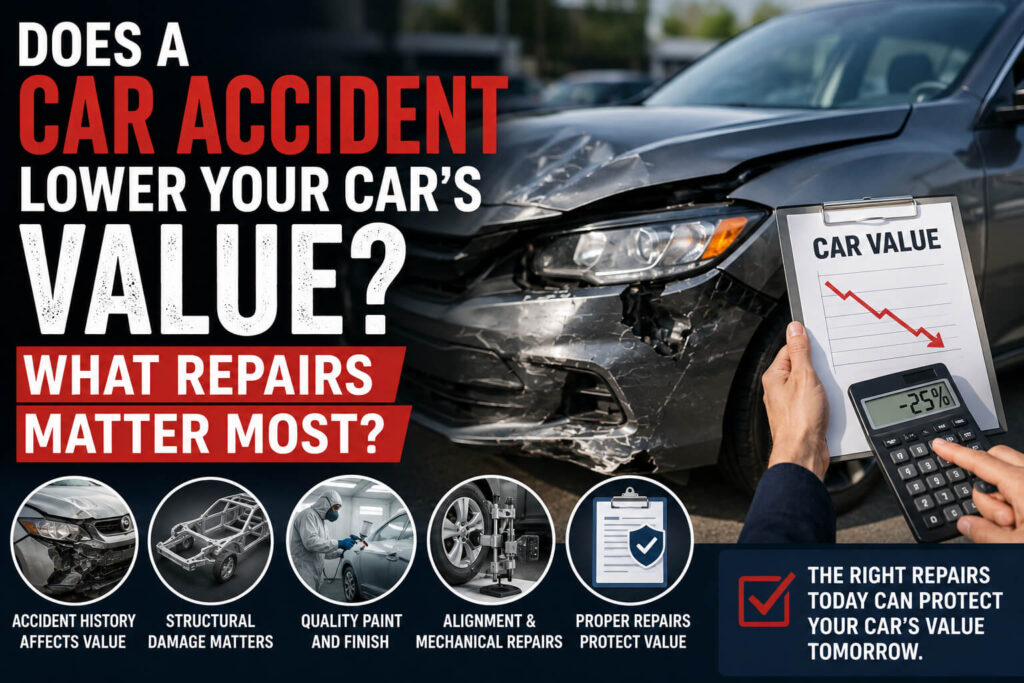
Yes, a car accident can lower its value, especially when the collision is reported to an insurance company or appears on the vehicle’s history.
The impact on value depends on several factors, including:
- Severity of the accident
- Type of damage
- Whether the frame or unibody structure was affected
- Quality of the repairs
- Number of panels repaired or replaced
- Vehicle age and mileage
- Previous accident history
- Condition of the paint and body
- Whether original safety systems were properly restored
- How the vehicle is documented after repairs
A professionally repaired vehicle can look and drive much better than one with poorly completed collision work. However, a vehicle with a reported accident history may still be worth less to some buyers than an otherwise similar vehicle with no reported accidents.
This is one reason proper collision repair matters.
If you recently had an accident in Cathedral City, CatCity Auto Body provides collision repair, auto painting, dent repair, bumper and fender repair, and frame straightening.
Why Does an Accident Affect a Car’s Value?
Buyers generally want confidence that a used vehicle has been properly maintained and has not suffered serious previous damage.
An accident can raise questions about:
- Structural repairs
- Previous paintwork
- Replacement parts
- Mechanical damage
- Alignment
- Safety-system repairs
- Hidden damage
- Long-term reliability
Even when a vehicle looks excellent after repairs, a buyer may discover the accident history through a vehicle history report or other documentation.
That can affect what the buyer is willing to pay.
However, not every accident affects vehicle value in the same way.
A minor parking-lot scrape repaired professionally is very different from a major collision involving structural damage.
What Is Diminished Value?
Diminished value refers to the potential reduction in a vehicle’s market value after it has been damaged and repaired.
The basic idea is simple:
Two otherwise similar vehicles may not have the same market value if one has a documented accident history.
For example, imagine two similar vehicles:
- Vehicle A has no reported accidents.
- Vehicle B was involved in a collision and professionally repaired.
Even if Vehicle B looks excellent after the repair, some buyers may prefer Vehicle A because it has no accident history.
That difference in perceived market value is often what people mean when they discuss diminished value.
Diminished value is not the same thing as the cost of repairing the vehicle.
Repair cost answers: “How much does it cost to fix the damage?”
Diminished value asks: “How might the vehicle’s market value be affected after the accident and repair?”
These are two different questions.
What Types of Accident Damage Can Affect Vehicle Value the Most?
Not all collision damage carries the same potential impact.
1. Structural or Frame Damage
Structural damage can be particularly important because buyers may be concerned about how extensively the vehicle was affected.
Depending on the vehicle, structural areas may include:
- Frame rails
- Unibody sections
- Aprons
- Rocker areas
- Suspension mounting points
- Floor sections
- Other structural components
A properly equipped collision repair facility can measure and repair structural damage according to applicable procedures.
CatCity provides frame straightening services for vehicles that require structural inspection and repair after a collision.
The quality of the structural repair matters.
A vehicle that has been properly measured and repaired is in a very different position from one that still has unresolved structural or alignment problems.
2. Multiple-Panel Collision Damage
An accident involving several body panels may raise more questions for a future buyer than a minor isolated scratch.
Multiple damaged areas may include:
- Hood
- Fender
- Door
- Quarter panel
- Bumper
- Trunk
- Roof
The repair may involve bodywork, replacement parts, refinishing, and blending.
A professional repair can restore the vehicle’s appearance, but the accident history may still remain part of the vehicle’s background.
3. Airbag Deployment
Airbag deployment generally indicates that the collision was more significant than a simple cosmetic incident.
A proper repair may involve restoring:
- Airbags
- Seat-belt systems
- Sensors
- Related modules
- Interior components
Safety-system repairs should be performed correctly rather than simply making warning lights disappear.
4. Suspension or Wheel Damage
An accident involving the wheel area can potentially affect:
- Control arms
- Steering components
- Hubs
- Wheels
- Tires
- Suspension mounting points
- Alignment
A vehicle that continues pulling or vibrating after repairs can create concerns for a future buyer.
Proper inspection and repair are therefore important.
5. Poorly Repaired Paint
Paint quality can have a major effect on how a repaired vehicle looks.
Signs of poor refinishing may include:
- Noticeable color differences
- Overspray
- Uneven clear coat
- Visible sanding marks
- Uneven texture
- Paint on rubber or trim
- Poor panel transitions
A professional auto painting service should focus on proper preparation, color matching, refinishing, and final inspection.
Does Professional Collision Repair Protect Car Value?
Professional collision repair cannot guarantee that a vehicle will retain its pre-accident market value.
However, proper repairs can help prevent additional problems that may make the vehicle less desirable.
Poor repairs can create:
- Misaligned panels
- Uneven paint
- Corrosion
- Persistent steering problems
- Uneven tire wear
- Loose trim
- Sensor problems
- Water leaks
- Visible repair defects
A vehicle that has been properly repaired is generally easier to present to a future buyer than one showing obvious signs of poor workmanship.
The goal is to restore the vehicle as completely as possible rather than simply making the damage look acceptable from a distance.
Does Replacing a Damaged Panel Lower a Car’s Value?
Replacing a damaged panel does not automatically mean the vehicle has been poorly repaired.
In fact, replacing a severely damaged panel may be the appropriate repair.
For example, a badly damaged fender may be replaced rather than repeatedly reshaped.
Similarly, a severely damaged bumper may require replacement.
The important factors include:
- Why the panel was replaced
- Quality of the replacement part
- Proper installation
- Panel alignment
- Paint matching
- Overall repair quality
A replacement panel that fits correctly and has been properly refinished can look very close to the surrounding vehicle.
Does Repainting a Car Lower Its Value?
A professional repaint does not automatically reduce a vehicle’s value.
However, buyers may notice repainting if:
- The color does not match
- Paint texture is inconsistent
- Overspray is visible
- The finish is noticeably different
- The repair was not documented clearly
A high-quality refinish should blend appropriately with the existing vehicle finish.
This is particularly important with:
- Metallic colors
- Pearl finishes
- Tri-coat paint
- Older vehicles with sun fading
Color matching and blending can help make a repaired panel visually consistent with the surrounding panels.
Why Paint Matching Matters After an Accident?
A repaired panel should not stand out from the rest of the vehicle.
For example, if a silver fender is repainted but the adjacent door has years of sun exposure, simply using the original factory paint code may not produce a perfect visual match.
A professional refinishing process may account for:
- Existing paint condition
- Vehicle age
- Sun exposure
- Factory paint code
- Color variants
- Metallic or pearl characteristics
Blending may also be necessary.
The goal is to create a smooth transition between the new and existing finish.
Can a Small Accident Still Affect Resale Value?
It can.
Even a relatively minor accident may appear in a vehicle history report if it was reported.
A buyer may care less about the physical severity of the damage and more about the fact that the vehicle has an accident history.
For example, a minor bumper repair and a major structural collision are not equivalent repairs.
However, both may become part of the vehicle’s documented history depending on how the incident was handled.
This is why maintaining repair records can be helpful.
Should You Keep Your Collision Repair Records?
Yes.
Keeping documentation can help explain what happened to the vehicle and how it was repaired.
Useful records may include:
- Repair estimates
- Final invoices
- Photos
- Parts information
- Alignment records
- Diagnostic records
- Calibration documentation
- Warranty information
If you eventually sell the vehicle, organized documentation can help answer questions from a prospective buyer.
Instead of simply saying:
“The car was in an accident, but it was fixed.”
you may be able to show what was repaired and provide supporting documentation.
What Repair Quality Matters Most for Resale Value?
Several areas deserve particular attention.
Structural Repair
If structural damage occurred, proper measurement and repair are critical.
Panel Fit
Doors, hood, trunk, fenders, and bumpers should align correctly.
Paint Finish
The repaired area should have an appropriate color, gloss, and texture.
Mechanical Condition
Steering, suspension, brakes, wheels, and tires should be inspected when affected by the accident.
Safety Systems
Airbags, seat belts, sensors, cameras, and other applicable systems should be properly restored.
Alignment
The vehicle should track properly after repairs.
Documentation
Keeping repair records gives future owners more information about the vehicle’s history.
Can Poor Collision Repair Reduce a Car’s Value More?
Yes, poor-quality repairs can create additional concerns beyond the original accident history.
A vehicle may lose additional appeal if a future buyer notices:
- Mismatched paint
- Uneven panel gaps
- Overspray
- Poorly fitted replacement parts
- Warning lights
- Uneven tire wear
- Steering problems
- Water leaks
- Loose bumper components
- Visible corrosion
In other words, the accident history is only part of the story.
The condition of the repaired vehicle also matters.
How Can You Tell If a Car Was Poorly Repaired?
If you’re buying a used vehicle, inspect it carefully.
Look for differences between adjacent panels.
Check the paint
Look for:
- Different shades
- Uneven gloss
- Texture differences
- Overspray
Check panel gaps
Look for:
- Uneven gaps
- Doors sitting too high or low
- Hood misalignment
- Bumper gaps
Check fasteners
Different or damaged fasteners can sometimes suggest previous repair work.
Check the tires
Uneven tire wear can indicate alignment or suspension problems.
Test the vehicle
Pay attention to:
- Steering
- Pulling
- Vibrations
- Unusual noises
- Braking
Review the vehicle history
A history report can provide additional information about reported accidents or repairs.
A professional pre-purchase inspection is also worth considering when buying a vehicle with accident history.
Should You Repair Cosmetic Damage Before Selling Your Car?
It depends on the damage and the vehicle.
Visible cosmetic damage can make a vehicle look poorly maintained even if it runs perfectly.
Examples include:
- Deep scratches
- Large dents
- Peeling clear coat
- Damaged bumpers
- Broken trim
- Mismatched paint
Repairing these issues may improve the vehicle’s presentation.
However, you should consider the expected repair cost versus the potential increase in selling price.
Not every cosmetic repair will return its full cost at resale.
Does Frame Straightening Affect Resale Value?
Frame straightening itself is not necessarily a negative sign.
If a vehicle suffered structural damage, proper structural repair may be necessary to restore its geometry.
The larger issue for a future buyer is usually the vehicle’s accident history and confidence in the repair.
A properly repaired structure is preferable to leaving a damaged structure unresolved.
If structural damage is suspected, the vehicle should be inspected by a qualified collision repair facility.
What Happens to a Car’s Value After a Total Loss?
A vehicle declared a total loss can have a very different history from a vehicle that receives conventional collision repairs.
The title status and insurance history can become important considerations.
A vehicle that is repairable and properly restored is different from one that has been branded or rebuilt following a total-loss event.
Because title and insurance rules can vary, buyers should carefully review the vehicle’s documentation before purchasing a previously totaled or rebuilt vehicle.
Does an Accident Affect All Cars the Same Way?
No.
The effect can vary based on:
- Vehicle age
- Mileage
- Make and model
- Condition before the accident
- Severity of damage
- Repair quality
- Number of previous accidents
- Local used-car market
- Documentation
A newer, low-mileage vehicle may attract more concern from buyers after a major collision than an older high-mileage vehicle that already has several cosmetic issues.
Luxury and specialty vehicles can also have different repair and resale considerations.
How to Protect Your Car’s Value After an Accident
You cannot always prevent a loss in market value after a reported accident.
However, you can take steps to protect the vehicle’s condition.
1. Choose a qualified repair shop
Look for a shop capable of handling the type of damage your vehicle has.
2. Don’t ignore hidden damage
Have the vehicle inspected for suspension, alignment, structural, and sensor problems.
3. Use appropriate repair methods
The repair should follow applicable vehicle and manufacturer requirements.
4. Pay attention to paint quality
A poor color match can make an otherwise good repair obvious.
5. Keep documentation
Save estimates, invoices, photographs, and repair records.
6. Address warning signs
Don’t ignore:
- Pulling
- Vibrations
- Uneven tire wear
- Warning lights
- Loose panels
- Unusual noises
7. Maintain the vehicle afterward
Regular maintenance and good overall condition can help preserve its value over time.
Is It Worth Repairing a Car After an Accident?
The answer depends on the vehicle’s condition, damage, market value, insurance situation, and repair cost.
Repair may make sense when:
- The vehicle is relatively valuable
- Damage is repairable
- Structural systems can be restored
- Repair costs are reasonable
- The vehicle was in good condition before the accident
Repair may be less attractive when:
- Damage is extensive
- Repair costs are extremely high
- The vehicle already has significant mechanical problems
- The vehicle’s market value is low
The right decision depends on the individual vehicle rather than a universal dollar threshold.
Why Repair Quality Matters More Than Making the Damage Disappear
A vehicle can look good immediately after a cheap repair and still have problems underneath.
For example, simply making a bumper look straight does not guarantee that:
- Mounting points are correct
- Reinforcement is undamaged
- Sensors are positioned properly
- The vehicle’s structure is correct
Likewise, matching the color of a replacement panel is only one part of a complete repair.
A proper collision repair should address the underlying damage as well as the vehicle’s appearance.
Accident Repair and Vehicle Value in Cathedral City, CA
If you’re dealing with accident damage in Cathedral City, the objective should be more than making the vehicle look good for a few weeks.
A quality repair should restore the vehicle’s body, finish, fit, and applicable safety-related systems as completely as possible.
CatCity Auto Body provides:
Whether your vehicle has a small cosmetic accident or more extensive collision damage, professional repair and good documentation can help you maintain the vehicle’s condition and make its repair history easier to understand.
For collision repair assistance in Cathedral City, contact CatCity Auto Body at 760-324-7117.
Frequently Asked Questions
It can. A reported accident may make a vehicle less attractive to some buyers, even after professional repairs. The impact depends on the severity of the damage, vehicle condition, repair quality, and accident history.
Diminished value refers to the potential reduction in a vehicle’s market value after it has been damaged and repaired, particularly when the accident becomes part of the vehicle’s history.
Not necessarily to the same degree. A minor cosmetic accident and a major collision involving structural damage can have very different effects on buyer perception and market value.
Structural or frame damage can create greater concern for potential buyers. Proper measurement and repair are important when structural damage occurs.
Not automatically. A professional paint repair can restore appearance, but visible color mismatch, overspray, poor texture, or obvious refinishing defects can make a vehicle less appealing.
It depends on the repair cost and the expected effect on the vehicle’s presentation and selling price. Large visible scratches can make a vehicle appear poorly maintained.